



Miscanthus mulch: trial results and application rates for beds, greenhouses and nurseries
French towns have used chopped miscanthus as a mulch since the 2010s, and demand grew after 2017, when plant-protection products were banned in public spaces. Trials have compared it with straw, bark, wood chips and hemp shives. The article sets out the trial results, the main uses, the properties of the material and the thickness and volume to spread. It then compares miscanthus with other mulches, gives the cost per square metre and the margin per hectare compared with fuel, describes the market, and ends with the retail mulch we are preparing from our own fields.
Growing media: miscanthus as a substrate · Hedges: the hedge article · Quantities: chapter 05
Main points for gardeners, growers and municipal services
-
A 5 cm layer of chopped miscanthus suppresses most weeds for about two growing seasons.
In a French municipal trial on shrub beds, miscanthus reduced weed numbers by more than 80-90% for 18 months and was visibly decomposing after two years. Straw and flax lasted six to twelve months in the same trial. A German orchard trial puts the life of a miscanthus layer at two seasons, the same as for pine bark and wood chips. -
The mulch keeps the soil moist and does not change its pH.
Under vines in Moldova, the soil at 10-15 cm under miscanthus held about twice the moisture of bare ground over the season. In an Austrian greenhouse, the compartment mulched with hay and grass used about half the irrigation water of the unmulched one. After two years in the French trial, the soil pH under every mulch, miscanthus included, was unchanged at 7.3-7.5. -
No nitrogen drawdown has been measured under a surface layer, and dug-in chips tie up nitrogen.
Vines under 10-20 cm of miscanthus showed no change in nitrogen status, and a review of the evidence on wood chips reports the same for surface layers. In a test for growing-media materials, miscanthus straw tied up 70% of the added nitrogen within a week. The mulch is therefore laid on the surface and not dug in. -
The chips contain no miscanthus seed or tannins, and they are light and probably as easy to ignite as straw.
The clone sets no seed. Settled chips weigh about 100-130 kg per cubic metre, so the layer is watered in after spreading to stop it blowing away. In ignition tests, which did not include miscanthus, straw caught fire from embers far more often than bark, and the chips are treated in the same way. -
One hectare's yearly harvest is enough to mulch about 2,200-3,500 square metres at 5 cm.
The figure is based on 12-18 t of dry matter per hectare and a settled density of about 120 kg per cubic metre, as calculated in chapter 05.
Fewer weeds and moister soil, with no change in soil pH or in the nitrogen supply under a surface layer
The main comparisons of mulches come from two trials. In Hazebrouck in northern France, a plant-health service laid eleven mulches at 5 cm on shrub beds in the town centre and counted weeds for two years. In Wallonia, a research centre rated miscanthus, hemp shives, pine bark and fabric at 5 cm in a nursery and an asparagus field for three years. Vineyard trials in France, Ohio and Moldova and greenhouse trials in Austria and Spain add data on soil moisture, temperature and yield.
| Trial | Setting | What was measured for miscanthus |
|---|---|---|
| Hazebrouck, France, 2010-2012 | Eleven mulches at 5 cm on shrub beds in a town centre | Weed numbers always more than 80-90% below the bare plot for 18 months; light to medium decomposition in that time, visible decomposition at 24 months; soil pH 7.3-7.5 under every mulch, the same as bare soil; little effect on soil organic matter; a thicker layer suggested because the uneven pieces leave small openings. |
| Wallonia, Belgium, 2014 | Mulches at 5 cm in a rootstock nursery and an asparagus field, three years | Weed protection excellent in year one, good to medium in year two, weak in year three, the same course as hemp shives and pine bark; cost about €0.75 per square metre a year bought from the grower; harmless fungi on the surface in very wet weather. |
| Loir-et-Cher, France, 2019-2020 | Vines, 80 cm strip, 10-20 cm high | One vine in 27 invaded by weeds; the mulch stayed in place all season; no change in the vines' nitrogen status; fewer bunches but heavier, sweeter berries; material and spreading about €2,200 per hectare a year against €63 for mechanical weeding. |
| Gard, France, three years | Vines, 10 cm of miscanthus straw, wood chips, fibre felt | Weed cover of 15-38% under the mulches after three years against 76% on the bare control; miscanthus settles well and resists wind once compacted. |
| Moldova, 2024 | Vines, 50 cm strip of miscanthus | Soil moisture at 10-15 cm about twice that of bare ground over the season; evaporation reduced about threefold; shoot growth up 12-20%; a single site, with no replication stated. |
| Ohio, 2019-2020 | Vines over winter: straw, maize stover and miscanthus against soil hilling | Graft unions kept above -2 °C with air below -15 °C; weed control and soil moisture better than hilling; no effect on yield or fruit quality. |
| Styria, Austria, 2020 | Greenhouse cucumbers under hay and grass mulches | The mulched compartment used 39,800 litres of irrigation water against 83,000 for the unmulched one; yields equal or slightly higher; living mulches raised humidity and disease. |
| Almería, Spain, 2022 | Greenhouse tomatoes under polyethylene, biodegradable film and straw | Evaporation, weeds and yield the same under straw as under film; soil warmer under every mulch; cereal seed in the straw sprouted all season. |
The trials found two limitations. Perennial weeds grow through organic mulches by the second year: in the French trials bindweed, couch grass, dandelions and thistles rooted through the layer, and the Walloon ratings fell to weak in year three. The layer also thins as it decomposes, so a bed mulched at 5 cm needs topping up after two seasons and a vineyard strip at 10-15 cm after one or two years. Advisers in the Pays de la Loire, who aim for three to four years of cover under vines, lay 20 cm in two passes because the first layer absorbs water and flattens.
The effect on yield differs between trials. The Loir-et-Cher vines gave fewer bunches with bigger berries, the Moldovan vines grew more strongly, and the yield of the Ohio vines did not change. In Alsace a wood-chip mulch reduced yield through nitrogen lock-up; miscanthus was not part of that trial. In Polish apple orchards, miscanthus straw under the trees gave stronger trunk growth, yields equal to those of the herbicide strip and larger fruit, although herbicide was still needed against perennial weeds.
The eleven mulches included pine bark and cocoa shells, and the bark did not acidify the soil, although it is often said to.
Nitrogen under a surface layer
Under a surface layer of miscanthus or of wood chips, no nitrogen drawdown has been measured on established plants. Chips dug into the soil tie up nitrogen, and fresh wood chips heaped thickly on bare forest soil cut the soil nitrate to a quarter for one season.
Uses on public and ornamental beds, vegetable and strawberry rows, greenhouse soil, vines, orchards and nursery pots
French towns are among the main users of miscanthus mulch. Since 2017 they may no longer use plant-protection products in public spaces, and a review of the French miscanthus sector names that year as the turning point for mulch demand. In the other uses, too, the mulch covers the soil in place of a herbicide or hoeing.
Ornamental beds and public spaces
This is the best-documented use. Rethel in the Ardennes has mulched its beds with miscanthus at 5-8 cm since 2009, and Ableiges in the Val-d'Oise since 2017. The Bavarian horticultural institute recommends 3-5 cm of miscanthus chips for its perennial mixes and as an alternative to mineral mulch at woodland edges. Dutch municipal contractors lay it at 5 cm and report fewer hoeing passes.
Vegetable beds
The mulch is laid at 3-5 cm between rows and around transplanted crops once the plants are up. It is not spread over a seed bed, because the seedlings cannot come through it, and onions, shallots and garlic are left unmulched because the layer holds moisture. In France, bagged miscanthus mulch is sold for strawberries and vegetables.
Strawberries
No trial has tested miscanthus under strawberries. Organic mulches keep the fruit off the soil, and in a Finnish trial grey mould affected 3-14% of the crop under straw, flax mat and wood chips; the berries grown on wood chips had the longest shelf life. In a German trial snails sheltered under a mulch film. Around strawberries the layer is kept thin, and the plants are checked regularly.
Greenhouse and polytunnel soil
In an Austrian greenhouse, a hay and grass mulch halved the irrigation water for soil-grown cucumbers, and in a Spanish greenhouse straw did as well as plastic film for tomatoes. Drip lines are laid under the mulch, and fertiliser is given through them. Under glass the soil was warmer under every mulch.
Vines and orchards
Under vines and fruit trees the mulch is laid as a strip 50-80 cm wide and 10-20 cm high; with a side spreader the work takes 10-18 hours per hectare. It replaces mechanical weeding and herbicide for one to two years. The Loir-et-Cher trial put the cost at about €2,200 per hectare a year, material and spreading included, which is far more than mechanical weeding. Growers use it on steep or narrow plots where mechanical weeding is difficult.
Nursery containers
On container stock a top-dressing of 2-3 cm can be used against liverwort and weeds. No container trial with miscanthus exists, so the depth is taken by analogy from parboiled rice hulls, which gave near-complete liverwort control at 1.3-2.5 cm in a US trial. Light top-dressings blow out of pots and are scratched out by birds, so the material is watered in.
Mulch in public spaces, fields, a polytunnel and a vineyard
- Public garden · Normandy
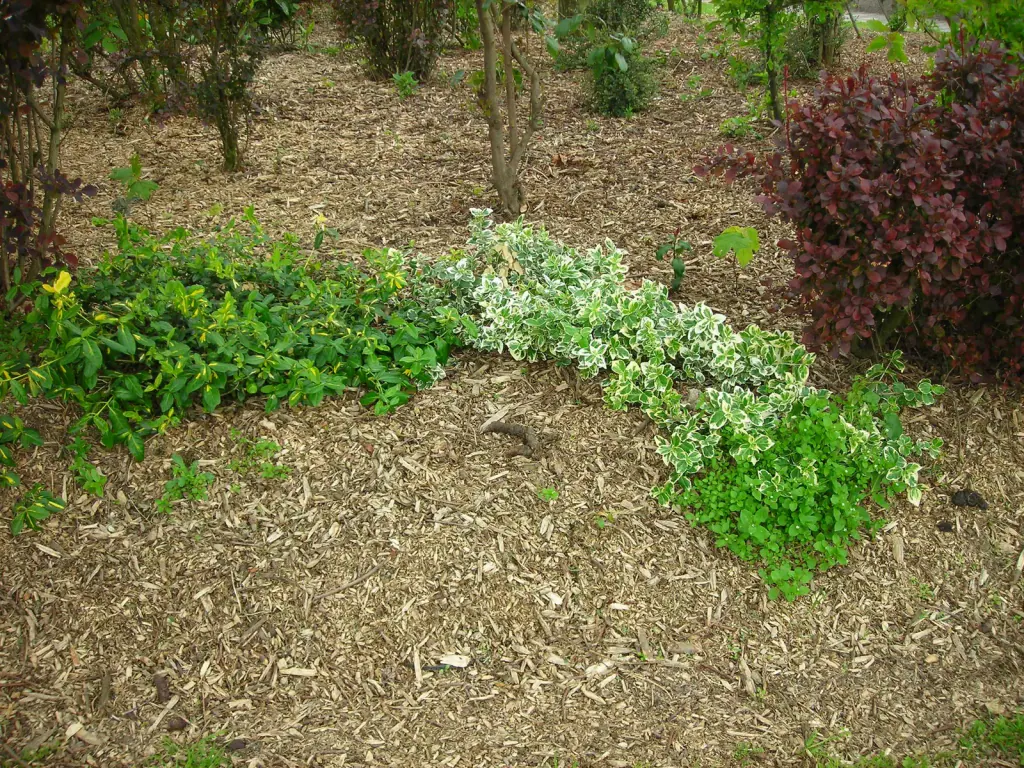
A mulched bed in a public garden in Normandy. Photo by Jmalo, via Wikimedia Commons, CC BY-SA 4.0.
- Park · Burghley House
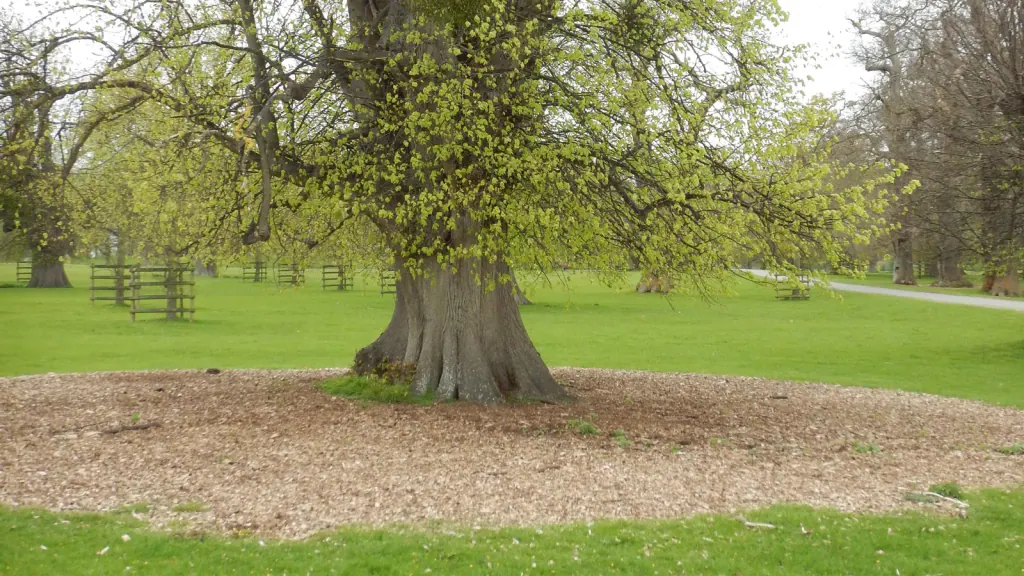
Mulch spread around the foot of an old oak in the park of Burghley House, near Stamford, England, in April 2017. Photo by Lamiot, via Wikimedia Commons, CC BY-SA 4.0.
- Municipal depot · Lille
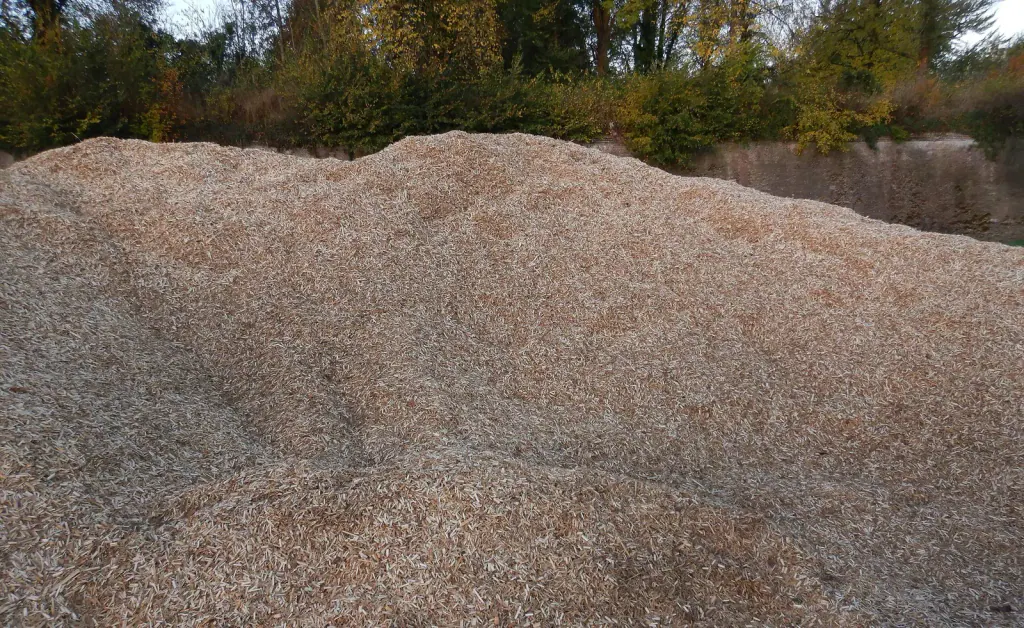
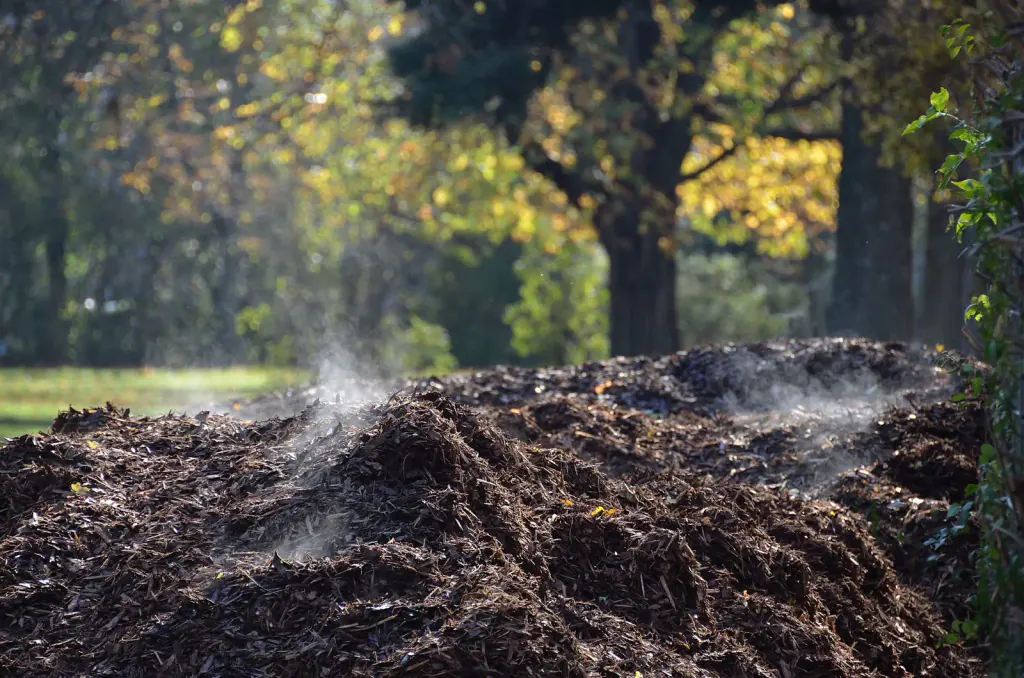
Chopped miscanthus delivered loose to a municipal depot in Lille, November 2018. Photo by Lamiot, via Wikimedia Commons, CC BY-SA 4.0.
- Strawberries · Dülmen
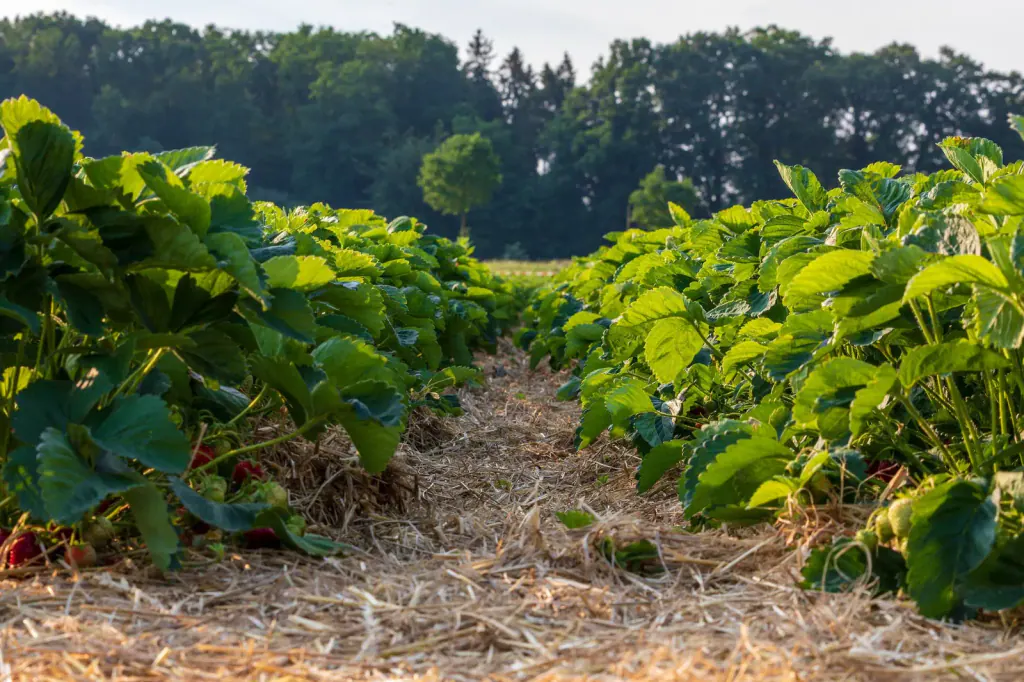
Strawberries on straw near Dülmen, North Rhine-Westphalia: the use for which miscanthus mulch is bagged in France. Photo by Dietmar Rabich, via Wikimedia Commons, CC BY-SA 4.0.
- Polytunnel · Cornwall
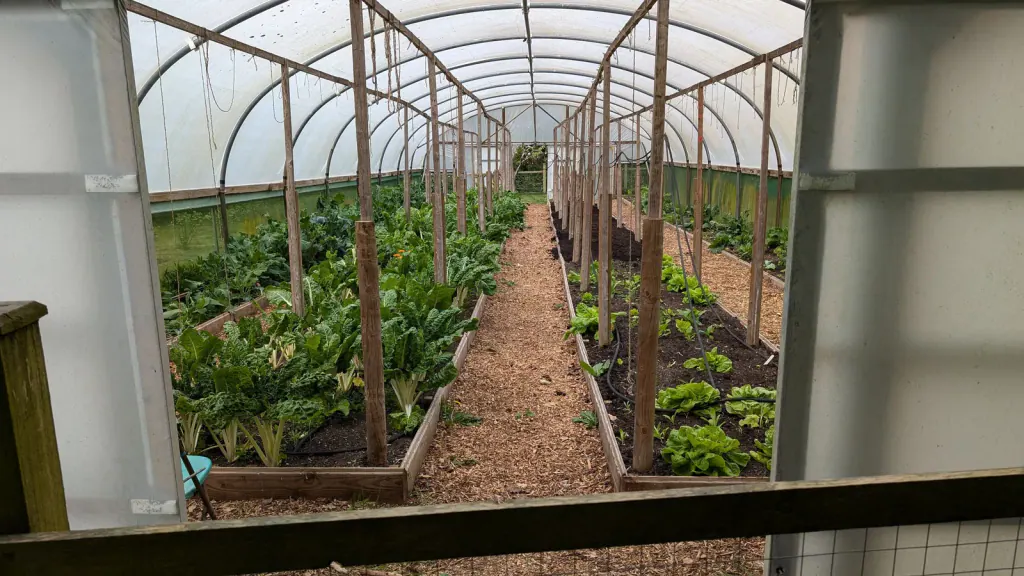
Raised beds inside a polytunnel at the Kehelland Trust, Cornwall, in April 2025, with wood chips on the path between them. Photo by David Medcalf, via Wikimedia Commons, CC BY-SA 2.0.
- Vines · France
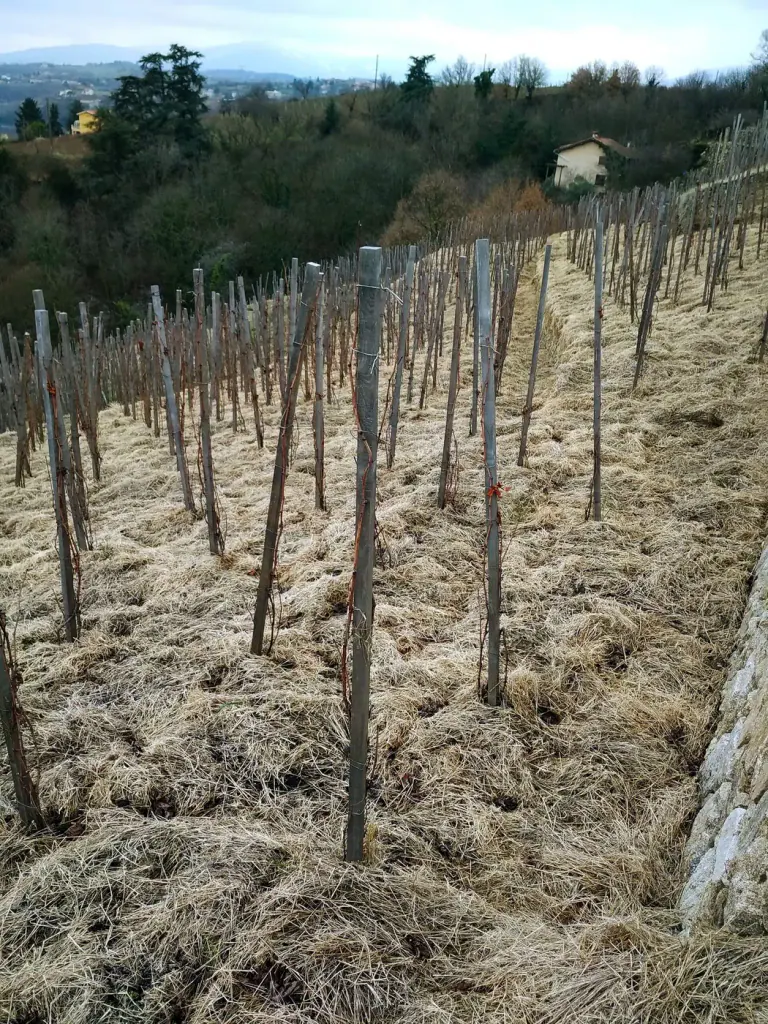
Mulched vine rows in France in February. Photo by Olivier Lemoine, via Wikimedia Commons, CC BY-SA 4.0.


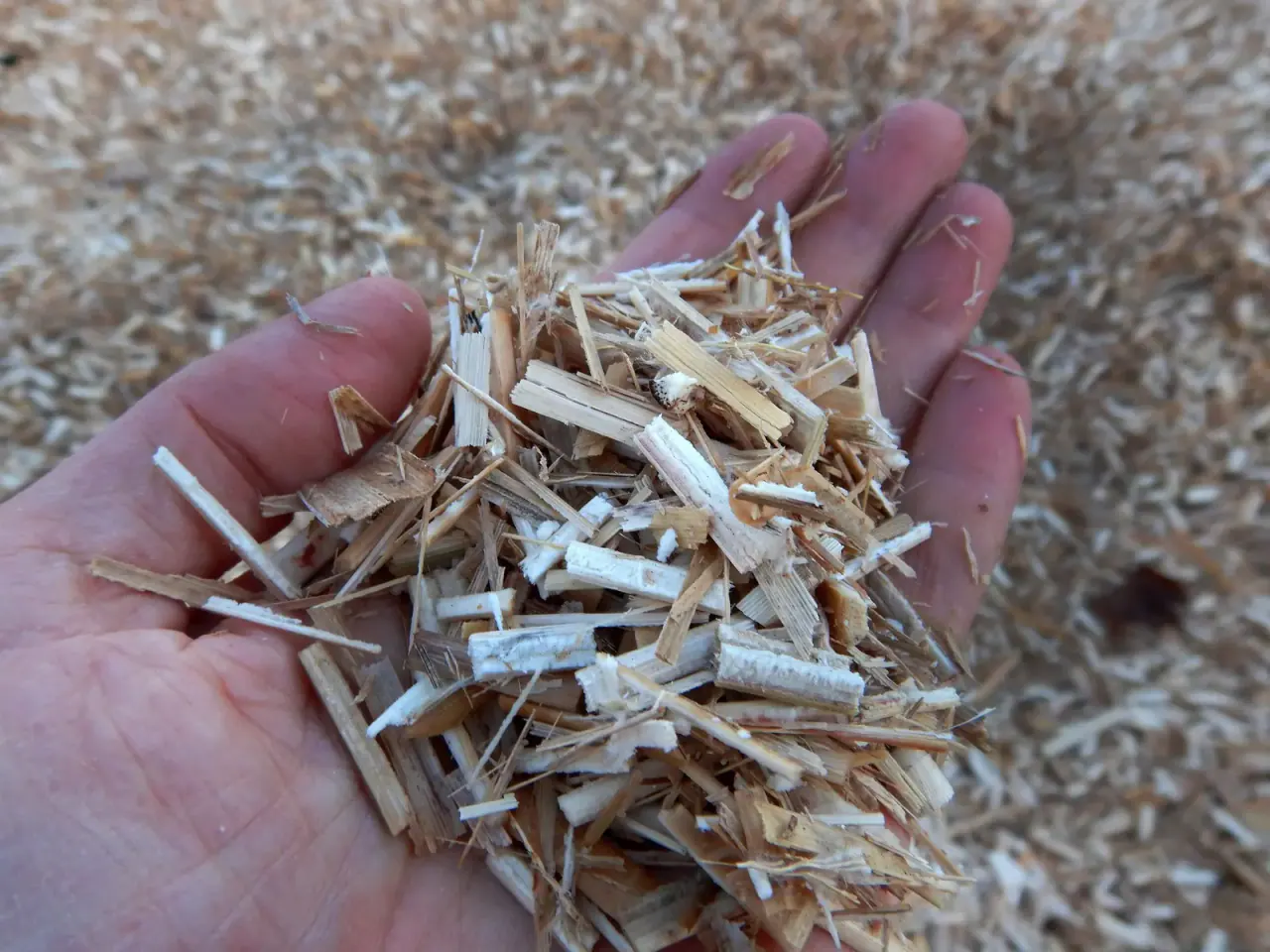
The chips consist of dry, woody stems that are light, close to neutral in pH and low in nutrients
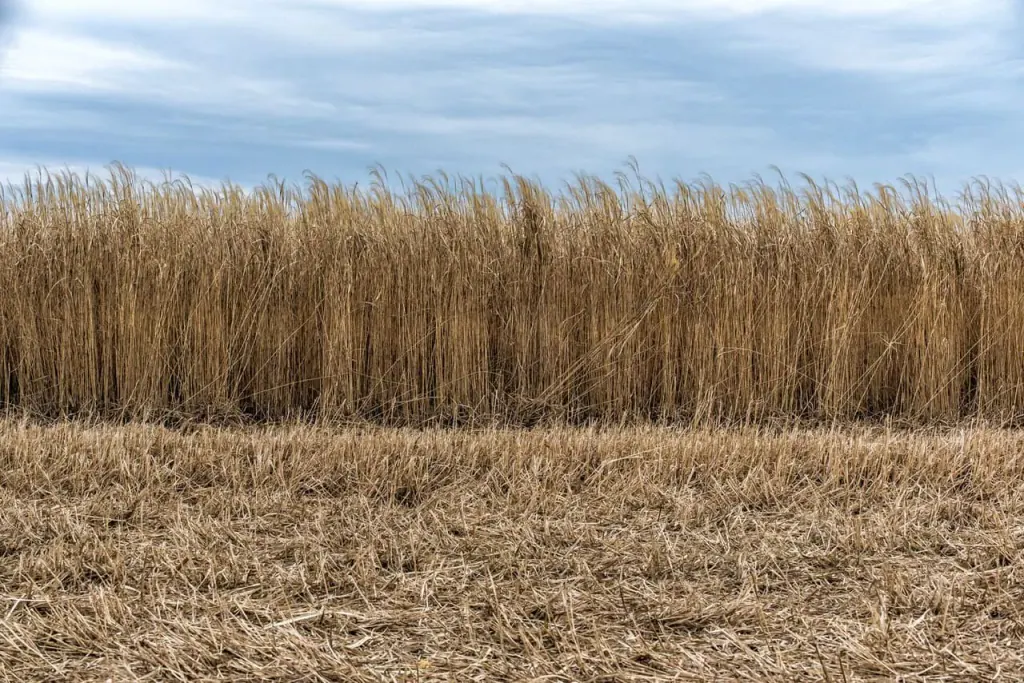
By late winter most of the leaves of miscanthus have fallen, so the harvest consists mainly of dry stems. The stems contain 8-12% lignin, 41-53% cellulose and only 0.4% nitrogen. The figures below come from spring-harvested stems of the clone measured in Britain and from the German fuel reference values.
The layer contains roughly 10-40 g of nitrogen and 20-50 g of potash per square metre, released over several years. That is too little for it to act as a fertiliser or to raise the salt content of the soil.
Stem chips and whole-plant chips
The leaves contain twice as much nitrogen as the stems, five times as much silicon and three times as much ash. Chips from a late-winter harvest, which are mostly stem, are paler and decompose more slowly than whole-plant chips cut in autumn.
Advantages of the material
- No miscanthus seed. The clone sets no seed. Weed seed and soil from the field can come in with a dirty harvest, so the fields are kept clean and the chips are screened.
- No tannins or acidity. The chips are close to neutral, and the soil pH under them did not change in the French trial.
- Slow decay. The stems are rich in lignin and cellulose, and in litter-bag tests miscanthus straw broke down more slowly than wheat straw.
- Light colour. The pale surface reflects more light than bare soil or a dark mulch and is expected to keep the soil cooler in the open, but no soil temperature has been measured under miscanthus.
Drawbacks and precautions
- Low weight. The chips are light, so a fresh layer blows about until it is watered in, and loads are covered in transport.
- Fire. In ignition tests, which did not include miscanthus, wheat straw caught fire from a smouldering charcoal briquette far more often than bark or wood chips, and a heap of chips harvested wet heats up in storage. The chips are therefore stored dry, and the layer is kept away from barbecues and bonfires.
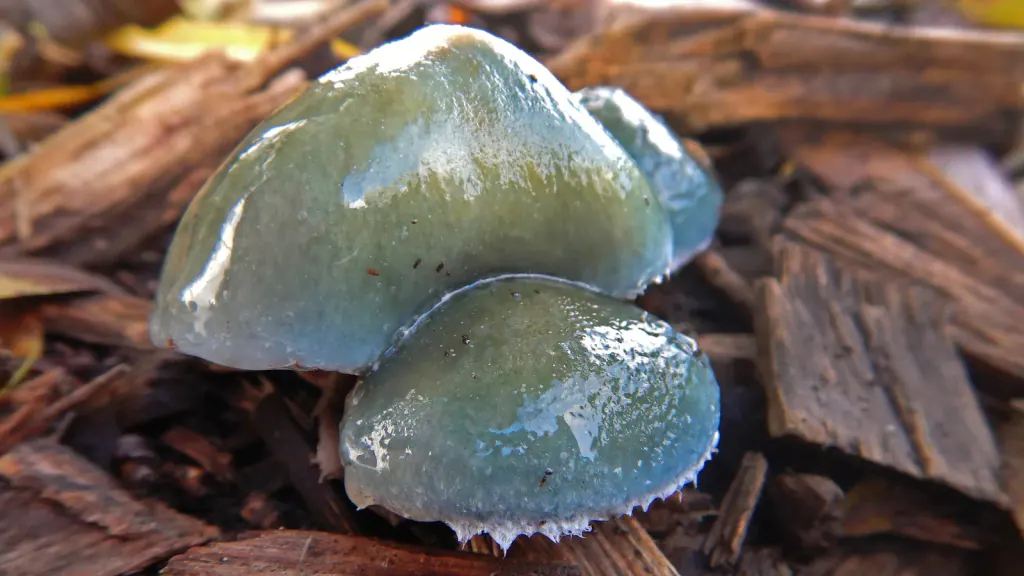
- Mould. In wet autumns harmless fungi grow on the surface, and one of them, the ink cap, can stain paving.
- Mice and slugs. Mulches can shelter both. The German orchard trial reports mice, and in British trials mulch was no barrier to slugs. No trial supports the claim that miscanthus repels slugs.
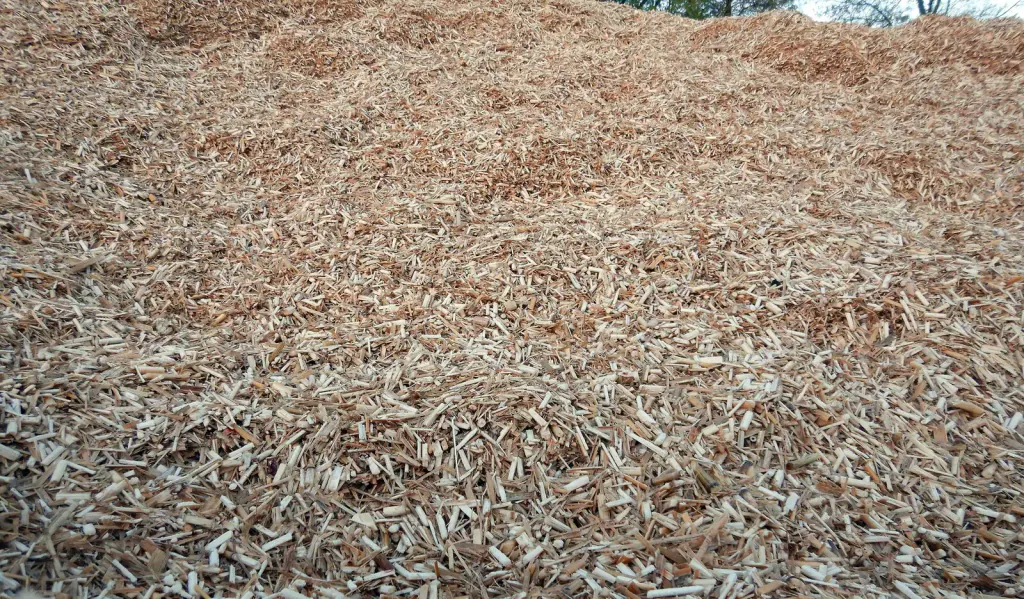


Layer thickness by use, and the volume and weight of mulch needed
The volume of mulch is the area multiplied by the thickness of the layer. At 5 cm a square metre takes 50 litres, so a 125-litre bag covers two and a half square metres. The calculator below converts an area and a thickness into cubic metres, bags and weight, and into the share of one hectare's harvest that the area requires.
| Where | Thickness | Litres per m² | Source |
|---|---|---|---|
| Shrub and perennial beds, public spaces | 5 cm; 7-10 cm where the ground is weedy | 50-100 | FREDON trial 2012; Normandy chambers; Rethel practice |
| Perennial mixes in their first years | 3-5 cm | 30-50 | LWG Veitshöchheim |
| Vegetable and strawberry rows | 3-5 cm, after the plants are up | 30-50 | German compost-works leaflet; French retail bags |
| Vines and orchards, under the row | 10-20 cm in a 50-80 cm strip | 100-200 per m² of strip | DEPHY Loir-et-Cher; IFV Gard; Pays de la Loire advice |
| Nursery containers | 2-3 cm as a top-dressing | 20-30 | By analogy with rice hulls (US trial) |
Mulch needed for an area
- Mulch needed
- 5 m³
- Bags of 125 litres
- 40
- Weight at 120 kg per cubic metre
- 600 kg
- Share of one hectare's harvest
- 3.6%
The calculation assumes settled chips at 120 kg per cubic metre and a hectare of mature miscanthus yielding about 140 cubic metres of chips a year, near the middle of the 110-175 m³ range given below.
A hectare of mature miscanthus yields 12-18 tonnes of dry matter a year, which is 14-21 tonnes of chips at the moisture at which they are sold, or about 110-175 cubic metres settled. That is enough to mulch roughly 2,200-3,500 square metres at 5 cm, the beds of a large park or the rows of a market garden, every year for about twenty years.
The mulch is spread on clean, moist soil after planting or weeding and watered in so that the top layer binds. When the layer thins, fresh mulch is added on top of the old. It is not dug in or spread over seed beds. In vineyards, a French growers' group linked damp mulch spread just before a frost to slightly more frost damage on the vines.
At 8 cm one cubic metre covers 12.5 square metres, and at 3 cm about 33. The German compost-works leaflet in the table above gives the volume in cubic metres as the area in square metres times 0.04, which corresponds to a 4 cm layer.
Mulch from one bale
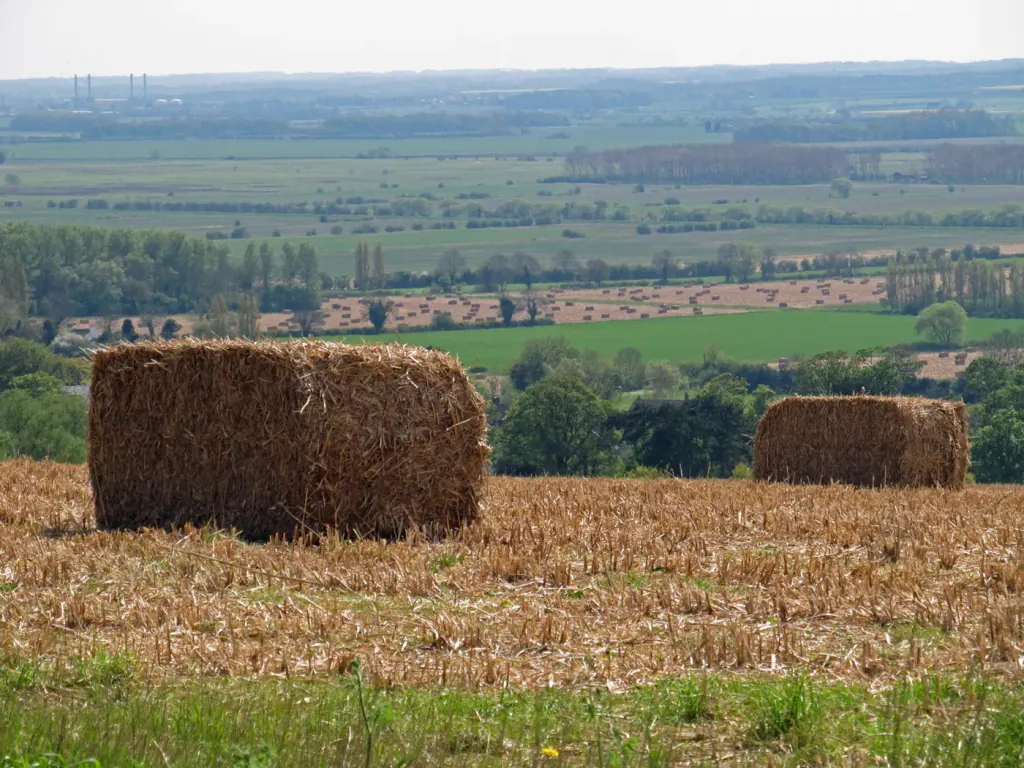
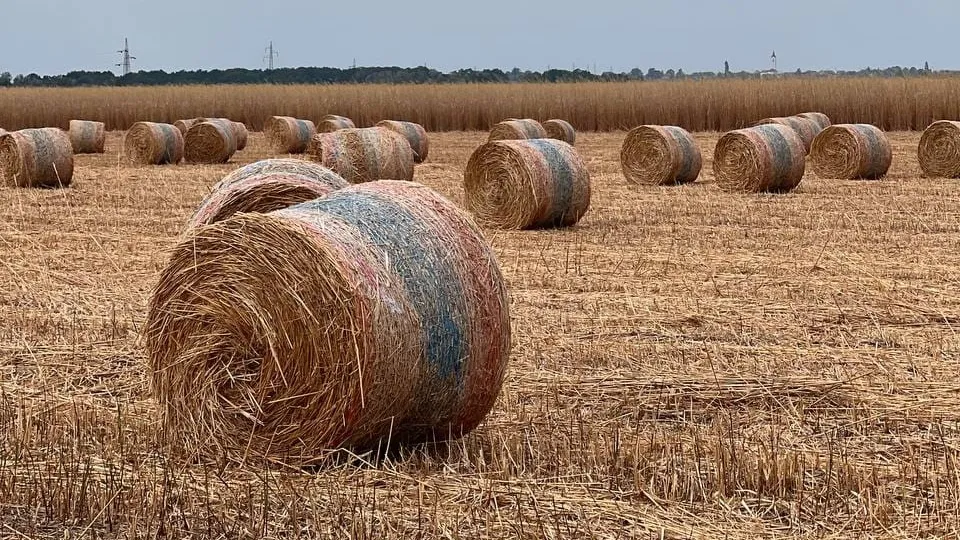
A large square bale of 2.6 cubic metres gives about six cubic metres of loose mulch, enough for some 120 square metres at 5 cm. A round bale of 250-350 kg covers 40-60 square metres.

Miscanthus compared with straw, bark, wood chips, hemp shives, cocoa shells and film
The table draws on the two comparative trials of chapter 02, the vineyard reports and the studies listed under it. In these sources miscanthus lasts about as long as pine bark, wood chips and hemp shives, and longer than straw.
| Material | How long it lasts | Seed brought in | Soil pH | Nitrogen | Other |
|---|---|---|---|---|---|
| Miscanthus chips | Two seasons at 5 cm; under vines 10-15 cm renewed every 1-2 years | No miscanthus seed; seed of field weeds possible | pH 6.5-7.2; soil pH unchanged after two years | No drawdown measured under a surface layer; strong if dug in | Pale; light, so watered in after spreading; mould spots in a wet autumn; probably ignites from embers, like straw (not tested) |
| Cereal straw | Six to twelve months; 40 cm under vines renewed yearly | Cereal seed sprouts; perennial grasses root in the layer | Slight rise in a greenhouse trial | Low; richer in nitrogen than miscanthus | Cheap; looks worn within months; ignites from embers |
| Pine or spruce bark | Two to three years | None | No measurable change after two to three years in two trials, although bark is often said to acidify the soil | Not to be dug in | Dark; heavy; rarely ignites from embers |
| Wood chips, ramial | Collapses by the third year at 15 cm | Low | No change measured | Strong nitrogen tie-up measured under fresh chips in Alsace vineyards and in a forest trial | Often free on the farm; large volumes to move; dug up by wild boar |
| Hemp shives | Two seasons at 5 cm | Hemp seedlings from badly cleaned shives | Does not acidify | Ties up some surface nitrogen in the first years | Holds four times its weight of water; about €2 per m² a year in Walloon trials |
| Cocoa shells | Excellent weed control for 18 months in the French trial | None | Releases minerals; raised soil organic matter | Low | Dark; warms the soil; toxic to dogs; shipped from the tropics |
| Woven fabric or film | Fabric two years and more; biodegradable film one season | None | None | None | Snails shelter under film; heat and mites on black plastic; nothing returned to the soil |
The seven materials of the table
- Miscanthus chips
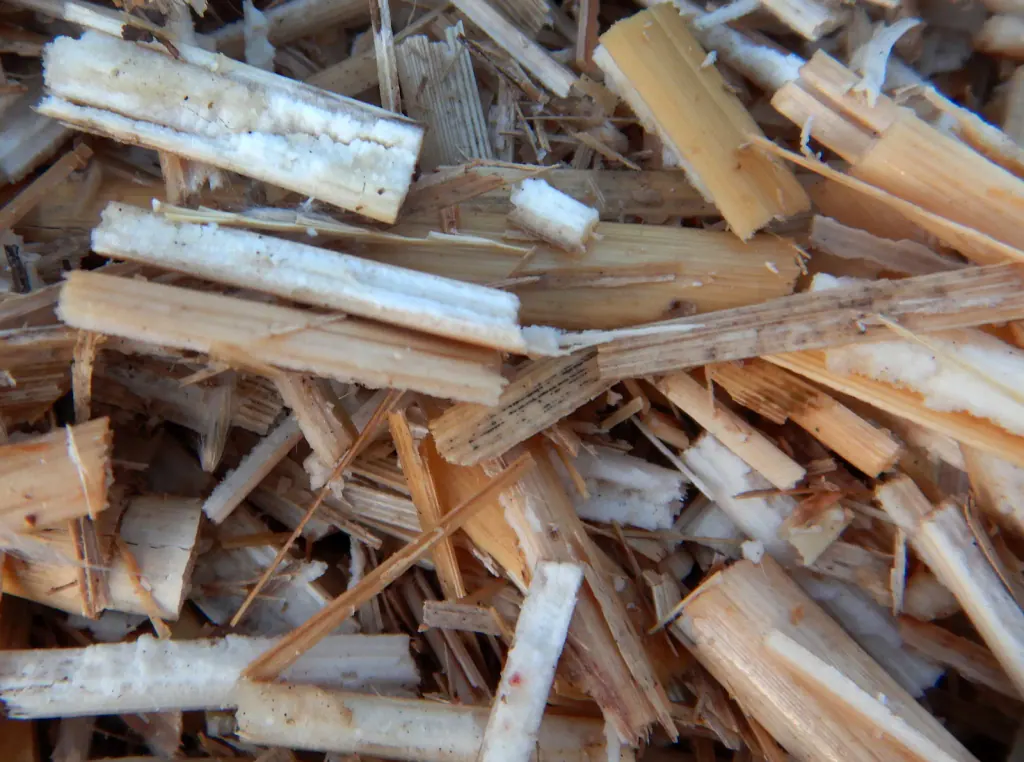
Chopped miscanthus stems at a depot in Lille, November 2018. Photo by Lamiot, via Wikimedia Commons, CC BY-SA 4.0.
- Cereal straw
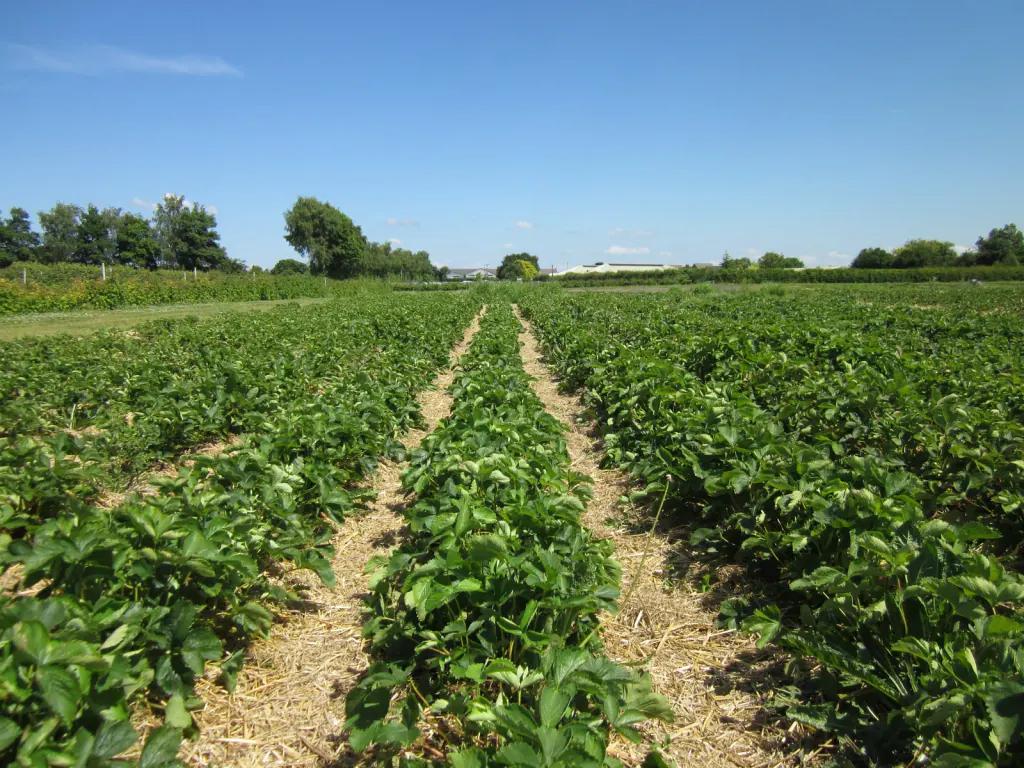
Strawberry rows with straw laid between them at Holt, near Wrexham, in June 2014. Photo by Jeff Buck, via Wikimedia Commons, CC BY-SA 2.0.
- Bark
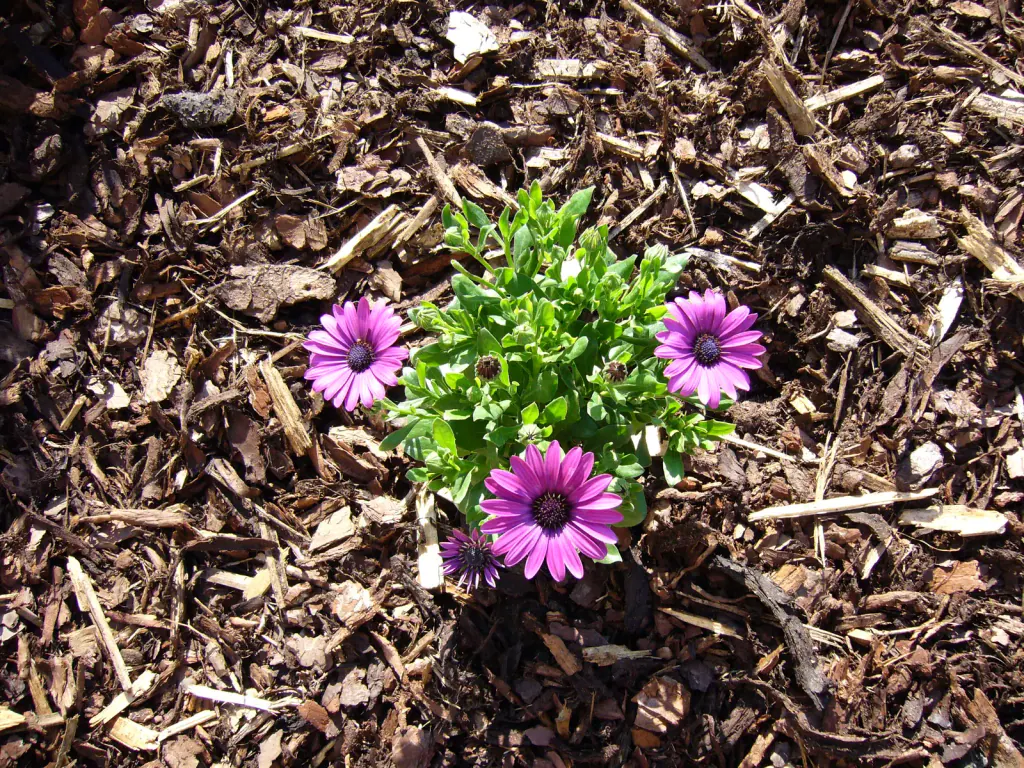
Bark mulch around a Cape daisy in a front garden in Berlin-Karow, April 2007. Photo by Geoprofi Lars, via Wikimedia Commons, CC BY-SA 4.0.
- Wood chips
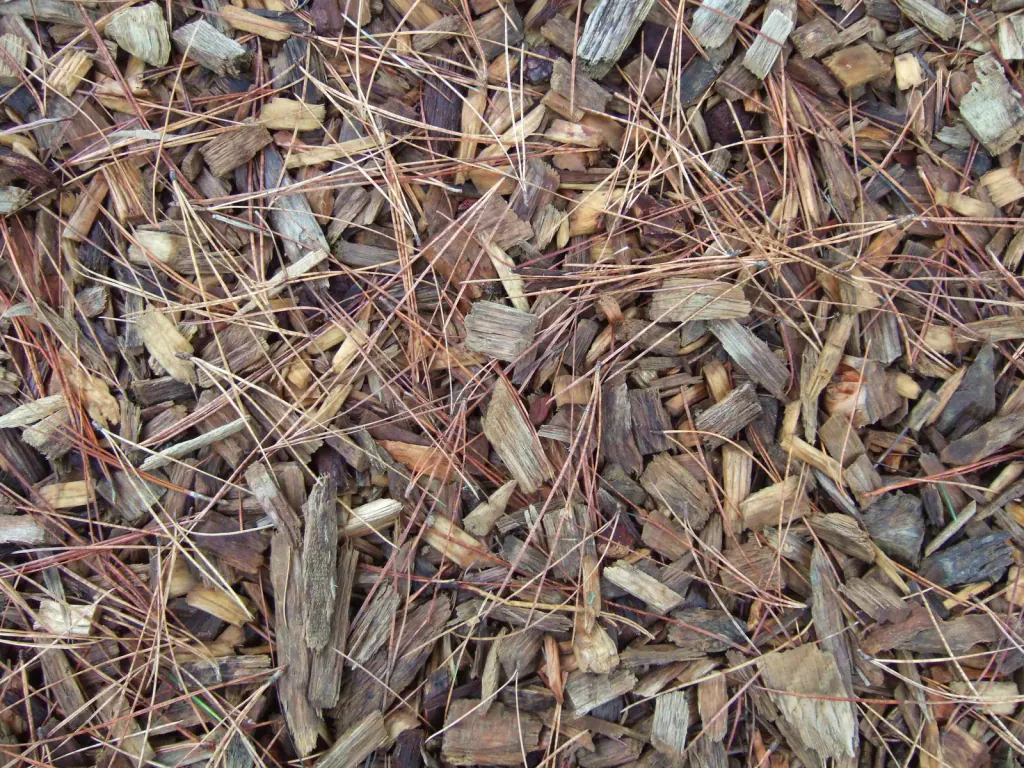
Wood-chip mulch on a bed at RHS Wisley, Surrey. Photo by Rowan Adams, via Wikimedia Commons, CC BY-SA 4.0.
- Hemp shives
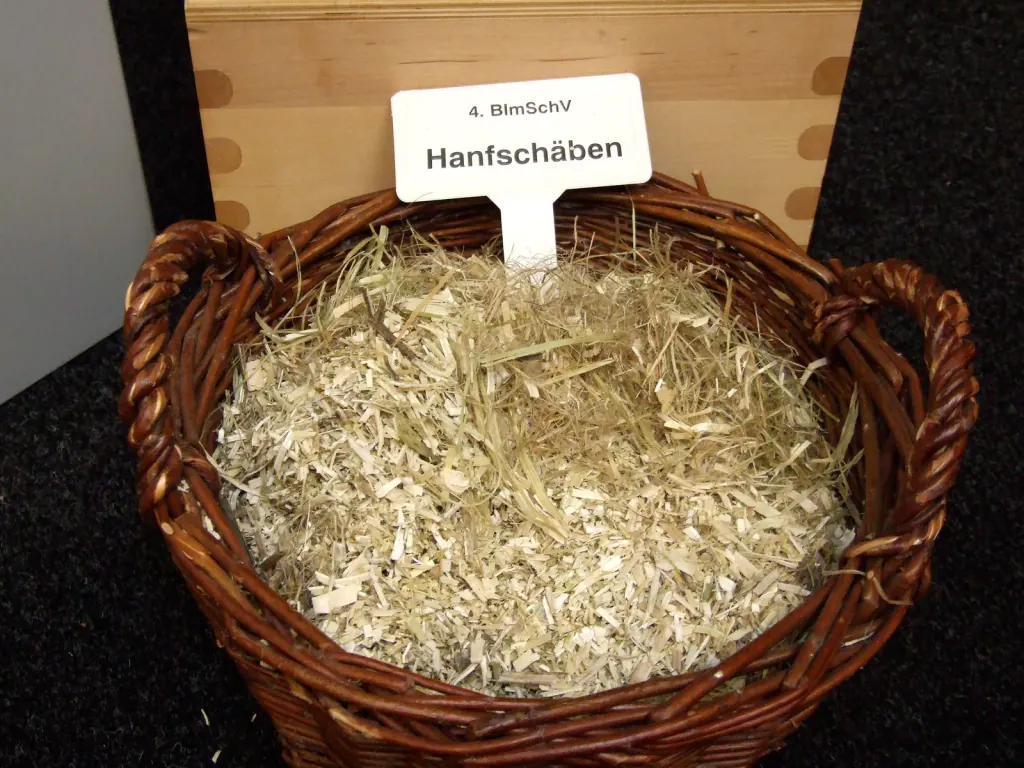
Hemp shives, the chopped woody core of the hemp stem, in a basket with a German label, 2008. Photo by Florian Gerlach, via Wikimedia Commons, CC BY-SA 3.0.
- Cocoa shells
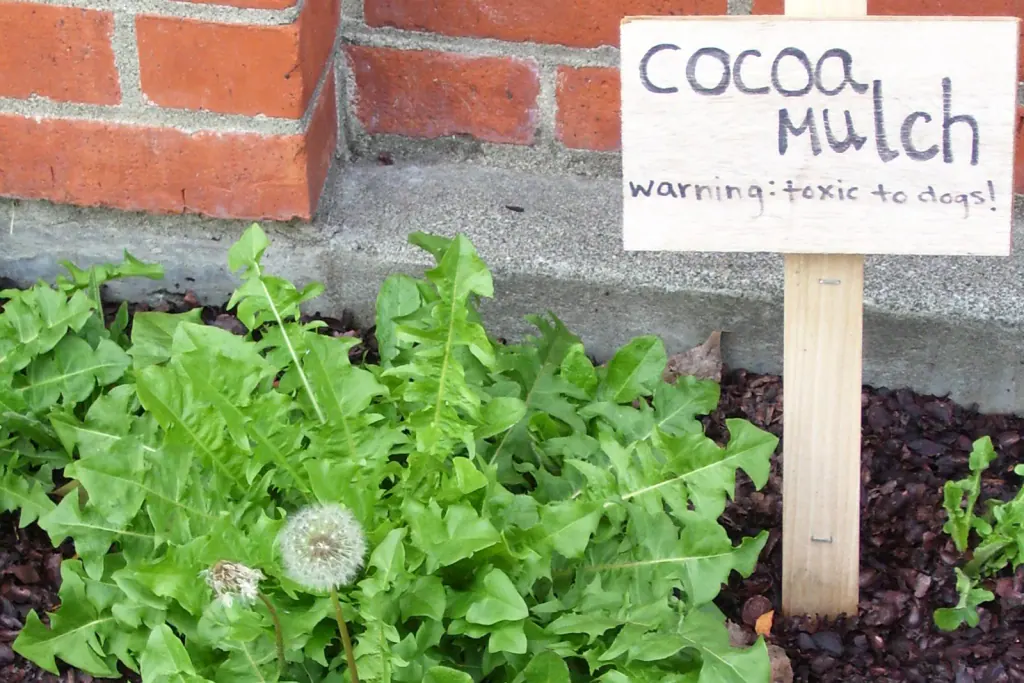
Cocoa-shell mulch in a bed with a sign warning that it is toxic to dogs, 2009. Photo by Leslie Seaton, via Wikimedia Commons, CC BY 2.0.
- Film
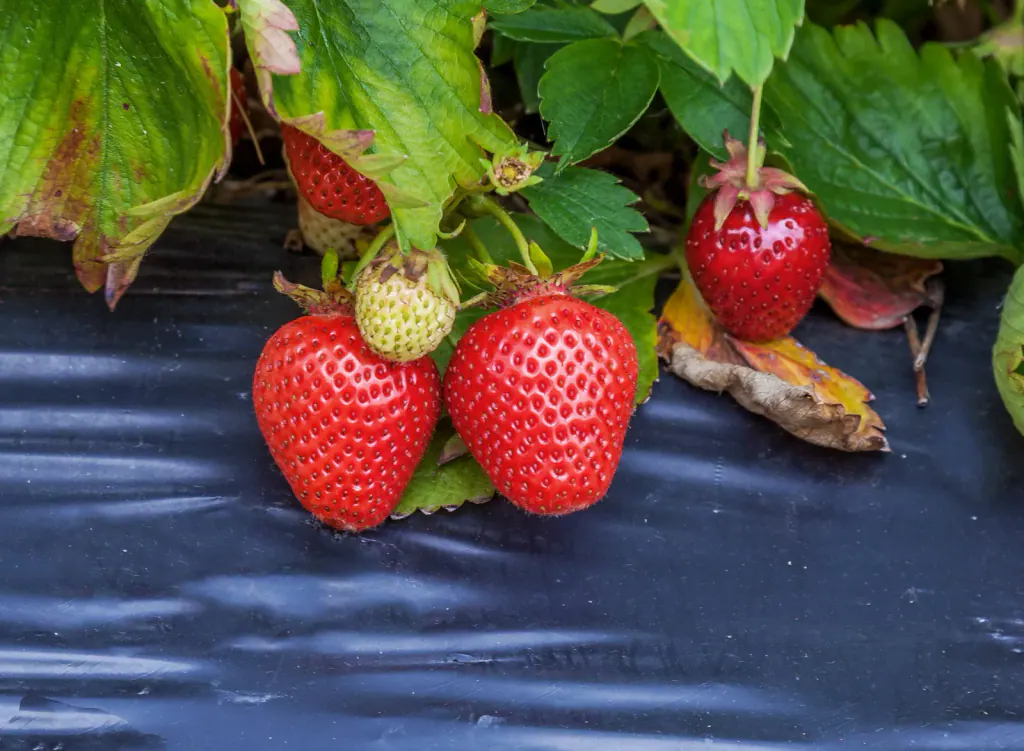
Strawberries on black plastic mulch film in a pick-your-own field in the Vorderpfalz, Germany, in June 2021. Photo by Fischer.H, via Wikimedia Commons, CC BY-SA 4.0.


.jpg)

Wood chips are often free on a farm and are the material most often compared with miscanthus. A thick layer of fresh chips on bare soil can tie up nitrogen for a season, as in the Alsace vineyards and a forest trial, and a 15 cm layer collapses by the third year; aged chips make a sound mulch. Bark lasts about as long as miscanthus. It is heavier and darker, and it rarely ignites from embers. Straw is the cheapest of these materials and the shortest-lived, and it brings in cereal seed.
The prices of these materials and the cost of a layer per square metre are compared in chapter 07.

The cost of a 5 cm layer per square metre, and the margin per hectare from mulch compared with fuel
In the first table the prices of miscanthus, bark, wood chips and straw are converted into the cost of a 5 cm layer, which takes 50 litres per square metre; the volume for any other area can be worked out with the calculator in chapter 05. The second table gives our calculation of the margin per hectare when the harvest is sold as mulch, compared with selling it as fuel bales.
Cost of a 5 cm layer of mulch per square metre
| Material and how it is sold | Per m² at 5 cm | Price per m³ | Where, when and on what basis |
|---|---|---|---|
| Miscanthus, loose, collected at the farm | €1.50-2.40 | €30-48 | Three farms in France, 2026; one price includes VAT, the other two do not state it |
| Miscanthus in big bags at a farm, or from a builders' merchant | €3.00-4.00 | €60-80 | France, 2026; farms €60-67, merchant €65-80 excluding VAT |
| Miscanthus in bags at garden centres and DIY chains | €8.90-14.00 | €178-280 | Germany, Belgium and France, 2026; bags of 50-70 litres, VAT included |
| Miscanthus in 125-litre bags at a French garden-centre chain | €16.00-20.00 | €320-400 | France, 2026; VAT included |
| Bark mulch, loose, at a compost works | €2.60-2.95 | €52-59 | Germany, 2026; ex works, one list including 7% VAT |
| Bark mulch in bags at a DIY chain | €3.65-6.00 | €73-120 | Germany and Austria, 2026; bags of 50-60 litres, VAT included |
| Bark mulch in bags at French garden centres and DIY chains | €9.30-16.00 | €186-320 | France, 2026; bags of 50-70 litres, VAT included |
| Wood chips, loose | €1.50-3.45 | €30-69 | France, Germany and the Netherlands, 2026; ramial chips from €30, screened and sawmill chips €49-69 |
| Cereal straw in bales, ex farm | €0.60-1.00 | €12-20 | €90-150 a tonne in Germany and France, 2025, converted at about 130 kg per cubic metre of bale |
Margin per hectare and year by route, our calculation
| Route | Margin per hectare a year | Sold per hectare | Price | Harvest and processing |
|---|---|---|---|---|
| Bales sold as fuel at the field edge, the buyer collecting | €750-1,780 | 14-21 t of bales | €110-115 a tonne | Baling €30-56 a tonne |
| Loose mulch sold to a municipality, cooperative or landscaper | €1,200-4,400 | 93-157 m³ of mulch, and 2-3 t of screenings sold as fuel | €16-30 per m³ | €26-42 a tonne of harvest for the forage harvester, haulage to the store, covered storage, loading and screening |
| Loose mulch sold at the farm gate, the buyers collecting | €2,000-7,200 | As above | €25-48 per m³ | As above |
| Mulch in 50-litre bags, sold ex works to the trade | €1,600-6,600 | 1,860-3,140 bags, and the screenings | €335-466 a tonne in 2019, about €2.00-2.80 a bag | As above, plus €0.60-1.00 a bag for the bag, filling and pallet |
Cost per square metre and year
A 5 cm layer of miscanthus lasts about two growing seasons, so by our calculation loose miscanthus from a farm costs €0.75-1.20 per square metre a year and bagged miscanthus from a garden centre or DIY chain €4.45-7.00. The Walloon trials found about €0.75 for miscanthus bought from the grower and about €1 for hoeing or a woven fabric. Rethel, which buys in bulk, gives about €1.50 per square metre laid at 5-8 cm. Straw is the cheapest material per square metre, but a layer lasts six to twelve months.
Conditions for the mulch routes
The mulch routes need a dry store for 110-175 cubic metres of chips per hectare and buyers nearby: French growers sell loose mulch within about 30 km, and processors buy within 80 km. If a retailer requires delivery 500 km away, the margin on bagged mulch falls to €400-4,900. In 2019 the whole French mulch outlet took about 11,500 t, the harvest of roughly 550-820 ha. Screenings and unsold mulch can be sold as fuel.
The market for miscanthus mulch, mainly in France, and the product we are preparing
France grows about 11,000 ha of miscanthus on more than 2,000 farms, and mulch is one of the two or three main outlets for the crop, beside animal bedding and fuel. A 2020 study for the national agricultural agency put mulch at about a fifth of the harvest. French cooperatives sell it loose by the cubic metre, in big bags, in compressed bales and in 8-25 kg sacks. In Germany and Austria it is sold in bags alongside bark mulch, and in the Netherlands municipal contractors lay it. We found no bagged miscanthus mulch at a British retailer.
The mulch we are preparing
We are preparing a bagged mulch from our own fields in Croatia. The crop is cut in late winter at 15-20% moisture, chopped, screened to remove dust and stored dry. A growing-medium component will follow, and it is described in a separate article.
Claims on the label
The label will state only what the trials support: the mulch contains no miscanthus seed, has a pH of about 7 and does not change the soil pH, needs no added nitrogen on established beds, lasts about two seasons at 5 cm and is watered in after spreading. It will not mention slugs, a three-year life or a cooling effect, because the trials do not support them.
Transport distance
The chips are light and bulky, so transport costs rise quickly with distance, which is why French growers plant near the towns they supply. Our first deliveries will go to the nearest buyers, and loose material by the cubic metre and big bags will be available before the retail bag.
Growing miscanthus for mulch
A market garden, a nursery or a municipality with a few hectares of land can grow its own mulch. A hectare is planted once and harvested every late winter for about twenty years, with a mower and a baler or with a forage harvester; chapter 05 gives the area that one harvest covers, and chapter 07 the margin per hectare. The planting stock for a hectare costs €3,000-3,600 at our list prices. The planting, the first-year weed control and the harvest are described in the planting article and the cultivation guide, and the hedge article describes a hedge whose winter cuttings can be used as mulch on the beds beside it.
Enquiries about mulch and planting stock
Municipalities and landscapers
We will supply loose material by the cubic metre and big bags from our harvest by arrangement, depending on the distance. Please give the volume, the thickness of the layer and the season.
Garden centres and retailers
The bagged mulch is still in preparation. Retailers who leave their details will receive the specification and the price when it is ready.
Growers who want their own supply
We supply planting stock of the clone for a field near the point of use; planting takes place in spring.
The growing medium, the hedge and the planting
Why peat is being replaced, what the trials found, and how the fibre is processed and blended.
Read it Green hedgeA miscanthus hedge: layouts from one to five rowsSpacing, the work through the year, the law on boundary distances and the use of the canes cut each winter.
Read it PlantingPlanting miscanthus rhizomes: timing, depth, machinery and densityThe planting window, the handling of the rhizomes, the machines and the choice of density.
Read itFrequently asked questions
On beds and around shrubs the usual layer is about 5 cm, which is 50 litres per square metre, and 7-10 cm where the ground is weedy or the mulch has to last longer. In vineyards and orchards a layer of 10-20 cm is laid under the row. In the French municipal trial, 5 cm of miscanthus kept weeds down for 18 months, and the authors suggested a slightly thicker layer because the uneven pieces leave small openings.
A 5 cm layer lasts about two growing seasons. In the French trial it was still suppressing weeds after 18 months and was visibly decomposing after two years, and a German orchard trial puts its life at two vegetation periods, the same as for pine bark and wood chips and twice as long as straw. Thicker layers under vines are renewed every one to two years, or laid in two passes to last three to four years.
No nitrogen drawdown has been measured under a surface layer on established plants. Vines under 10-20 cm of miscanthus showed no change in nitrogen status, and a review of the evidence on wood chips reports the same. Dug into the soil or used in a potting mix, the material ties up nitrogen strongly, so it is laid on the surface and topped up when it thins. Seedlings and young plants on poor soil should be watched for signs of nitrogen shortage.
It contains no miscanthus seed, because the clone sets none, and in the French trial no weeds came in with the material. Any mulch harvested from a field can still carry seed of other plants, or soil, if the field was weedy or the harvest dirty. Straw can also carry the seed of its own crop, and in a Spanish greenhouse trial cereal seed in the straw germinated throughout the season.
There is no evidence that it does. No trial has tested miscanthus against slugs, and independent trials with other mulches found that mulch is no barrier to slugs and can shelter snails. We do not make this claim for our mulch.
It can be used on soil beds. In an Austrian trial, the compartment mulched with hay and grass used about half the irrigation water of the unmulched one, with equal or slightly higher cucumber yields, and in a Spanish greenhouse straw matched plastic film for tomatoes; neither trial used miscanthus. Under glass the soil was warmer under every mulch, so the cooling expected in the open does not apply. Drip lines are laid under the mulch, and top-dressed fertiliser does not reach the soil through it.
A hectare yielding 12-18 tonnes of dry matter gives roughly 110-175 cubic metres of settled chips a year, enough to mulch about 2,200-3,500 square metres at 5 cm. A large square bale of 2.6 cubic metres gives about six cubic metres of loose mulch, enough for about 120 square metres.
Most of it is sold in France. At French farms in 2026, loose mulch collected by the buyer costs €30-48 per cubic metre, or €1.50-2.40 per square metre at 5 cm. Bags at garden centres and DIY chains in Germany, Belgium and France cost €178-280 per cubic metre, and 125-litre bags at a French garden-centre chain €320-400. Bagged miscanthus costs about as much as branded bark and two to three times as much as plain bark mulch at a DIY chain. We are preparing a retail mulch from our own fields and will write to everyone who leaves their details in the form below when it goes on sale.
About this article
We wrote this article ourselves. We grow miscanthus and sell planting stock, and we used the sources listed below and our own figures.
The information was current when the article was published. Prices and products change, and errors are possible, so please check the figures before you rely on them.
If you find an error or have more accurate figures, write to us at info@miscanthus.eu or use the form below.

Sources
- Quennesson, S. & Dewaegeneire, P. (2012). Utilisation de paillis pour la maîtrise des adventices sur massifs arbustifs. Rapport d'étude 2010-2012, FREDON Nord Pas-de-Calais (Hazebrouck): weed counts, decomposition, soil pH and organic matter under eleven mulches.
- Arlotti, D. (2014). Le paillage à base de chanvre industriel cultivé en Wallonie est une réelle alternative. Le Sillon Belge, 25 April 2014 (CRA-W trials): ratings over three years, costs per square metre, fungi on wet mulches.
- Ecophytopic / DEPHY (2021). Essai de paillage: zoom sur le miscanthus (Loir-et-Cher vineyard, 2019-2020). Delbecque, X. (2025). Viticulture: pailler le rang quand la mécanisation peine. Réussir Vigne, 5 March 2025 (IFV Gard trial). De Nadaillac, C. (2017). Les paillages, une fausse bonne idée? and Plus besoin d'herbicide entre les rangs. Réussir Vigne, 30 September 2017.
- Alexandrov, E. & Sandu, A. (2024). The use of Miscanthus sp. mulch in the technological process of grapevine cultivation. Scientific Papers Series Management, Economic Engineering in Agriculture and Rural Development 24(4): 33-39. Dami, I. et al. (2023). Vineyard mulching offer many benefits beyond winter protection. GiESCO 2023, IVES Conference Series.
- Lengauer, D. (2020). Testung unterschiedlicher Mulchsysteme im geschützten Anbau. Haidegger Perspektiven 4/2020, Versuchsstation Wies, Land Steiermark. Marín-Guirao, J. I. et al. (2022). Alternative mulches for sustainable greenhouse tomato production. Agronomy 12(6): 1333.
- Kivijärvi, P., Parikka, P. & Tuovinen, T. (MTT Agrifood Research Finland). The effect of different mulches on yield, fruit quality and strawberry mite in organically grown strawberry. Pfeiffer, B. (2007). Testing of strawberry varieties with and without biodegradable mulch film for organic cultivation. LVWO Weinsberg.
- Jensen, E. et al. (2017). Towards Miscanthus combustion quality improvement: the role of flowering and senescence. GCB Bioenergy 9(5): 891-908: nitrogen, potassium, chlorine, silicon and ash in stems and leaves. Hodgson, E. M. et al. (2010). Biomass and Bioenergy 34: 652-660: lignin and cellulose. Dresbøll, D. B. & Magid, J. (2006). Bioresource Technology 97: 973-981: stability of miscanthus straw.
- Debode, J. et al. (2018). Frontiers in Plant Science 9: 213 (nitrogen tie-up of straw in a growing medium). Chalker-Scott, L. (2007). Impact of mulches on landscape plants and the environment: a review. Journal of Environmental Horticulture 25(4): 239-249. Homyak, P. M. et al. (2008). Nitrogen immobilization by wood-chip application. Forest Ecology and Management.
- Rogstad, A. et al. (2014). Comparing the Ignitability of Mulch Materials for a Firewise Landscape. University of Arizona Cooperative Extension AZ1440. Everard, C. D. et al. (2013). Evaluation of self-heating in Miscanthus x giganteus energy crop clamps. Energy 58: 350-356.
- Neal, J. (2016, rev. 2026). Mulches for Weed Control in Container Nursery Crops. NC State Extension. Altland, J. E. & Krause, C. R. Rice-hull top-dressing for liverwort control, Journal of Environmental Horticulture 32(2). RHS (2018). Gastropod barriers experiment.
- Heintze, F. (2018). Miscanthus: Ausführliche Anbaubeschreibung. TFZ-Merkblatt 18PHz007 (harvest moisture, bulk density, nutrient removal). 3N Kompetenzzentrum Niedersachsen (2012). Miscanthus-Kurzinformation. LWG Veitshöchheim, Veitshöchheimer Mischpflanzungen für sonnige Standorte (3-5 cm of miscanthus chips). Killer, A. (2023). Mulchmaterialien, DLR Rheinpfalz (orchard mulches, two vegetation periods).
- Brancourt-Hulmel, M. (2022). Miscanthus: l'essor d'une nouvelle culture en France. Agronomie, Environnement & Sociétés 12(1): area, farms, the 2017 turning point for municipal demand. Agrex Consulting for FranceAgriMer (2020). Étude miscanthus, note de synthèse (outlet shares, as summarised). DRAAF Bourgogne-Franche-Comté (2025). Note 16: Miscanthus (area 2024). Gloria, C. (2018). Le miscanthus veut séduire éleveurs et municipalités. Réussir Grandes Cultures, 10 May 2018 (Rethel, cooperative outlets and prices).
- Chambre d'agriculture de Normandie (2022). Fiche solution BLC: valorisation en paillage horticole (bulk price reference 2022). Commune d'Ableiges (2017). Fiche suivi zéro phyto. Attender Groen / Vebego (2021) and Stad+Groen 2/2017 (Dutch municipal practice). Kompostwerk Würzburg, Miscanthus-Mulch leaflet (the 0.04 rule, watering in). Retail prices: Truffaut product pages, October 2026; German and Austrian listings, 2026.
- Chambre d'agriculture Pays de la Loire (2023). Essais de couvre-sols pour gérer les adventices: retour sur dix ans d'expérimentations (miscanthus under vines at 20 cm in two passes).
- Apple orchards mulched with miscanthus straw, Poland: Agronomy 11(1): 58 (2021, Warsaw, 2012-2016); Acta Agrobotanica (2021) and Agriculture 12(12): 2070 (2022), Wrocław.
- Agrex Consulting for FranceAgriMer (2020). Étude sur la formation des prix dans la filière française de production du miscanthus, rapport final (survey January-March 2020): producer, processor and shelf prices of mulch, the costs of harvest, field transport, storage and loading, and the distances over which mulch is sold.
- Prices of miscanthus mulch at farms and a merchant in France, October 2026: Compostoise (Oise); miscanthus.cc (Finistère); Miscanthus du Goëlo (Plouha); BHT Matériaux (Amilly), also for wood chips and bark. Retail listings, October 2026: OBI.de (Compo Bio-Gartenmulch 50 L, bark mulch 50-60 L), OBI.at (bark mulch 60 L), Hubo.be (Agrofino miscanthus mulch 60 L), Gamm Vert (miscanthus and bark mulch), Castorama and Truffaut (bark mulch).
- Kompostanlagen Schwarzwald-Baar-Kreis (2026). Preisliste ab 01.01.2026 (bark mulch and sawmill chips). RETERRA Service GmbH, listings 2026. Gamma (Netherlands), wood chips, 2026. topagrar (20 August 2025). Strohpreis 2025 (Landwirtschaftskammer Niedersachsen). Réussir / La Dépêche (27 May 2025). Marché des oléagineux et coproduits (straw prices in north-eastern France).
- Maschinenring Westfalen-Lippe / Landwirtschaftskammer NRW (2024). Erfahrungssätze (forage-harvester rates). FNR / TFZ, qualiS handbook (screening costs). Chambre d'agriculture de la Gironde (2024). Fiche diversification miscanthus (storage and loading). TimoCom transport barometer Q4 2025, via transport-online.de (road freight per kilometre).
- Zelena Biomasna Energija: our fields, harvest and product plans, and the calculations in chapter 07.