



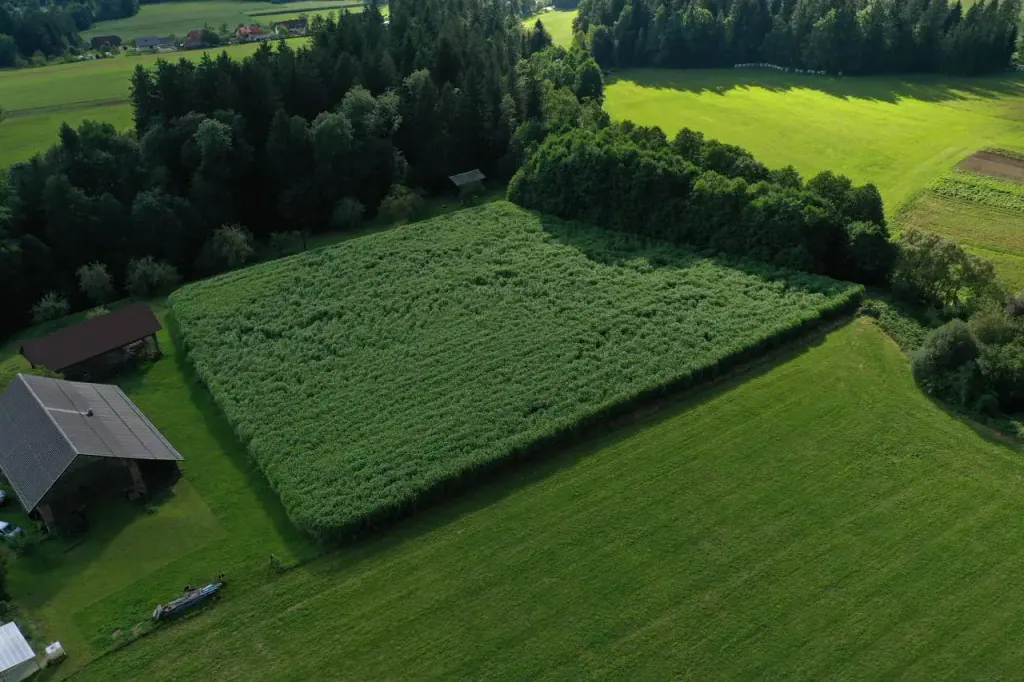
The main uses of miscanthus biomass
The canes are harvested dry in late winter or early spring. The harvest is a fibrous, low-ash biomass with several uses; two of them, mulch and growing media, have their own articles:
Solid biomass fuel
The biomass is pressed into pellets and briquettes for heating and combustion.
Animal bedding
Miscanthus makes an absorbent, low-dust litter for livestock and horses.
Biogas
Miscanthus is used as a feedstock for anaerobic digestion.
Pulp and fibre
The fibre is used for paper, board, packaging and bio-composites.
Which use is most profitable depends on local demand, transport costs, processing options and the size of the planting. For heating, the cost of heat from bales is compared with gas, oil and pellets in our article on miscanthus as fuel. In aviation fuel, a newer market is developing on an industrial scale. EU law now requires a minimum share of sustainable aviation fuel in the jet fuel sold at EU airports. Waste oils can cover only a small part of this demand, and the rest will have to be met from non-food cellulosic biomass and from synthetic fuels made from hydrogen and captured CO₂. The article “Jet fuel from miscanthus” describes this market in more detail.
Climate & hardiness
Where miscanthus grows and how it overwinters
Clone Illinois can establish and produce a harvest on a wide range of European sites, from the south of the continent to the cooler regions of central and northern Europe. Outside Europe it grows in the colder, more continental climate of the US Midwest, where the University of Illinois has studied it since 2002. One reason it can grow in these climates is that it continues to photosynthesise at lower temperatures than many C4 plants.
Miscanthus is a hardy perennial crop. The canes die back over winter and are harvested dry, while the plant survives as dormant rhizomes and regrows in spring. Established stands survive cold winters because soil, snow and leaf litter insulate the rhizomes, which die if the soil temperature around them falls a few degrees below zero. The risk is greatest in the first winter after planting.
Miscanthus can also grow well on marginal land that is less suited to food crops, such as light, stony or less productive soils. A farmer can therefore plant it on the poorer fields and keep the better ones for the arable rotation. Site conditions still matter, as yields are lower on waterlogged or shallow soils. We describe planting on such land in more detail in our article on marginal and contaminated land.
Site choice and establishment are covered in more detail in the guide “How to plant and grow miscanthus”.
Biosecurity
Sterility and the risk of spread
Miscanthus is native to Asia, so anyone planting it on a large scale in Europe needs to know whether it could escape from cultivation and become invasive. For Miscanthus × giganteus ‘Illinois’, the answer depends mainly on its sterility.
Clone Illinois is a sterile triploid. It has three sets of chromosomes and produces no viable seed. Grasses spread beyond a field mainly by seed that is blown or dropped into ditches, hedges, roadsides and neighbouring land, and the clone cannot spread in this way. It gives high yields without the risk of seed spread that fertile miscanthus types carry, and this is one of the main reasons why it is grown for biomass.
The clone can still spread through its rhizomes. A stand widens slowly at the edge, where the spread is easy to see and can be contained with a cut edge, a cultivated strip or a mown headland. Edge management does not prevent spread by water, because floods and erosion can carry pieces of rhizome downstream. Plantings should therefore be kept off stream banks and ditch sides that flood.
These questions matter to landowners, buyers and regulators as much as to growers. A biomass plantation stays in the ground for many years, often over large areas, so legality, traceability and biological containment are part of the commercial case. Because the clone is grown from rhizomes, establishment and yield on each hectare depend on the quality of the planting stock.
The genus Miscanthus
The two parent species and their sterile hybrid
The name “Miscanthus” is often used as if it meant one crop, although it covers several related Asian grasses with very different characteristics in the field. For a commercial biomass plantation the most important factor is the genotype: whether the plant is fertile, how it spreads and whether the origin of its planting material can be traced.
The two parent species, Miscanthus sinensis and Miscanthus sacchariflorus, are fertile and can produce viable seed. Their hybrid, Clone Illinois, is the high-yielding sterile triploid described above.
M. sinensis
This species is best known as an ornamental grass. It is fertile, produces viable seed and can spread beyond planting sites in suitable conditions.
M. sacchariflorus
This vigorous species grows in wetter habitats. It is fertile, produces viable seed and also spreads strongly through its rhizomes. For this reason it is regarded as potentially invasive in parts of Europe and is treated with caution.
Provenance
Where our planting material comes from: generations G0 to G2
Commercial miscanthus plantations in the EU are usually planted with sterile triploid Miscanthus × giganteus, but rhizomes of this genotype vary widely in quality from one supplier to another. Rhizome quality is one of the main factors in how well a crop establishes, and a buyer can check it before planting.
Our stock starts as G0 material, which is raised in a laboratory, screened for pathogens and genetically verified. We then multiply it in the field for two generations, G1 and G2, and retire anything beyond G2 from propagation.
A short propagation chain helps to keep the stand genetically uniform, the stock traceable and the plants healthy. It also lowers the risk of pathogens building up or of other material being mixed in, which can happen when a line is multiplied indefinitely.
Genotype choice
The table compares Clone Illinois with seed-propagated miscanthus lines and M. sinensis types on the main criteria for choosing planting material.
For commercial biomass planting in the EU, seed-propagated miscanthus lines should not be presented as a direct substitute for Clone Illinois. They are fertile and produce seed, and this raises regulatory and biosecurity questions of its own. A grower needs to know the yield and establishment cost of such material and also whether it is registered, authorised and acceptable for commercial planting at field scale.
Clone Illinois remains the standard for commercial biomass because it is sterile, has a long field record and is planted from traceable rhizomes.
History & origin
Origin of the clone and its research record in Europe and the US
The origin of commercial Miscanthus × giganteus is unusually well documented. Almost every commercial line traces back to a sterile hybrid that the Danish nurseryman Aksel Olsen brought from Japan to Denmark in 1935. The plant was later recognised as Miscanthus × giganteus, a cross between Miscanthus sinensis and Miscanthus sacchariflorus.
Because M. × giganteus sets no viable seed, it is propagated by dividing its rhizomes. The commercial crop is therefore based almost entirely on a single known clonal genotype.
Brought from Japan
The nurseryman Aksel Olsen brings the original sterile hybrid to Denmark.
Recognised as M. × giganteus
The plant is recognised as a sterile triploid hybrid between M. sinensis and M. sacchariflorus and is distributed through European botanical and research collections.
European field trials of miscanthus for biomass
European researchers move the plant from botanical collections into field trials. Programmes such as the Miscanthus Productivity Network (MPN) and European Miscanthus Improvement (EMI) test establishment, yield, biomass quality, end uses and genetic resources at sites with contrasting conditions across Europe.
US biomass law and the first Billion-Ton Study
The Biomass Research and Development Act of 2000 creates the federal framework for coordinated USDA-DOE work on biomass, bioenergy and bioproducts. In 2005, DOE and USDA publish the first Billion-Ton Study, which assesses whether the United States could sustainably supply more than one billion dry tons of biomass per year. The national debate on feedstocks begins to include high-yielding perennial grasses such as miscanthus.
Feasibility work in Illinois
Researchers at the University of Illinois test whether M. × giganteus can grow in Illinois, out-yield switchgrass and match its modelled yield potential in the field.
Illinois field research and the name “Clone Illinois”
University of Illinois researchers begin long-term field work on M. × giganteus as a biomass feedstock. The commercial name “Clone Illinois” comes from this work, which links the European clone to almost three decades of US field and bioenergy research.
Major US funding for bioenergy research
US bioenergy work moves beyond modelling to large-scale research. DOE funds new Bioenergy Research Centers. BP commits $500 million to the new Energy Biosciences Institute, in which the University of Illinois is a main partner. Miscanthus is among the perennial feedstocks tested for cellulosic fuels and bio-based products.
A yield study from Illinois
Emily Heaton, Frank Dohleman and Stephen Long publish “Meeting US biofuel goals with less land: The potential of Miscanthus”. The paper shows that M. × giganteus could give high biomass yields from less land than conventional annual crops, and it makes the crop widely known in US bioenergy research.
Billion-Ton updates and European genotype work
The US Billion-Ton Update and the 2016 Billion-Ton Report refine the national biomass supply model and include miscanthus among the dedicated herbaceous energy crops. In Europe, OPTIMISC tests new miscanthus germplasm against the standard M. × giganteus clone across a wide range of climates and soils. Its results add to the evidence on genotype selection, marginal land, harvest timing, biomass quality and the matching of biomass to end uses.
CABBI, GRACE and bio-based value chains
The US Department of Energy sets up CABBI, the Center for Advanced Bioenergy and Bioproducts Innovation, based in Illinois. Its work on miscanthus covers genetics, advanced feedstocks, conversion and bioproducts. In Europe, GRACE demonstrates large-scale production of miscanthus and hemp on low-productivity, contaminated and unused land and links it to industrial value chains.
In summary, Clone Illinois has a known origin, decades of European field data, almost three decades of research at the University of Illinois and a place in the US billion-ton studies. For a buyer who commits land to a biomass plantation for 15-20 years, this means that the published yields were measured on the plant they will grow, provided that their stock can be traced to the clone.
Frequently asked questions
Sources
- Heaton, E. A., Dohleman, F. G. & Long, S. P. (2008). Meeting US biofuel goals with less land: the potential of Miscanthus. Global Change Biology, 14(9).
- Hodkinson, T. R. & Renvoize, S. (2001). Nomenclature of Miscanthus × giganteus (Poaceae). Kew Bulletin, 56(3).
- U.S. Department of Energy (2016). 2016 Billion-Ton Report. DOE EERE.
- Regulation (EU) 2016/2031 on protective measures against pests of plants. EUR-Lex.