




EU law requires sustainable aviation fuel, and supply lags behind demand
A rising share of the fuel that airlines buy at EU airports must now be sustainable aviation fuel (SAF). The regulation created this demand from the day it took effect, but building the plants and growing the feedstock to meet it takes years.
Demand is set by law, and feedstock limits supply
-
SAF use is compulsory.
EU law fixes the minimum SAF share at 6% of all jet fuel in 2030, 20% in 2035 and 70% by 2050, regardless of what airlines would choose or what the fuel costs. -
Supply is well below the obligation.
When the mandate took effect, the EU was supplying 0.6% of its jet fuel as SAF, about a third of the initial 2% obligation. The technology is proven, but nearly all of this fuel comes from the HEFA route, whose raw material limits it to 4-8% of jet-fuel demand. -
The penalty keeps the premium high.
Falling short of the obligation costs at least 2× the price gap between SAF and fossil jet fuel, and the missing tonnes are still owed in the next period. Obligated buyers therefore compete for the limited supply of compliant fuel. -
Demand more than triples between 2030 and 2035.
The mandated share rises from 6% to 20% in these five years, so the output of new plants built in the 2030s will be sold into a market in which demand set by law exceeds supply. -
The feedstock base takes the longest to build.
A conversion plant can be built in 2-3 years, while a full biomass base takes 8-10 years. Technology can be licensed and facilities financed, but the feedstock has to be planted years in advance.
Market structure
The law obliges buyers to purchase SAF, supply is likely to stay short for years, and the penalty exceeds the premium.In this seller's market, suppliers of eligible feedstock are well placed.
ReFuelEU Aviation
The SAF obligation applies whatever the fuel costs
Under ReFuelEU Aviation, all fuel supplied at EU airports must contain a rising share of SAF, and every aircraft operator departing from an EU airport is bound by the regulation. The mandated fuel costs several times as much as fossil jet fuel.
Conventional jet fuel
€640 baseline per tonne · EASA 2025 ref.Bio-based SAF · HEFA
€1,925 ≈ 3× per tonne · EASA 2025 ref.Advanced aviation biofuel
€2,760 ≈ 4× per tonne · EASA 2025 ref.Synthetic SAF · e-SAF
€7,520 ≈ 12× per tonne · EASA 2025 ref.| Year | Minimum SAF share | of which e-SAF |
|---|---|---|
| 2025 | 2% | - |
| 2030 | 6% | 1.2% |
| 2035 | 20% | 5% |
| 2040 | 34% | 10% |
| 2045 | 42% | 15% |
| 2050 | 70% | 35% |
The penalty for a shortfall is higher than the cost of compliance. It is charged on every missing tonne, and paying it does not cancel the obligation: the missing volume must still be supplied in the next reporting period, in addition to that year's new obligation.
penalty, per missing tonne
the SAF/fossil price gap
Non-compliance costs more
than buying SAF.
The penalty is higher than the SAF premium and the missing fuel is still owed in the next period, so obligated buyers bid for whatever compliant fuel is available.
The supply gap
World SAF output is expected to fall below the EU mandate
On current trends, supply is not growing fast enough to meet the mandate, and because the shortage is worldwide, the EU cannot close the gap with imports.
Growth is slowing, and production is expected to reach only about 2.4 Mt in 2026. The 2025 volume is less than a third of what the EU alone will need in 2035.
Food crops are excluded and waste lipids are capped, so most of the growth has to come from non-food cellulosic biomass. Meeting the EU's 2035 mandate alone would require about this much of it every year, and only a small fraction of that supply exists today.
According to IATA, airlines worldwide have no realistic prospect of reaching a 10% SAF share by 2030.
Aviation's free EU carbon allowances end in 2026. Burning one tonne of fossil jet fuel emits about 3.16 t of CO₂, and because that CO₂ is priced under the EU ETS, fossil jet fuel becomes more expensive just as the SAF obligation rises.
Demand is guaranteed by law, buyers pay a premium and the obligation is backed by a penalty, yet supply is growing slowly. The main constraint is the raw material.
SAF production routes
Three routes are limited by feedstock, law or cost
Nearly all SAF made today is HEFA, refined from used cooking oil and waste fats. Only a limited amount of these wastes is collected worldwide, and the supply is already close to its physical limit.
the HEFA ceiling
the largest share of jet-fuel demand that waste lipids can cover (ICCT / Neste), a limit expected to be reached around 2030
Four routes to jet fuel without crude oil, and their limits
HEFA
It is made from waste oils and fats and accounts for most SAF produced today, but the feedstock is enough only for the first steps of the mandate.
Capped · 4-8%Food-crop ethanol
Ethanol from corn, wheat or Brazilian sugarcane is cheap and available, but ReFuelEU excludes food and feed crops.
Does not counte-SAF (PtL)
It is made from green hydrogen and captured CO₂ and is mandated from 2030, but it is far too expensive to meet the obligation of the 2030s on its own.
~10-12× the priceCellulosic ATJ
Ethanol made from cellulosic biomass such as miscanthus or switchgrass is upgraded to jet fuel by the alcohol-to-jet (ATJ) route. It costs about 3-5 times as much as fossil jet fuel today, and the cost is expected to fall with scale.
Scales on non-food landMiscanthus meets the four requirements for a feedstock crop
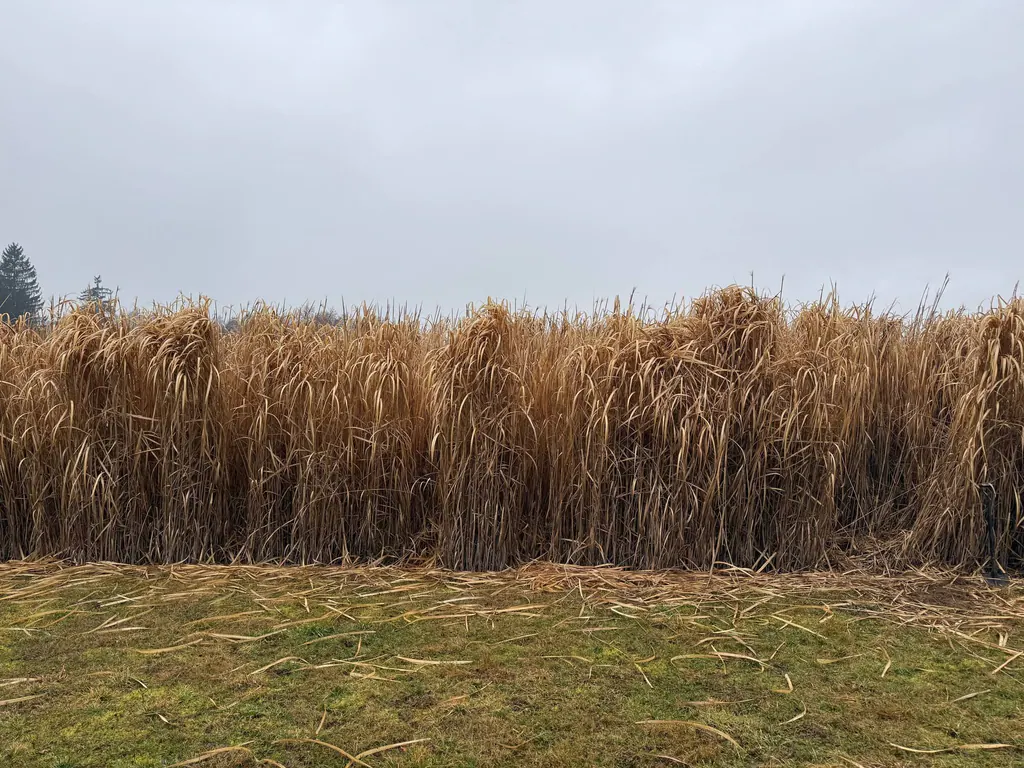
A crop grown to supply aviation fuel production for twenty years or more has to meet four conditions: it must give high yields, cost little to maintain, be neither a food nor a feed crop, and have low life-cycle emissions. Miscanthus × giganteus, a sterile perennial grass, meets all four.
Perennial for 15-25 years
A single planting can be harvested every year for decades with low inputs, which is roughly the period covered by the mandate.
Non-food land
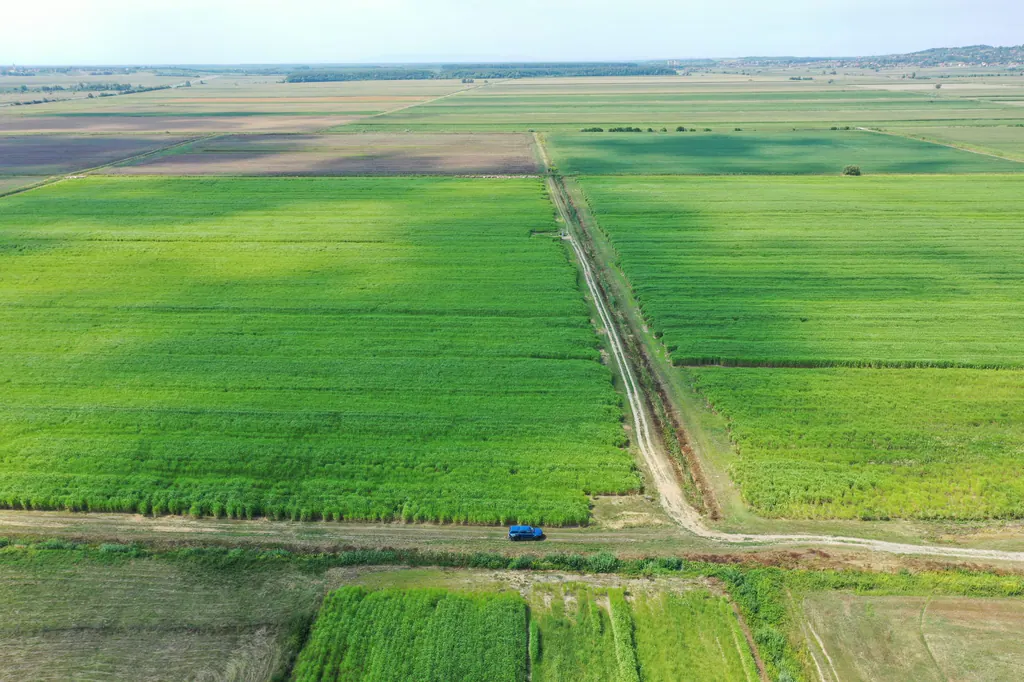
Miscanthus can be grown on marginal, under-used land. Grown there, it takes no land from food production, which simplifies the sustainability accounting. Fuel made from it falls within the categories that count towards the EU mandate. What can and cannot be grown on such land is covered in our article on marginal and contaminated land.
High yield at low cost
The crop gives a high tonnage of biomass per hectare with little upkeep. This matters because the cost of feedstock largely determines whether a fuel project is profitable.
Can be carbon-negative
Carbon stored in roots and soil can outweigh the emissions of the whole supply chain. The fuel then has a negative carbon balance: over its life cycle, more carbon is removed from the air than is emitted. In the 2026 Illinois study of miscanthus and switchgrass, carbon intensity ranged from −9.7 to 39.4 gCO₂e/MJ, compared with about 89 for fossil jet fuel.
Timeline
The feedstock base determines when full output is reached
As an example, consider one integrated project: a 50,000-hectare miscanthus base supplying a single commercial-scale plant. If planting starts now, the base reaches full output in the mid-2030s, when the mandate rises to 20% and HEFA is already at its ceiling. If planting is delayed until the shortage is widely recognised, the same base reaches full output in the 2040s, a decade after competitors who started earlier.
The build consists of four workstreams that run in parallel. Three of them are engineering work; the fourth, the feedstock base, depends on the growth of the crop and determines the overall schedule.
Financing is the easier part: the money can be raised as it is needed, and the amount is modest compared with the cost of the plant that the base supplies. The binding constraint is the time the crop needs in the ground, which does not depend on how much is invested.
~€4,000/ha to plant, staged across the build
a stable recurring cost for two decades of feedstock
Case study: Kazakhstan
A planned SAF plant and open questions about its feedstock
The problem
Kazakhstan's airlines are bound by ReFuelEU on every EU departure and pay Europe's SAF premium there, yet the country has no domestic SAF production. For a country that aims to be a transit hub between Europe and Asia, this is a strategic risk.
The plan
Air Astana and KazMunayGas have co-funded a pre-feasibility study (backed by the EBRD), and KazMunayGas has agreed with LanzaJet to progress an alcohol-to-jet project. The aim is to build the first SAF plant in Central Asia by 2029, using domestically produced ethanol.
Open questions
The ATJ process converts ethanol made from biomass into jet fuel, and Kazakhstan has large areas of marginal steppe on which such biomass could be grown. A non-food perennial crop grown there would count as eligible feedstock under ReFuelEU. Two questions remain open: where the feedstock will come from, and whether planting will start early enough to supply the plant.
Disadvantages and risks · 08
The weak points of a cellulosic SAF project
The build cannot be rushed.
It takes years from planting the first rhizomes to full output. The yield in each year after planting is given in our cultivation guide.The upfront cost is high.
Establishment and plant construction together cost hundreds of millions of euros before the first tonne of fuel is produced.Biomass is bulky.
Transport costs limit the economic supply radius to roughly 50-80 km around the plant.Supply and offtake depend on each other.
The plant needs committed feedstock and the grower needs committed offtake, so one of them has to take the first step.Conversion is still being scaled up.
Far fewer cellulosic ATJ plants are in operation than HEFA plants, so each new one carries a real execution risk.The mandate can be revised.
The scheduled review could tighten or loosen it; this analysis assumes that the current direction of policy holds.On price alone, cellulosic fuel is not competitive.
It still costs more than untaxed fossil jet fuel, so the business case depends on the mandate and the shortage.
Next steps · 09
The first step is a feedstock base
Airlines & fuel producers
Further up the supply chain, they can hedge against a rising premium through long-term offtake agreements and direct stakes in a feedstock base planted before the shortage becomes acute.
Investors
Because of the HEFA ceiling, further growth in SAF supply has to come from cellulosic feedstock, so demand for it will grow as the mandated share rises. Returns are expected in the late 2030s, but the investment has to be made now, while planting a feedstock base is still cheap.
Governments
They already create the demand, and without domestic supply their airlines pay the premium to producers in other countries on every EU departure. The first step towards domestic fuel, jobs and energy security is to support feedstock production about a decade before the fuel is needed.
For all three groups, the feedstock base must be low-cost and use a sterile crop, and it has to be planted before anything else is built. We carry out this part of the work: Zelena Biomasna Energija has grown miscanthus for over a decade, holds traceable planting stock of the Illinois clone at programme scale, and has the machinery and crews to plant it.
FAQ
Frequently asked questions
World production was about 1.9 million tonnes in 2025, or 0.6% of the jet fuel that airlines burn. Its share is expected to rise only to about 0.8% in 2026, because growth is slowing. Net zero by 2050 would require around 500 million tonnes a year, while realistic biomass supply is estimated at no more than about 300 Mt. The shortfall is therefore large and structural.
Almost all SAF is currently made by the HEFA route from used cooking oil and waste fats. These feedstocks can cover only 4-8% of jet-fuel demand, and that limit is expected to be reached around 2030. Growth beyond it requires a different feedstock: lignocellulosic biomass, converted by the alcohol-to-jet route. Miscanthus is one source of such biomass.
Most alcohol-to-jet fuel produced today is made from food-crop ethanol: grain ethanol in the US and sugarcane ethanol in Brazil. In the EU, where the use of SAF is compulsory, this fuel does not count towards the mandate. ReFuelEU builds on the Renewable Energy Directive, which caps biofuels from food and feed crops and excludes them from the fuel categories that the mandate recognises. Eligible SAF must come from wastes, residues or non-food cellulosic material such as miscanthus.
On price alone, SAF cannot compete with kerosene. ReFuelEU, however, requires a rising share of fuel to be SAF whatever the premium, and falling short of the obligation costs at least twice the price gap, with the missing tonnes still owed in the next period. Carbon pricing also narrows the gap by making kerosene more expensive, as aviation's free EU allowances end in 2026. The commercial question is therefore who will have compliant fuel to sell when the mandated share rises.
Within the mandate's timeline, e-SAF is not expected to replace biofuels. It costs around 12 times as much as conventional jet fuel today (EASA 2025 reference), and its production depends on green hydrogen and captured CO₂, for which the infrastructure takes longer and costs more to build than a crop base. The law therefore gives e-SAF its own sub-quota, which starts at a lower level: 1.2% in 2030, 5% in 2035 and 35% by 2050. Even in 2050 roughly half of the obligation is expected to be met with biofuel, so cheaper e-SAF in later years does not remove the need for a cellulosic feedstock base now. The e-SAF and biofuel shares grow side by side.
At today's commodity prices it is not, because cellulosic jet fuel costs more than fossil jet fuel. The business case rests on the structure of the market: buyers are obliged by law, the penalty is higher than the premium, the main existing feedstock is capped, and the feedstock that can be expanded at scale takes about ten years to build up. Feedstock is also the largest single cost in the production chain, so the economics depend mainly on the biomass supply, and much of the margin is likely to go to those who have planted the biomass base. All figures in this article are conservative and illustrative.
A full feedstock base takes eight to ten years to build: each block needs three seasons to reach full yield, and planting across 50,000 ha is staged over several years. If planting starts now, full output is reached in the mid-2030s, when the mandate rises to 20% and HEFA is already at its ceiling. Those who plant first will have feedstock to sell when demand rises sharply.
Miscanthus can be converted to jet fuel by the alcohol-to-jet route: the biomass is fermented into ethanol, and the ethanol is then upgraded to a jet-range fuel. Both steps are already carried out at commercial scale. The 2026 University of Illinois study modelled this route for miscanthus and switchgrass across a thousand sites.
The 2026 University of Illinois study of miscanthus and switchgrass found life-cycle carbon intensities from −9.7 to 39.4 gCO₂e/MJ, compared with about 89 for fossil jet fuel. A value below zero means that the fuel is carbon-negative. A biofuel is not automatically zero-carbon, because the score counts emissions across the whole supply chain. Fuel made from miscanthus can reach the negative end of the range because the crop stores carbon in the soil.
Kazakhstan is a current example of the situation described in this article. Its airlines pay Europe's SAF premium, the country has no domestic SAF production, and an alcohol-to-jet project (Air Astana, KazMunayGas, LanzaJet) is already under way, with the aim of opening Central Asia's first SAF facility by 2029. The country also has large areas of marginal land on which the feedstock could be grown.
A note from us
Who wrote this
We wrote this article ourselves. We grow miscanthus and sell planting stock, and we used the sources listed below and our own figures.
The information was current when the article was published. Prices and rules change, errors are possible, and the figures for the 2030s are forecasts. Please check the figures before you rely on them.
If you find an error or have more accurate figures, write to us at info@miscanthus.eu or use the form below.
Sources
- Bianco, M. F. et al. Co-Location of Cellulosic Bioethanol and Alcohol-to-Jet (ATJ) Production Facilities for Targeted Scale-Up of SAF Production. Environmental Science & Technology (2026). DOI:10.1021/acs.est.5c17460.
- IATA: SAF Production Growth Rate is Slowing Down (Dec 2025); SAF Fact Sheet (2026); Global Feedstock Assessment for SAF (to 2050).
- S&P Global / Fastmarkets: SAF market prices 2025-26 (~$2,181-2,900/t); implied airline price $3,000-3,500/t.
- ICCT / Neste: HEFA lipid ceiling 4-8% of jet-fuel demand.
- Regulation (EU) 2023/2405 (ReFuelEU Aviation): mandate trajectory; anti-tankering; penalty ≥2× the SAF/fossil price gap, with the missing volume still owed the next period.
- EASA, 2025 Aviation Fuels Reference Prices for ReFuelEU Aviation: conventional jet fuel €640/t; bio-based SAF (HEFA) €1,925/t; advanced aviation biofuel ~€2,760/t; synthetic SAF (e-SAF) €7,520/t (~12× conventional).
- The Astana Times / GreenAir News / Aviation Business News: KazMunayGas-Air Astana pre-feasibility (EBRD/ICF); KazMunayGas-LanzaJet ATJ project; Central Asia's first SAF plant targeted 2029.
- Probabilistic TEA of alcohol-to-jet SAF (2025), Environmental Research: Energy, DOI:10.1088/2977-3504/ae7801: MJSP $8.89/gal; ethanol = 75.5% of operating cost; ~2.4 gal ethanol → 1 gal jet.
- US DOE, Pathways to Commercial Liftoff: Sustainable Aviation Fuel: cellulosic-ATJ $4.5-9.6/gal; 8-12 plants for 800-1,200 M gal/yr.
- EU ETS carbon forecasts (Enerdata, GMK Center, ABN AMRO); aviation free allowances end 2026; jet combustion ≈3.16 t CO₂/t. SAF/e-SAF cost decline: EU impact assessment; Stillwater Associates.
- Miscanthus yield/economics: ~15-26 t DM/ha; establishment, harvest and build-rate figures are our own internal project figures (Zelena Biomasna Energija d.o.o.).
- EU aviation fuel volume ~32.1 Mt (2024) and SAF 0.6%: EASA / European Commission ReFuelEU reporting; biomass-per-tonne-SAF and country-area scale comparison are our own illustrative calculation. The ≈€10 bn/yr figure for unmet demand: the ≥12-point gap at 2035 (20% mandate minus the 4-8% HEFA ceiling, ~3.8 Mt of SAF) priced at the EASA advanced-biofuel reference of €2,760/t; the ≈€0.8 bn/yr current-premium figure: the 2% 2025 obligation (~0.64 Mt) at the €1,285/t gap between the EASA HEFA and conventional-jet references - both our own illustrative calculations. The chart's world-output curve extrapolates IATA production figures at today's slowing pace - likewise illustrative; the ≥12-point (2035) and ~45-point (2050) gap figures follow from the same curve and ceilings against the mandate.
- Directive (EU) 2018/2001 (RED II), Annex IX, and ReFuelEU eligible-fuel definitions: food- and feed-crop biofuels capped and excluded from the SAF obligation; eligible SAF limited to wastes, residues and non-food cellulosic feedstocks.