



Soil and climate requirements
A miscanthus stand can remain productive in the same field for more than 20 years, so the site should be chosen with the long term in mind. Check the soil, the climate and, above all, the drainage, because the crop does not tolerate standing water for long. Deal with any risk of waterlogging before you order planting stock.
Soil
Miscanthus grows on most agricultural soils, including poorer ones. Its roots can reach a depth of 2.5 m and take up water and nutrients from the deeper soil layers.
Climate
The crop is suited to temperate continental and maritime climates, and as a C4 plant it makes efficient use of summer warmth. In winter the dormant rhizomes of an established stand are insulated by soil, snow and leaf litter. A new planting is most at risk in its first winter.
Rhizomes are planted once the soil has warmed to 10 °C, so the planting date depends on latitude and altitude. In Southern and Central Europe the soil reaches this temperature in March or early April, and in Northern Europe and mountain areas in late April or May.
For a commercial biomass crop, choose a level or gently sloping, well-drained field without compaction. The soil should have a pH of about 6.5 and enough phosphorus and potassium for root growth and yield.
Miscanthus also grows on less fertile soils, on slopes and on heavy clay, where other crops do less well. On such sites it can improve soil structure and reduce erosion, and it provides a harvest from land that would otherwise be underused.
Do not plant it on permanently waterlogged soil, on pure sand that holds no moisture or on shallow soil over bedrock. Stream banks and ditch sides that flood are also unsuitable, because floodwater can carry pieces of rhizome away. Land contaminated with heavy metals needs a soil analysis before planting; our article on marginal and contaminated land explains why.
Establishing a plantation in six steps
The productivity of a miscanthus plantation is largely determined in the first one or two years after planting. The young crop grows slowly, so the main task in this period is to get the rhizomes well rooted and to stop weeds from smothering them.
Unlike many conventional crops, miscanthus has no standard herbicide programme. Weed control therefore starts before planting, with the choice of site, field cleaning, thorough soil preparation and, where needed, cover crops.
- 01
Site assessment
Autumn, the year beforeCheck the field's pH, soil structure, nutrient status and drainage against the conditions above, and assess the weed pressure. Miscanthus tolerates a wide pH range but grows best on slightly acidic to neutral soils.
Where weed pressure is high, especially from perennial weeds, plan the field cleaning (step 02) so that the weeds are under control before the main cultivation begins.
- 02
Field cleaning
Autumn to early springMake the field as clean as possible before planting. This is the easiest time to control perennial weeds, which become much harder to deal with once the rhizomes are in the ground.
Depending on the field, use an overall herbicide spray, cultivation, cover crops or a combination of these methods.
- 03
Soil preparation
Before plantingThe main cultivation is usually done to a depth of 25-30 cm to break up compaction and encourage root development. Before planting, the soil should be level, fine and firm, without large clods or crop residues.
A good seedbed allows the rhizomes to be planted evenly and in close contact with the soil, which helps them to establish.
- 04
Rhizome planting
March-May · soil at 10 °CPlant in spring, once the soil has warmed to about 10 °C. The usual planting depth is 10-15 cm. We plant about 20,000 rhizomes per hectare, for example 1.0 m between the rows and 0.5 m within the row.
If the topsoil is dry and the soil is moist only below the usual depth, the rhizomes can be planted slightly deeper. This decision should be made by an agronomist, because rhizomes planted too deep may emerge poorly.
- 05
Caring for the young plantation
First seasonInspect the field regularly after planting. In the first season, inter-row cultivation and targeted weed control may be needed.
Each treatment is chosen according to the weeds present, the growth stage of the crop, the soil and the weather. The methods are described in the section on weed control below.
The crop is not usually harvested in the first year. The aim in this season is an even, viable stand with a well-developed root system.
- 06
First harvest
From year 2The first commercial crop grows in the second season and is harvested in the late winter or early spring that follows. After that the stand is harvested every year. Harvest timing and methods are described in the harvest section below.
Weed control in the first year
Weeds easily outcompete young miscanthus shoots for light, water and nutrients.
Field cleaning and soil preparation (steps 02 and 03) reduce the weed burden before planting. After planting, weeds are controlled by the three methods described below.
Pre-emergence stage. After planting, before the miscanthus shoots and most of the weeds emerge, a residual soil herbicide may be applied. This keeps the seedbed free of weeds during the first weeks, when the crop is most vulnerable.
Choose the product, rate and timing to suit the soil type and soil moisture, and follow the manufacturer's instructions.
Post-emergence stage. Once the miscanthus shoots have emerged, weed control requires more care, because the young plants can be sensitive to some active ingredients and tank mixes.
Selective herbicides, spot treatment of problem patches, or both, may be used. Spray only when the miscanthus is well rooted and the weeds are growing actively.
Mechanical control. Inter-row cultivation is an important part of weed control in the first season, especially where few herbicides are available or none are used.
The inter-rows are usually cultivated 2-3 times in spring and summer, when the weeds are small and the young shoots are least at risk. This keeps the weeds under control until the miscanthus is established and its canopy begins to close over the inter-rows.
Important. After planting, have an agronomist make every herbicide decision for the field in question, and use only products registered in your country.
Yields by year over the life of a plantation
The stand usually reaches full yield by the third harvest, as the rhizomes spread and the canopy closes. The yield then stays at this level for about 15 years before it slowly declines.
| Stage | Yield (t DM/ha) | What happens |
|---|---|---|
| Planting year | No harvest | The soil is prepared and the rhizomes are planted (March-May). Weed control is the priority. The planting itself, the machines and the choice of density are covered in the planting article. |
| 1st harvest | 8-15 | This is the first commercial harvest. The plants reach 2-3 m, the rhizome network spreads and the closing canopy starts to shade out weeds. |
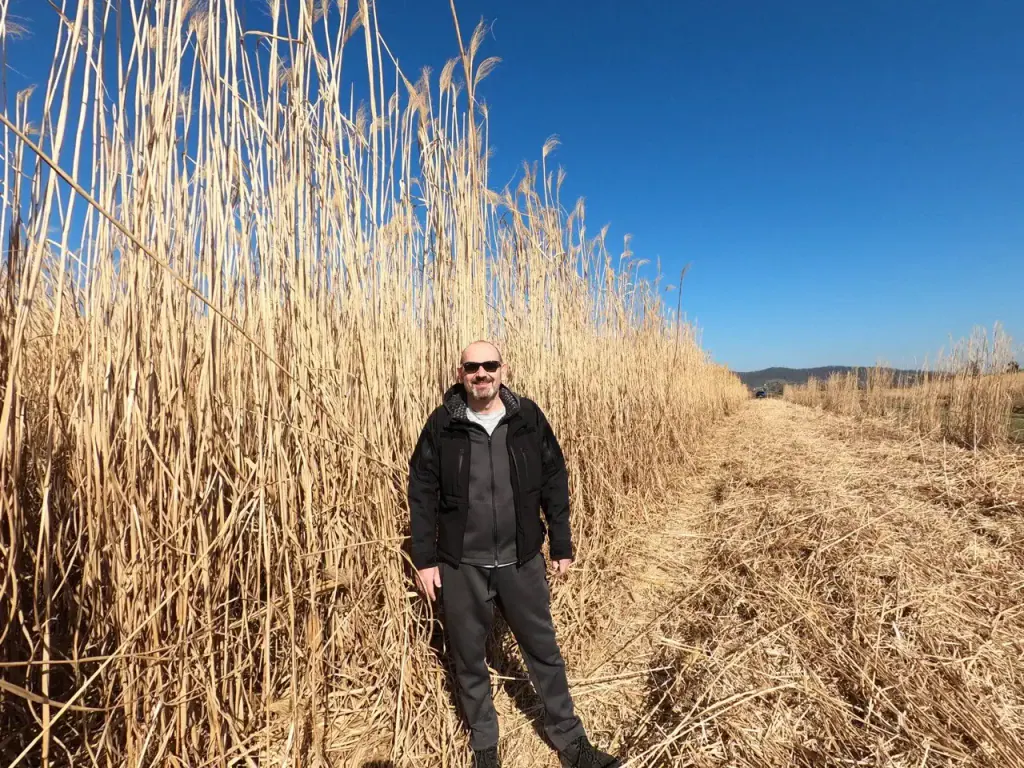
| 2nd harvest | 15-25 | The stand reaches nearly full density. The plants grow to 3-4 m and the roots go deeper than 1.5 m. |
| 3rd harvest+ | 18-36 | The stand reaches full yield, and the build-up of carbon in the soil becomes measurable. |
| Year 10+ | 18-36 | The yield remains steady. Significant amounts of carbon accumulate deep in the soil, and soil structure visibly improves. |
| Year 20-25 | 15-30 | In some stands the yield begins to fall slowly, and the grower decides whether to keep the stand or to start a new cycle. |
Rhizomes and soil preparation account for most of the establishment cost, which is paid in full before the first harvest. After that, harvesting is the only large annual cost. The 20-year budget for a hectare is set out in our article on miscanthus as fuel.
When and how to harvest
The best harvest window is usually February to March, once the growth above ground has died back. By then the nutrients have moved back into the rhizomes, some of the leaves have fallen and the stems have dried naturally.
Main harvesting methods
Mowing, swathing and baling
The crop is mown, left in swaths to dry further in the field and then pressed into standard rectangular or round bales.
Direct chopping
A self-propelled forage harvester, or another machine adapted for the job, cuts and chops the stems in one pass. This method is suitable when the buyer wants chopped material or when the crop will be used or processed soon after harvest, without long storage.
Machinery
Miscanthus is harvested with standard arable machinery, such as mowers, swathers, balers, forage harvesters and trailers, which can be owned or hired. This is a practical advantage over some other energy crops, which may need specialised equipment.
Blade wear. Miscanthus stems have a high silica content, which can wear cutting parts quickly. Have spare blades ready before the harvest starts, and check and sharpen them regularly while harvesting.
Low pest and disease pressure in Europe
So far, pests and diseases have caused few problems for miscanthus in Europe.
During establishment, poor planting stock is a greater risk than pests or diseases. Rhizomes that are weak, dried out, damaged or badly stored, or that were lifted from a very young or very old mother field, can emerge unevenly. The result is a thin stand with a lower yield potential.
Once a stand is established, pests, viruses and leaf diseases rarely put the yield at risk or need treatment, and no regular crop protection programme is required.
Frequently asked questions
- Lewandowski, I. et al. (2000). Miscanthus: European experience with a novel energy crop. Biomass and Bioenergy, 19(4).
- Bullard, M. J. & Nixon, P. (2003). Optimisation of Miscanthus harvesting and storage strategies. Defra, UK.
- Huisman, W. & Kortleve, W. J. (1994). Mechanization of harvest and conservation of Miscanthus sinensis Giganteus. Industrial Crops and Products, 2(4).
- Davis, S. C. et al. (2010). Comparative biogeochemical cycles of bioenergy crops reveal nitrogen-fixation and low greenhouse gas emissions in a Miscanthus × giganteus agro-ecosystem. Ecosystems, 13.
Related articles