



Miscanthus as fuel: the value of a tonne of bales
A tonne of miscanthus bales burned in a boiler replaces gas, and its value as fuel is the price of that gas in the year it is burned. We compare the cost of heat from bales with the cost of heat from gas, oil and pellets in the EU and in Ukraine, and identify the cases in which burning bales does not pay.
Part two: grain dryers and factories · Part three: houses, farms and villages · If you have no field of your own, start here
What a tonne of miscanthus bales is worth, and where gas is cheaper
-
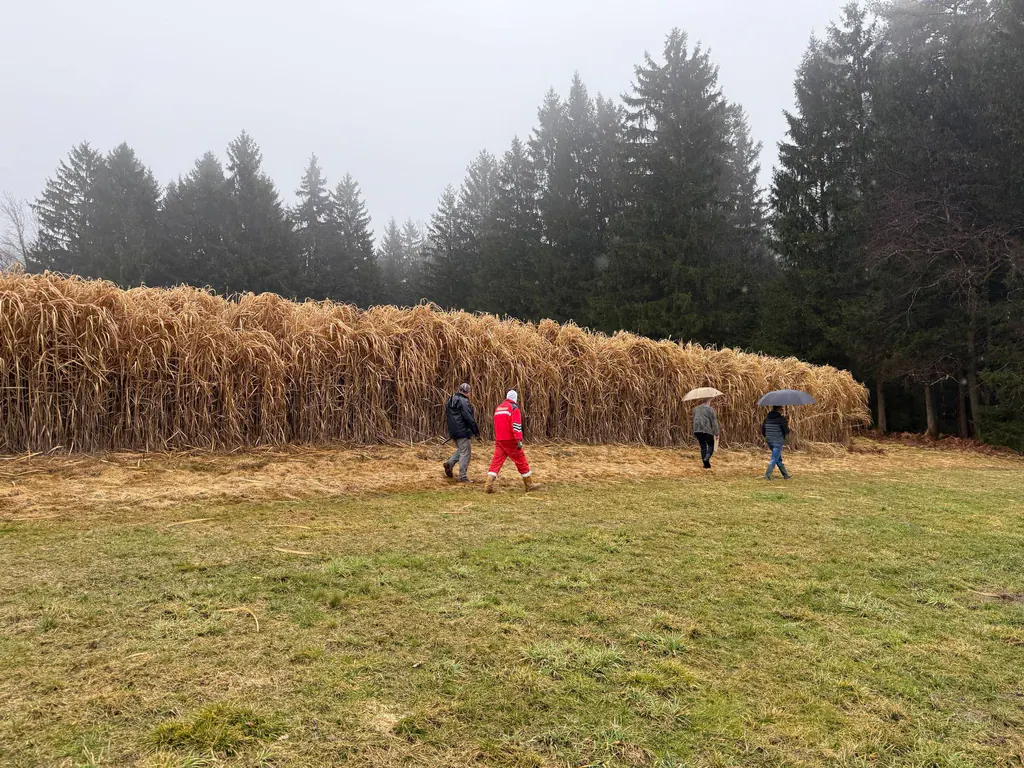
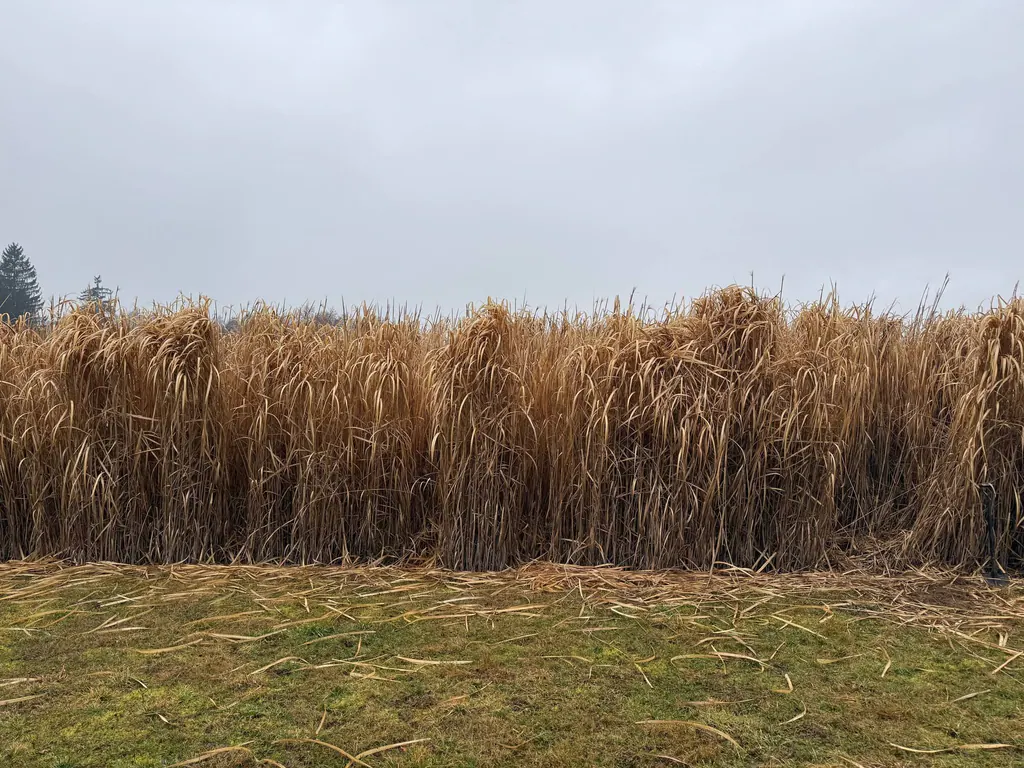
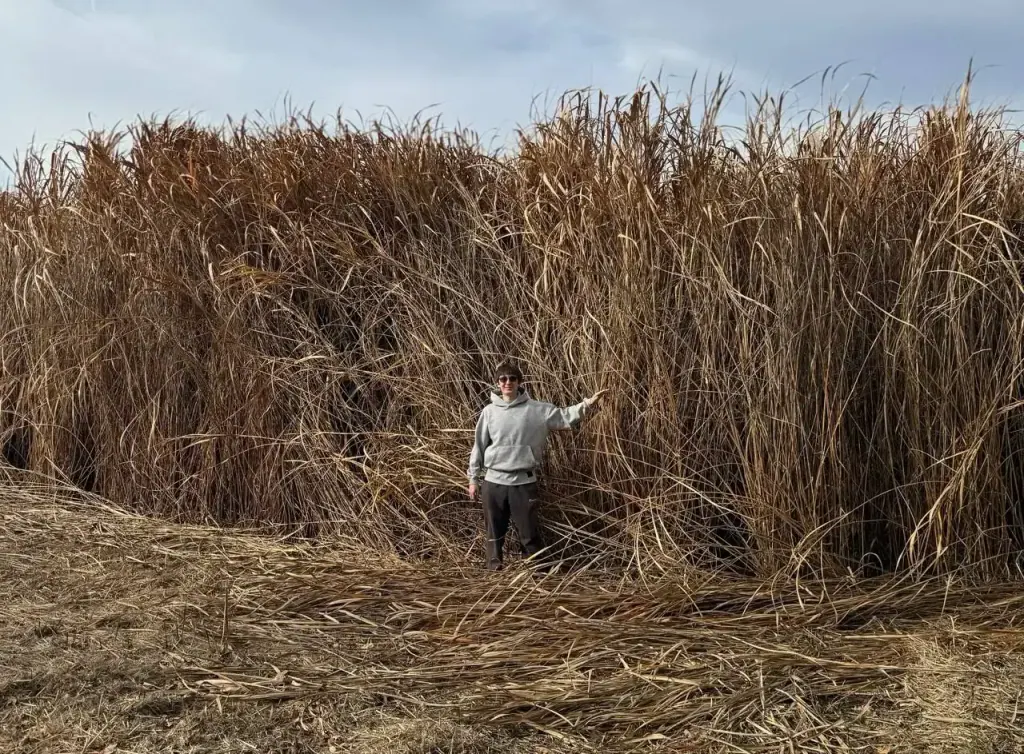
Bales from our fields need no drying before they are burned.
On our fields the crop is baled in January and February at 13-16% moisture, which falls to 12-15% in the stack. A kilogram of dry miscanthus contains 17.7 megajoules of energy, more than wheat straw and less than spruce. -
A tonne of bales burned in place of business gas saves more money than it would sell for.
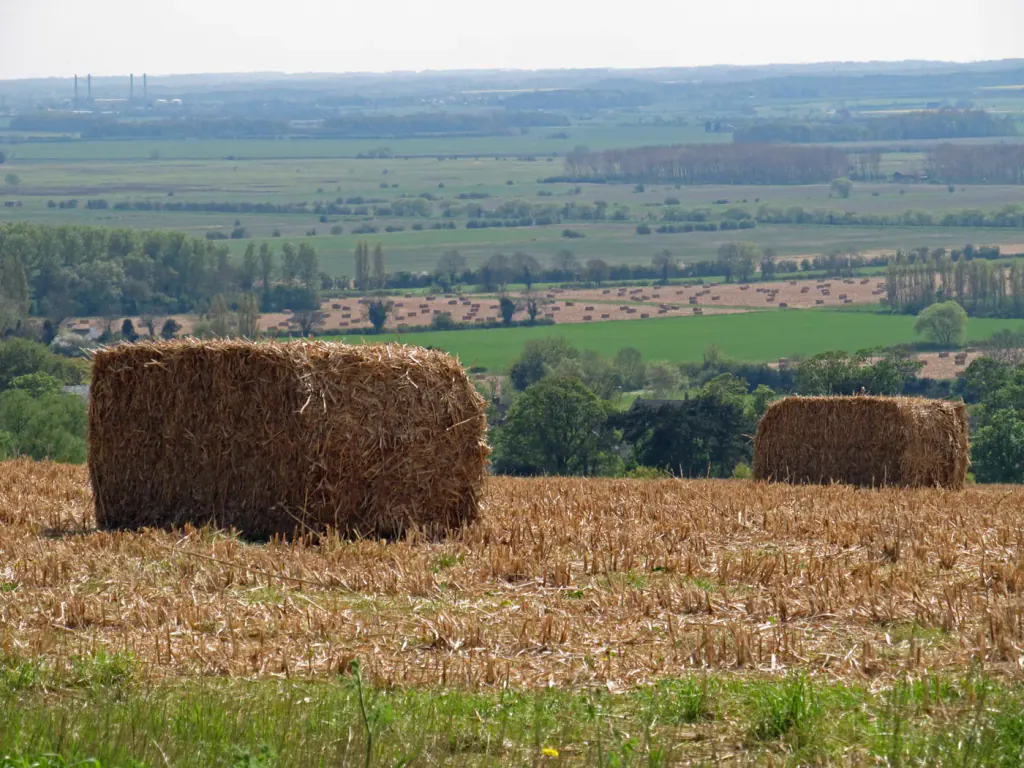
A tonne of bales replaces 3.64 megawatt-hours (MWh, 1,000 kWh) of gas. At 2025 prices that amount of gas cost €173 for a Ukrainian business and €255 for an EU farm. In our own trade a tonne fetches €110-115 at the field edge, and growing it costs about €80 with Ukrainian land rent. Ukrainian export listings quote €40-55, which is less than the cost of growing a tonne. -
Miscanthus ash melts at a similar temperature to straw ash, so the fuel needs a boiler built for straw.
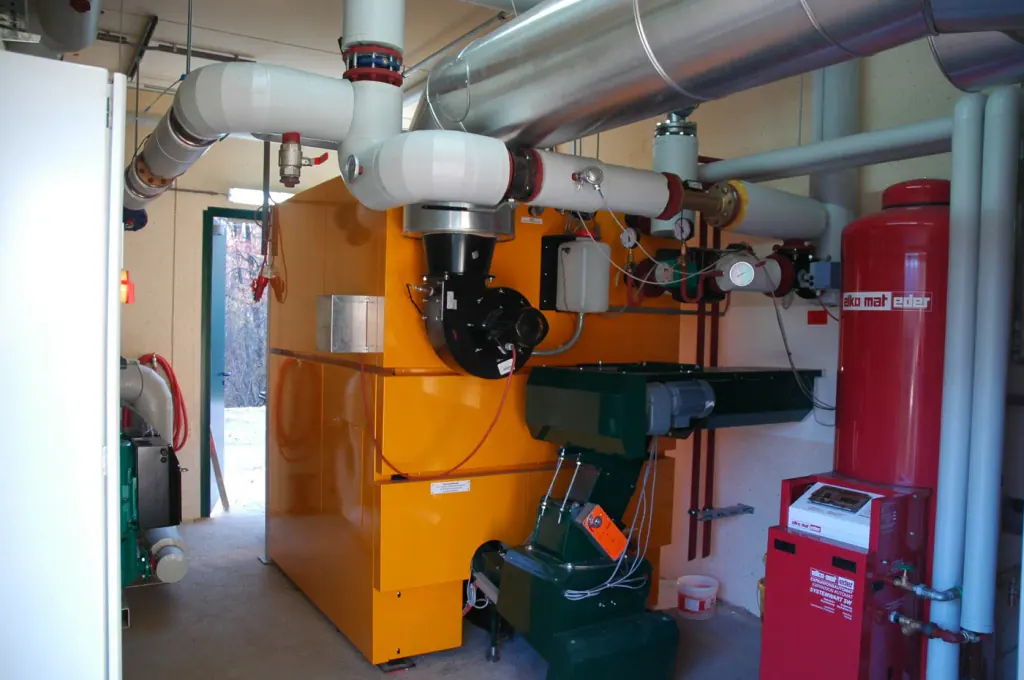
The ash content is 2-4%, the ash softens at about 970 °C, and the chlorine content is several times the limit in the wood-pellet standard. In a pellet or chip boiler built for wood, the ash fuses into hard lumps of clinker on the grate, the bed on which the fuel burns. A straw boiler with a moving grate and a filter can burn miscanthus. -
With the boiler included, heat from bales in a dryer or a house costs about as much as heat from gas, or less.
For a dryer that burns the farm's own bales, heat costs about the same as heat from Ukrainian business gas at 2025 and 2026 prices and much less than heat from EU farm-scale gas. Heating a house with bales costs about as much as heating it with EU gas. A factory saves money only if it already owns a solid-fuel boiler. The calculations are on two separate pages, one for the dryer and the factory and one for the house and the farm. -
At the frozen Ukrainian household gas tariff, heating with bales does not save money.
A Ukrainian household pays a gas price frozen at 7.96 hryvnia a cubic metre. Heat at that price costs about as much as heat from home-grown bales and less than heat from bought bales. In our model the cost of planting a field to heat such a house is never recovered, and the owner would earn more by selling the bales.
Miscanthus has slightly more energy than wheat straw, and its ash melts at a similar temperature
The Bavarian technology centre TFZ measured the net calorific value of Miscanthus × giganteus at 17.7 MJ per kilogram of dry matter, or 4.9 kWh; the table compares it with wheat straw and spruce. Part of the heat is used to evaporate the water in the bale, so a wetter bale delivers less heat: 15.7 MJ/kg at 10% moisture, 14.6 at 15% and 13.7 at 20%.
| Property | Miscanthus | Wheat straw | Wood pellet / spruce |
|---|---|---|---|
| Net calorific value, dry matter | 17.7 MJ/kg | 17.2 MJ/kg | 18.8 MJ/kg (spruce) |
| Net calorific value, as burned | 14.6-14.7 MJ/kg at 15% · 4.08 kWh/kg | ≈14 MJ/kg at 15% | ≥16.5 MJ/kg at ≤10% |
| Ash | 2-4% (stems 1-3, whole plant 3.9) | 5.7% | ≤0.7% |
| Ash softening | ≈973 °C (deforms from 835-890) | ≈998 °C | ≈1,426 °C |
| Chlorine, dry matter | 0.04-0.37% | ≈0.19% | ≤0.02-0.03% (standard) |
| Potassium, dry matter | ≈0.7% | ≈1.0% | ≈0.13% |
| Bulk density | bales 120-180 kg/m³ · chips 70-130 | bales 120-160 | ≥600 kg/m³ |
| Energy per m³ | big square bale ≈0.55 MWh | ≈0.5 MWh | ≈2.7 MWh |
| Fuel standard | ISO 17225-6 / -7 (non-woody) | ISO 17225-6 / -7 | ISO 17225-2 / ENplus |
Moisture depends on the harvest date
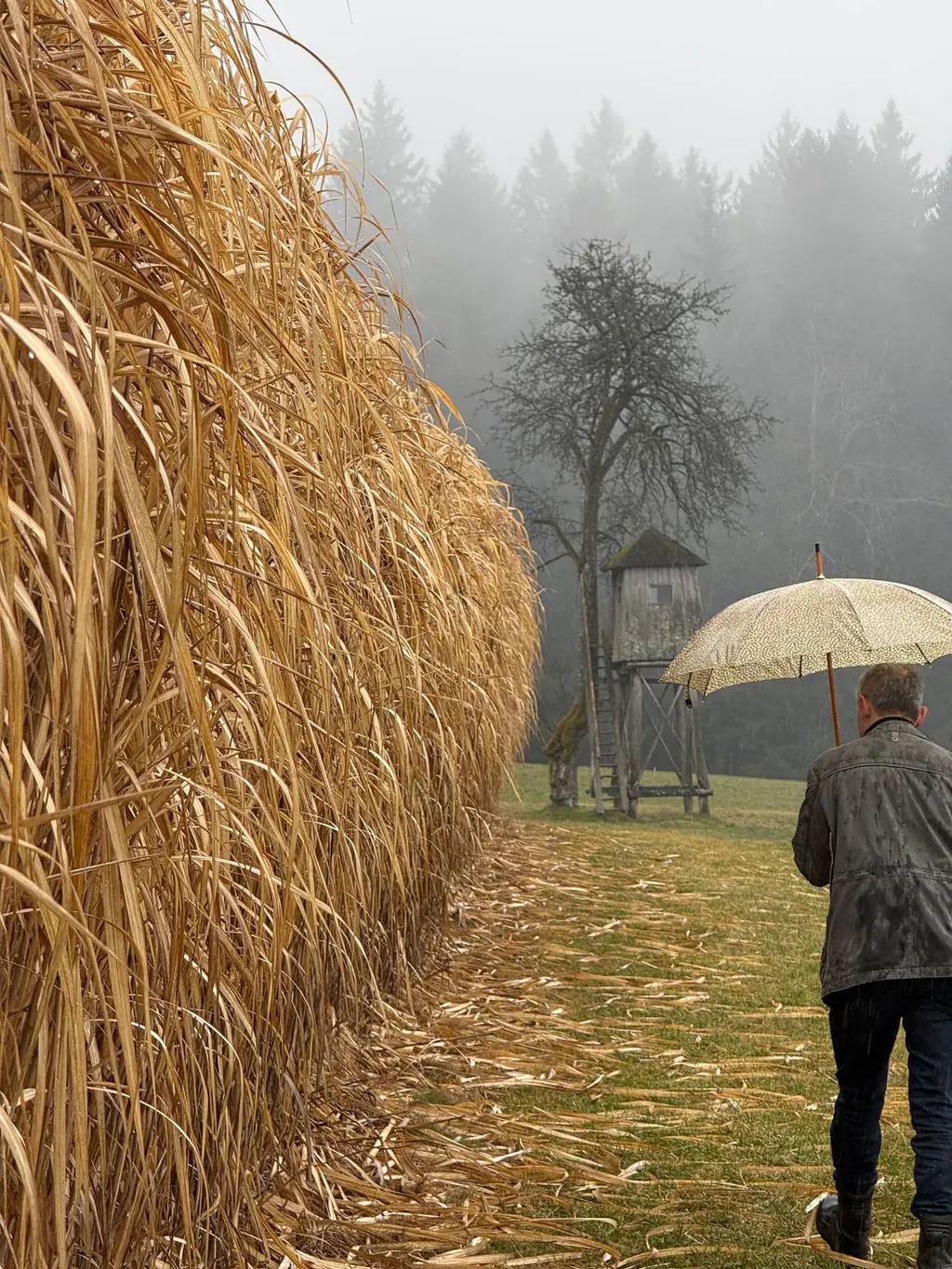
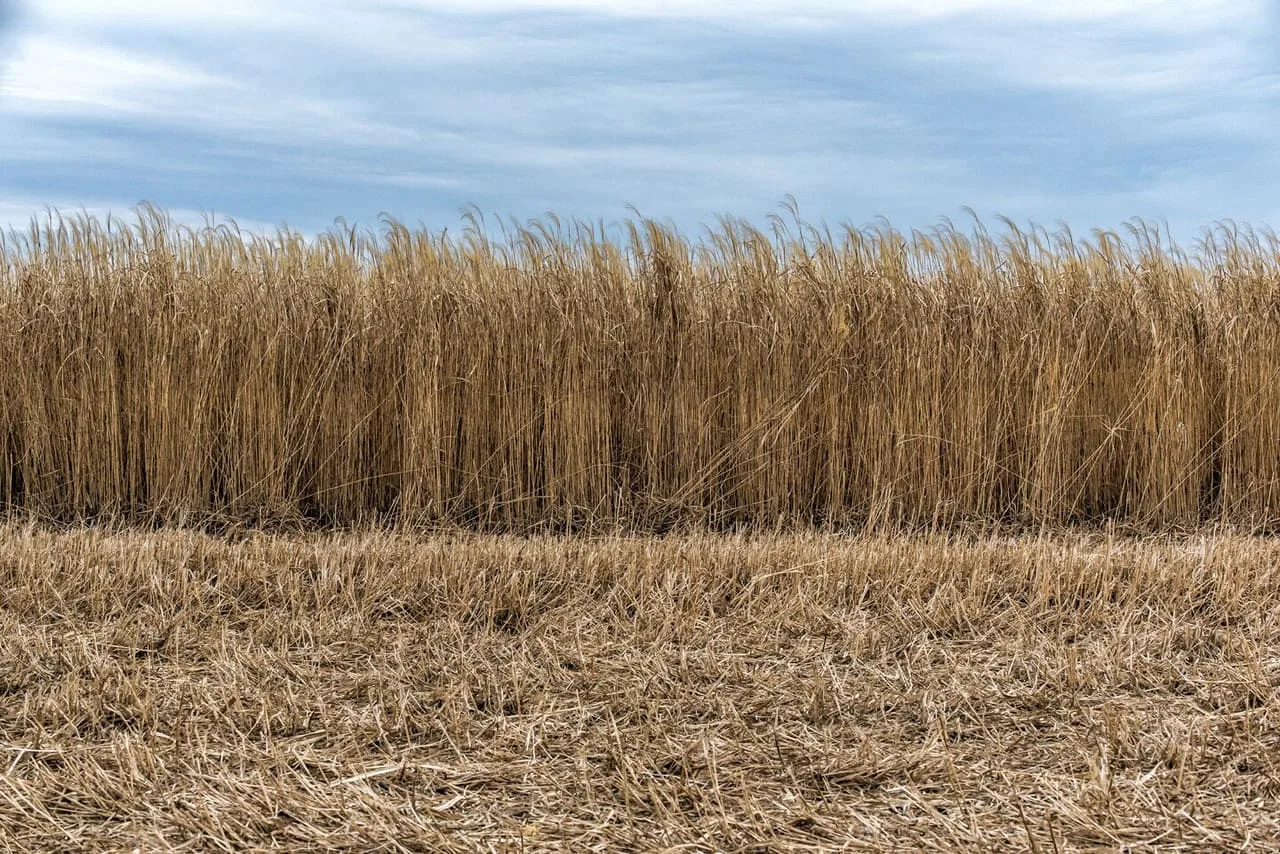
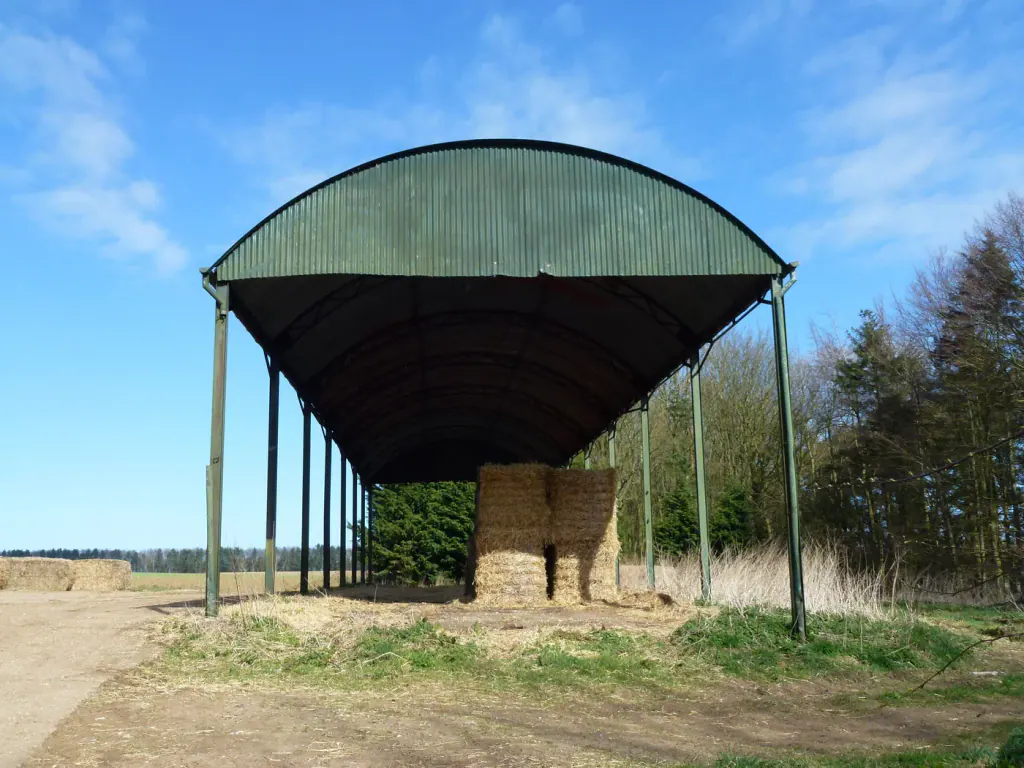
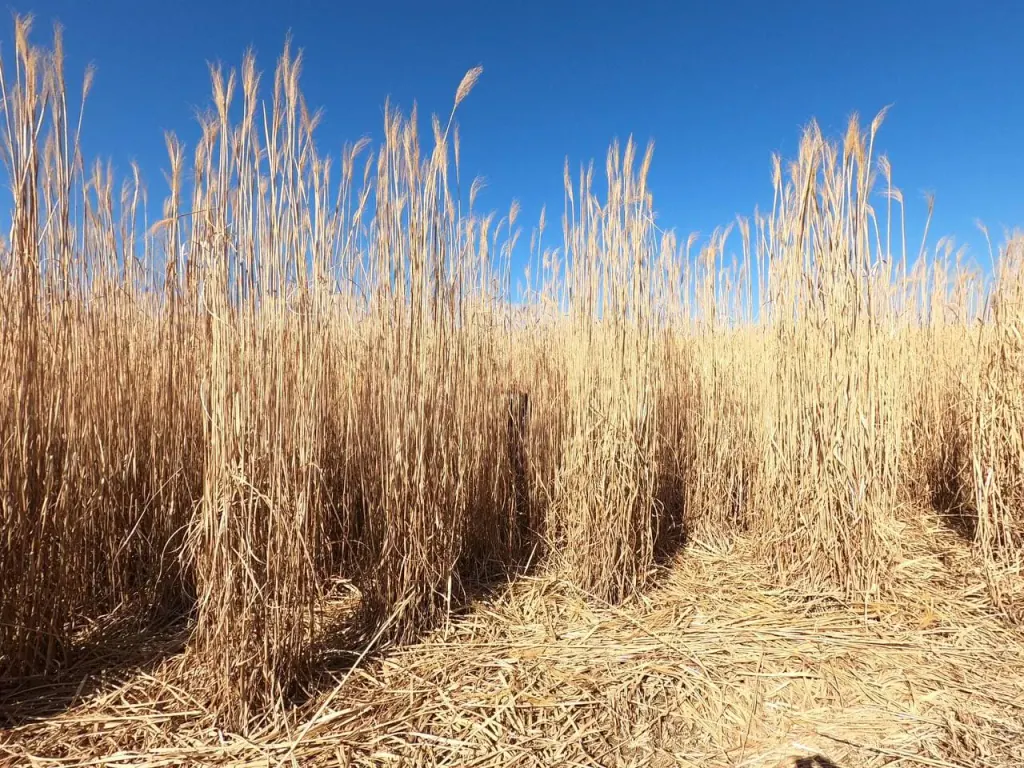
On our fields the crop is cut and baled in January and February, after the winter's frost and wind have removed the leaves and most of the water from the stems. The bales have a moisture content of 13-16% at baling and 12-15% after storage under cover; we measured these figures in our own stacks. They agree with the Bavarian growing guide, which gives "15% and less" for a late harvest, and are lower than the moisture found in published trials. Bales this dry need no further drying, and we make pellets from them only when a customer orders pellets.
Wet bales
After a wet spring or an early cut, bales have 25% moisture or more. Such a bale heats up, goes mouldy and loses 7-15% of its dry matter before it is burned. A stack kept under a roof for nine months loses less than 1% of its dry matter; in the open it loses 9%.
Read the detailAsh, chlorine and the basis of our calculations
Calculation basis
A tonne of bales at 15% moisture contains 4,080 kWh. We assume boiler efficiencies of 82% for bales, 92% for gas and 88% for oil and pellets. A cubic metre of gas is counted as 9.5 kWh in the EU and 8.64 kWh on a Ukrainian meter. Both are net values, which exclude the heat carried away by water vapour in the flue gas. Eurostat quotes gas prices on the gross calorific value, which includes that heat, so we convert them to the net value. On this basis a tonne of bales gives 3.35 MWh of heat. To deliver the same heat, a gas boiler needs 3.64 MWh of gas, which is 380 m³ in the EU and 420 m³ in Ukraine, or about 400 m³ in round figures. A 500 kg big square bale at 15% moisture holds about 2,000 kWh. Yields are given in tonnes of dry matter, that is, the weight of the crop without its water; bales at 15% moisture weigh about 18% more.
Published trials found higher moisture. A British trial of 16 genotypes measured an average of 22% in spring stems, with a range of 12% to 38%, and the only published bale study gives 45-50% for bales made in January.
The boiler chapter of the heating page describes the makers that list miscanthus as a fuel, the boilers that burn it without such a listing, the one model tested on it in Germany and straw-fired plants of up to 15 MW.
The ash
Late-cut stems leave 1-3% ash, and a whole plant baled with its leaves nearer 4%, compared with 0.6% for wood. Miscanthus ash starts to deform at 835-890 °C and softens at nearly the same temperature as wheat straw ash, far below the softening point of spruce ash. The reason is the potassium and chlorine in grass stems, which form a glass in the ash that melts at relatively low temperatures. The chlorine content is 0.04-0.37% of dry matter; the wood-pellet standard allows 0.02-0.03%.
Wheat straw ash softens at 998 °C and spruce ash at 1,426 °C. The grate of a wood boiler runs above the softening point of miscanthus ash, and the grate of a straw boiler stays below it.
A wood boiler
In a boiler designed for wood, the ash fuses into hard clinker once the grate gets hot. The flue gas becomes acidic, and the boiler does not reach its rated output.
A straw boiler
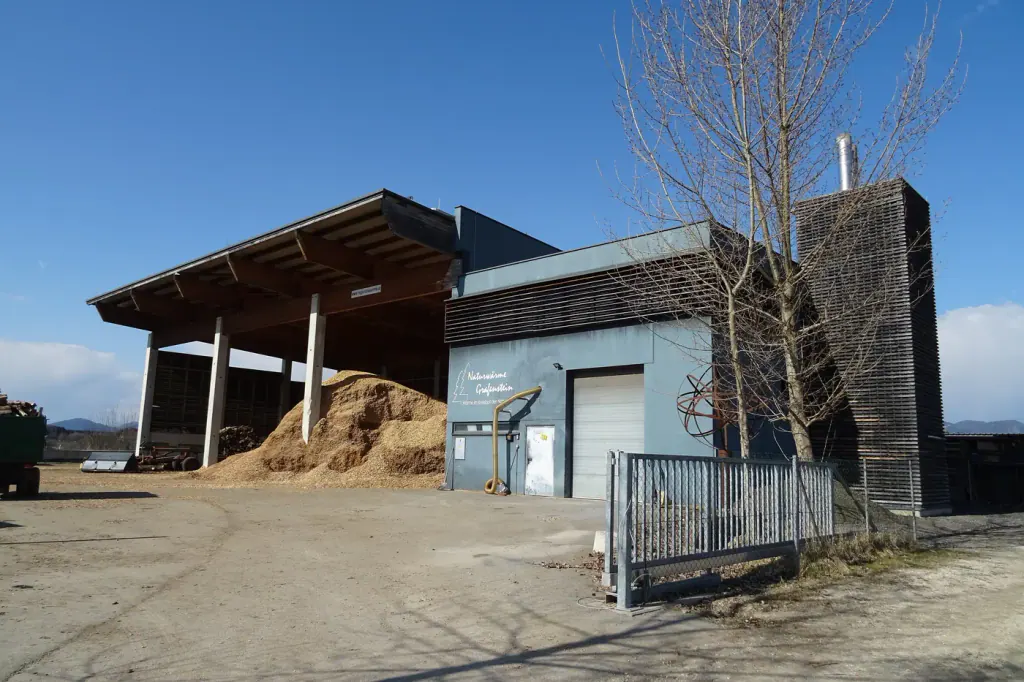
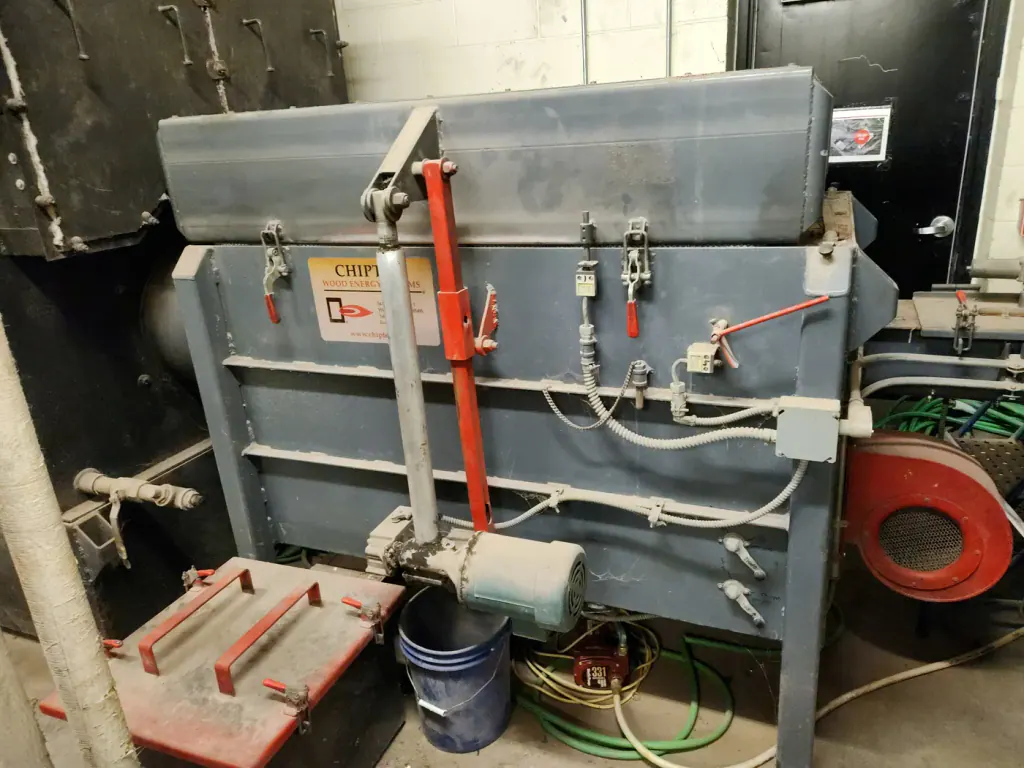
In a boiler built for straw the same fuel burns without forming clinker. A moving or stepped grate removes the ash before it can fuse. The ash pan is two or three times the size of a wood boiler's, and the lining is made of stainless steel or refractory material. The fuel gives off several times as much dust as wood, and a filter catches it.
In 2025 the fuel cost of heat from bales was below that of business gas, oil and pellets
The price of heat is the fuel price divided by the boiler efficiency. Every line on the chart is calculated in this way and includes only the fuel. The boiler, the running costs and the cost of growing a tonne are added in chapter 04.
Euros per megawatt-hour of heat, 2020 to 2026
Bales, ex-field
Our field-edge price, shown as the ex-field line on the chart, is €110-115 a tonne as baled, with the buyer collecting. A bale boiler with an efficiency of 82% produces 3,350 kWh of heat from a tonne, so at the middle of the price range the heat costs €34 a megawatt-hour, or 3.4 cents a kilowatt-hour.
Bales, delivered
The Lower Saxony chamber of agriculture publishes straw haulage rates of €6.50 a tonne plus 15 cents per tonne-kilometre. At these rates a tonne hauled 50 km costs €125-130 delivered, and the heat from it costs €38 a megawatt-hour, as shown by the delivered line on the chart. With a 150 km haul the heat costs €43. In 2025 every gas, oil and pellet line on the chart was above the delivered figure, except the Ukrainian household tariff at €25.
Calculator
- Heat from bales
- €34/MWh
- Heat from gas
- €76/MWh
- One tonne of bales replaces
- €255 of gas
- Gas replaced per hectare
- 8,100 m³/yr
- Hectares to heat a 150 m² house
- 0.3
- Hectares to dry 1,000 t of maize
- 3.1
For comparison, rounded 2025 prices per megawatt-hour of gas are €23 for Ukrainian household gas at 7.96 UAH/m³ plus distribution, €48 for Ukrainian business gas (€50 in 2026), €70 for EU farm-scale gas and €131 for EU household gas. The house needs 20,000 kWh of heat a year, and drying maize takes 210 kWh of heat a tonne, supplied by a furnace with an efficiency of 80%. The calculation uses the basis set out in chapter 02, with gas at 9.5 kWh a cubic metre as in the EU, and does not include the boiler.
Read the detailThe price rises of 2022 and 2026, and fuels that cost less than bales
Gas and oil prices have risen sharply twice since 2020, in 2022 and again in 2026.
Gas prices in 2022
Wholesale gas at the TTF, the Dutch trading hub whose price is the European benchmark, averaged €10 a megawatt-hour in 2020 and €236 in August 2022. Heat from EU farm-scale gas rose from €35 to €92 a megawatt-hour, and heat from German heating oil from €53 to €148.
EU household gas prices after 2022
In 2025 an EU household paid 76% more for heat from gas than in 2020, although wholesale gas had fallen to a quarter of its 2022 average. Network charges and taxes do not fall when the hub price falls, and taxes alone make up about a third of the bill.
Oil and gas prices in 2026
On 28 February 2026 the United States and Israel attacked Iran, and the Strait of Hormuz was closed. Brent crude averaged $120 a barrel in April. Wholesale gas doubled to about €60 by August and reached €80 on 24 September. In August, heat from German heating oil cost €162 a megawatt-hour, which was above the 2022 annual average of €148 and within a few per cent of the 2022 monthly record.
Coal
Coal is not shown on the chart. Heat from coal cost €15 a megawatt-hour before the EU carbon price, which large plants pay on each tonne of CO₂ they emit, and €49 with it. For a plant inside the EU emissions trading system, heat from coal therefore costs more than heat from bales; for a plant outside the system it costs less. We use the Rotterdam coal price.
The Ukrainian household tariff
The Ukrainian household tariff has been 7.96 hryvnia a cubic metre since May 2021 and is frozen until at least April 2027. Heat at that tariff costs less than heat from bought bales and about the same as heat from home-grown bales.
The cost of heat from bales and gas, including the boiler and running costs
The price chart includes only the fuel. A buyer pays for the whole heating system, and gas and bales need very different systems. The calculations for the house, the dryer and the factory are on the other two pages and are summarised here.
Gas is delivered by pipe to a boiler that costs far less than a straw boiler and needs no one to tend it. Bales have to be grown, cut, stacked under a roof and carried to the grate, and the field they grow on could have been rented out instead. For this reason we count all the costs of both fuels, in euros per megawatt-hour of heat.
Costs included
The bales are counted at their growing cost in our planning model, which is our budget for one hectare. The boiler is counted as an annual instalment over 15 years at 6%, together with its electricity, the hours spent tending it and, for a factory, ash handling. Where gas also needs a boiler, that boiler is counted too. Servicing and chimney sweeping are left out for both fuels, as are the gas connection charge and the cost of a barn if you do not already have one.
Selling a tonne at the field-edge price leaves a margin of €30-35 over its growing cost on land at Ukrainian rent. Burned in a boiler, a tonne replaces 3.64 megawatt-hours of gas, worth €173 to a Ukrainian business and €255 to an EU farm at 2025 prices. The growing cost, the boiler, its electricity and the labour of tending it have to be deducted from that saving. The cards below give the result for each case.
the cost of growing and baling a tonne over a 20-year stand in our planning model, with planting stock at list price and no charge for land. This is €17 a megawatt-hour of fuel and €21 a megawatt-hour of heat, or €24 with Ukrainian rent.
With all costs counted, heat from bales costs €134-243 a megawatt-hour, compared with €191-229 for gas at 2025 German household prices; for a house the boiler costs more than the fuel. An estate that replaces heating oil with bales saves money even with the boiler counted.
Costs for a house A grain dryerDrying with bales costs less than with EU farm-scale gas and about the same as with Ukrainian business gas in 2025 and 2026; in 2024 the Ukrainian gas was cheaperWith all costs counted, heat from bales burned in a furnace with a heat exchanger costs €43-60 a megawatt-hour, or €47 at Ukrainian rent. Heat from gas in a direct-fired dryer, where the combustion gases pass through the grain, costs €36-50 in Ukraine and €70 on an EU farm.
Costs for a dryer A sugar factoryBurning bales saves money only in a factory that already has a solid-fuel boilerHeat from bales delivered on contract costs €38 a megawatt-hour, plus €8 for running the boiler and handling the ash. In 2025 heat from gas cost €73 in the EU, including the carbon price, and €52 in Ukraine. A new boiler house built for a 100-day campaign adds about €50 a megawatt-hour; with that cost included, heat from bales costs more than heat from gas in every year except one like 2022.
Costs for a sugar factoryRead the detailWhat a tonne costs to grow
The planning model
Our planning model, based on Croatian machinery rates, puts the cost of a hectare's first year at €5,100 with planting stock at our list price. This covers soil preparation, mechanical planting, the establishment fertiliser, three herbicide passes, a contingency allowance and mulching at the end of the season. The first harvest, 12 t in the second season, costs €790. A full harvest of 20 t from the mature stand costs €1,120 a year, or €56 a tonne with round bales.
Land and finance
Without any charge for land, growing a tonne costs €86 over a 10-year stand, €75 over 15 years and €70 over 20. With an assumed Ukrainian rent of €200 a hectare, the 20-year figure is €81. With the Croatian leases on which the model is based, it is €102 on state land and €124 on private land at €1,000 a hectare. The model does not include financing, fertiliser after establishment, storage or removal of the stand. A loan at 6%, a fertiliser dressing every third year and a tarpaulin would add €15-25 a tonne.
Rules for burning miscanthus differ by country and by the type and size of boiler
Germany allows miscanthus in an automatic boiler that has been type-tested, that is, a model that a testing institute has tested on the fuel and approved; the German rule does not cover pellet stoves. In Poland's anti-smog zones a boiler needs a label that straw boilers do not have, and a French chamber of agriculture recommends a moving or refractory grate. We have found no country whose rules allow miscanthus in a pellet stove. The rules in Ukraine and the rules that apply across the EU are set out below.
Fuel and tariff. Solid biofuel is not subject to excise duty, but 20% VAT applies. Heat from biomass may be sold at up to 90% of the tariff for heat from gas (Law 1959-VIII). The household gas tariff is frozen until 30 April 2027.
Permits. A stationary combustion source needs an air-emissions permit from the regional (oblast) environment department. The class of the source, and therefore the paperwork required, depends on its emissions rather than on its fuel.
Small boilers. The Ecodesign rules (Lot 15) exempt boilers built for non-woody fuels.
Large plants. The Medium Combustion Plant Directive covers plants of 1-50 MW, and the Industrial Emissions Directive covers plants of 50 MW and above, which includes the boilers of a sugar plant. The emissions trading system (ETS) applies from 20 MW, and emissions from biomass are counted as zero when the renewable-energy criteria are met. RED III's sustainability criteria apply from 7.5 MW, as set out in chapter 06. From 2028 a second trading system, ETS2, will put a carbon price on gas and oil for buildings and small industry; Ukraine plans its own ETS from the same year.
Permits and the carbon price
The rules for small boilers in Germany, Austria, Poland and France, including the German type test, are on the heating page. Under Ukrainian and EU-wide rules, a larger plant burning miscanthus needs the same permit as any other boiler of its size. German rules are stricter for straw-type fuels and require a permit from 100 kW of fuel input. From 2028 gas and oil used in buildings and small industry across the EU will also be subject to a carbon price, like the one that already makes coal more expensive than bales for plants inside the EU emissions trading system.
A Ukrainian study puts the CO₂ saving of heat from miscanthus chips at 85-92% compared with gas
In 2018 Oleksandra Tryboi of the Institute of Engineering Thermophysics in Kyiv modelled a 500 kW chip boiler over 20 years, using figures from Ukrainian growers. The supply chain in the model consists of 33 hectares of miscanthus, which produce 464 tonnes of chips a year, giving about 1,400 megawatt-hours of heat.
The energy return falls as the haul distance increases
Tryboi compared that heat with all the fossil inputs: the diesel, the fertiliser, the lorries, the boiler's electricity and the manufacture of the boiler. The return is highest when the crop is grown beside the boiler and falls as the haul distance grows, because transport uses diesel. With a 100 km haul the supply chain gives 10.4 units of heat for each unit of fossil energy. At 400 km the ratio is still just above the target that the study takes from the International Energy Agency (IEA), which is drawn on the chart below. A gas or oil boiler delivers less heat than the fossil energy it uses.
for chips grown beside the boiler, counting the boiler's own electricity and its manufacture.
EU rules require no carbon saving from plants below 7.5 MW, such as farm boilers and dryers
The EU's third renewable-energy directive, RED III, requires a saving only from 7.5 MW of thermal input, and a plant that came into operation after November 2023 must show a saving of 80%. The operator has to calculate the saving, because the EU has published no default value for miscanthus. The study's supply chain is 10 percentage points above that threshold at 100 km and still one point above it at 600 km.
CO₂ emissions per kilowatt-hour
The EU's renewable-energy directive measures the saving against a reference value of 80 grams of CO₂ per megajoule for heat from gas, which is 288 grams per kilowatt-hour. On the same basis the study's supply chain emits 22 grams per kilowatt-hour of heat at the field edge, 27 grams with a 100 km haul and 43 grams at 400 km. These are reductions of 92%, 91% and 85%. A tonne of bales burned instead of gas gives 3.35 MWh of heat, and at the field-edge figure this avoids about 0.9 tonnes of CO₂. The saving falls to 60%, the level the study treats as acceptable, only when the chips are hauled 1,700 km.
Heat out per unit of fossil energy in, by haul distance
Read the detailInputs, willow and the study's assumptions
Inputs
The largest fossil input, 38% of the total, is the electricity and repairs for the boiler house; cultivation accounts for 27% and the harvest for 15%.
Willow
Willow is harvested green, so its chips contain 8.4 megajoules per kilogram, compared with 13.7 for miscanthus chips. Each tonne hauled therefore delivers less heat for the same amount of diesel, and in the same study willow falls below a 60% carbon saving at 390 km.
Assumptions
The study assumes one fertiliser dressing, at planting, and four herbicide passes in 20 years. It gives no credit for the carbon stored in the soil by the roots and does not account for the previous use of the land. It covers chips in a 500 kW boiler; we have found no comparable calculation for bales in a dryer or a factory boiler.
The planting cost of a hectare is recovered fastest when the bales replace business gas
A hectare of miscanthus is planted once and then harvested every winter for 20 years, from the January and February after its second season. It needs no replanting or gap-filling if the planting stock matches its documents and the first winter is normal. The return from a hectare depends on its yield and on the fuel that its bales replace.
Cumulative cash flow of one hectare over 20 years, with the bales burned in place of gas or sold
- EU farm-scale gas, 2025 · year 3 · €61k
- Ukrainian business gas, 2025 · year 5 · €31k
- Ukrainian business gas, 2024 · year 7 · €16k
- Sold as bales at €110-115 · year 8 · €12k
- Ukrainian household tariff · never · -€2k
The calculation uses our planning model over 20 years, with rent, harvest and maintenance counted and the boiler left out. When the bales replace Ukrainian business gas at 2025 prices, the net saving from a hectare is about €2,000 a year once the stand is fully established. When the bales are sold at the field-edge price, it takes longer to recover the planting cost, because the margin between the sale price and the growing cost is small. The chart shows the other cases.
at 2025 prices, with rent counted and the boiler left out; a cumulative gain of €31,000 by year 20
Site requirements
Miscanthus needs deep soil that holds water and 500 mm of rain a year. Dry sand and waterlogged clay are unsuitable, even where other crops give a poor return.
The ground is prepared as for maize. Each hectare is planted with 17,800 rhizomes, the pieces of underground stem from which the crop grows. In the first season the main work is weed control.
We advise planting the least profitable field that suits the crop and burning the bales where gas is most expensive.
Do not plant for fuel if
- you have no business gas bill to replace, because in our model the planting cost is never recovered when the bales replace gas at the frozen household tariff;
- you have nowhere dry to keep 20 tonnes of bales a hectare;
- your dryer runs six weeks a year and the boiler has no other heat load in winter;
- another use of the land brings in more than about €1,000 a hectare;
- you need the fuel before the third autumn after planting.
If you buy gas as a business and have a barn, our model shows that planting for fuel is profitable, provided none of the conditions above applies. Choose the boiler before the rhizomes are planted.
Read the detailThe 20 years of a stand, the main cost factors and the markets for bales
- Year 1planting stock costs €3,000-3,600, and the field work brings the total to €5,100; there is no crop worth harvesting
- Year 2about 60% of a full crop, or 12 t of bales, harvested in January and February of year 3 and available for the third autumn after planting
- From year 320 t of bales a year in the planning model; a normal field of ours yields 21 t
- Year 20the stand is removed with a herbicide pass and ploughing; the model includes no removal cost
The harvest cost
In our planning model the harvest cost has a greater effect on the budget than the price of the rhizomes. The model includes €56 a tonne for mowing, raking, baling, collecting and stacking 300 kg round bales. With big square bales and a field laid out for the machines, the cost falls to about €30. The difference of €26 a tonne, on 20 t a year, comes to €10,000 a hectare over the life of the stand.
Prices of the fuels that bales replace
Wood pellets in Germany cost €233 a tonne in 2020, €519 in 2022 and €454 in September 2026. The EU's renewable-energy rules now also give priority to higher-value uses of woody biomass over its use as fuel. A farm that grows its own fuel is independent of the pellet market as well as the gas market. Prices can also fall. In 2020 an EU factory and a Ukrainian business paid less for heat from gas than heat from bales would have cost them. A budget should therefore be calculated at 2020 prices as well as at this year's.
The market for bales
Ukrainian export listings at €40-55 are below the cost of growing a tonne, and we have found no record of a Ukrainian fuel buyer paying our price. At a sale price below about €100 a tonne, the planting cost is not recovered within 10 years, and at the price of the Ukrainian export listings it is never recovered. The market is local and has few buyers, so a plantation should have a buyer, or its own boiler, before it is planted.
Bale prices by country
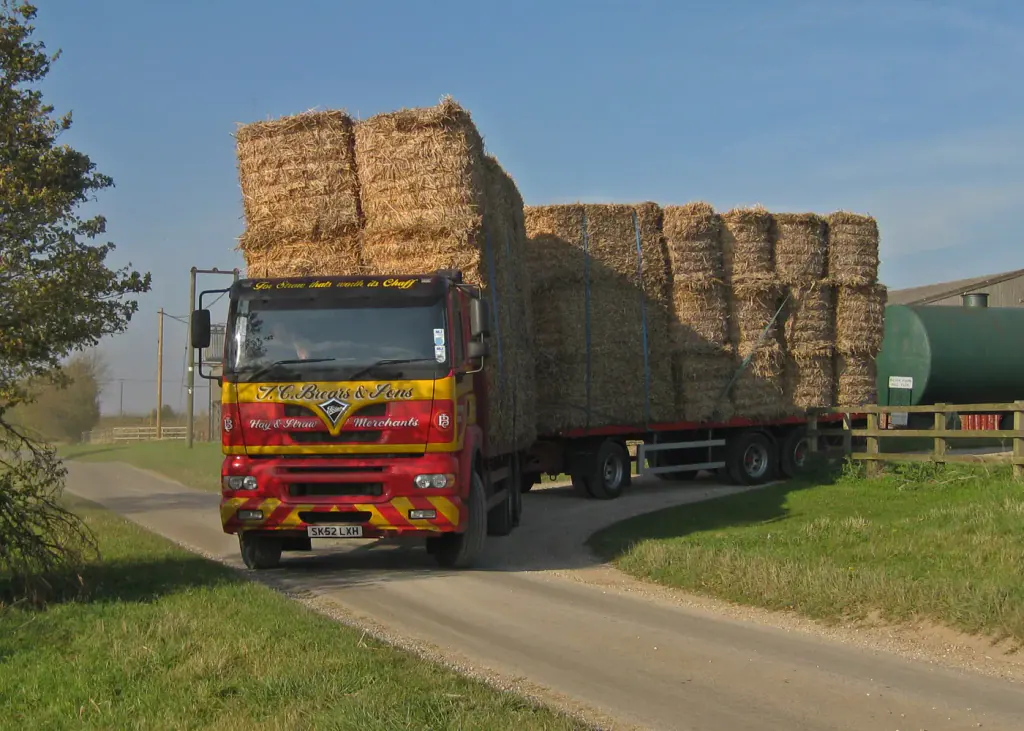
In our own trade a tonne of bales fetches €110-115 at the field edge, as baled, with the buyer collecting. In Germany chopped miscanthus sells for about €120 a tonne at the farm gate. In France the price is €110-160 a tonne of dry matter, mostly for animal bedding; in 2023 the operator of the village boiler in Alsace paid its growers about €110 a tonne, delivered. In Britain bales sell for £55-75 a tonne.
Planting area and timing
A farm with a dryer
Allow three hectares for each 1,000 tonnes of maize dried. A field planted in spring 2027 gives its first bales for the 2029 drying season and a full crop from 2030. The furnace and the calculations are described on the drying page.
An estate or a village
Plant a third of a hectare for each house and choose a boiler built for straw. For the two winters before the first harvest, the boiler can burn bought chips. The boiler prices and examples of boilers in operation in Alsace, Cornwall, Bavaria and Austria are on the heating page.
A factory
Put 1,000 hectares or more under contract and plant them in phases. The calculations and the supply chain are described in the sugar chapter of the drying page.
Miscanthus as fuel: the other two parts of the series
The page describes farms that have switched from gas, the furnace and the fuel feed, and gives the full-cost comparison for a dryer and the calculations for a sugar factory.
Read it Houses, farms and villagesHeating a house, a farm or a village with miscanthusThe page compares annual costs with gas, oil and pellets and describes the boiler required, examples of users, the rules by country and the cases in which it is better to keep the gas boiler.
Read itFrequently asked questions
Bales suit farm boilers and dryers. Stacked under a roof, they dry to 12-15% moisture. Chips suit boilers with a screw feed and take up five to seven times the volume of pellets. Pellets can be burned only in a boiler designed for agricultural pellets, such as Guntamatic's Powercorn, and not in a pellet stove. It is difficult to make durable pellets from miscanthus alone. At 2025 prices miscanthus pellets cost about as much per tonne as wood pellets and give less heat per tonne. Briquettes are pressed from the stems, and in a log boiler they form clinker, lumps of fused ash; one German user reported that half of his fuel came out of the boiler as slag.
Bales from our fields need no drying, provided the crop is cut late and after a dry spell. Baled in January and February, they have a moisture content of 13-16%, which falls to 12-15% in the stack. After an early or wet harvest the moisture content is 25% or more, and the bales need a season under cover.
Heat from bales bought at €110-115 a tonne costs about €34 a megawatt-hour, or 3.4 cents a kilowatt-hour, and €38 if the bales are delivered. Heat from bales grown on your own field costs €21-24 a megawatt-hour for the fuel alone, and €30-40 including the boiler's electricity and labour, for which we use figures from a German straw-fired plant. In 2025 a megawatt-hour of heat cost €15 from coal before the carbon price and €49 with it, €25 from Ukrainian household gas, €52 from Ukrainian business gas and €55-76 from EU business gas. It cost €81 from wood pellets, €96 from a heat pump on EU household electricity, €106 from heating oil and €143 from EU household gas.
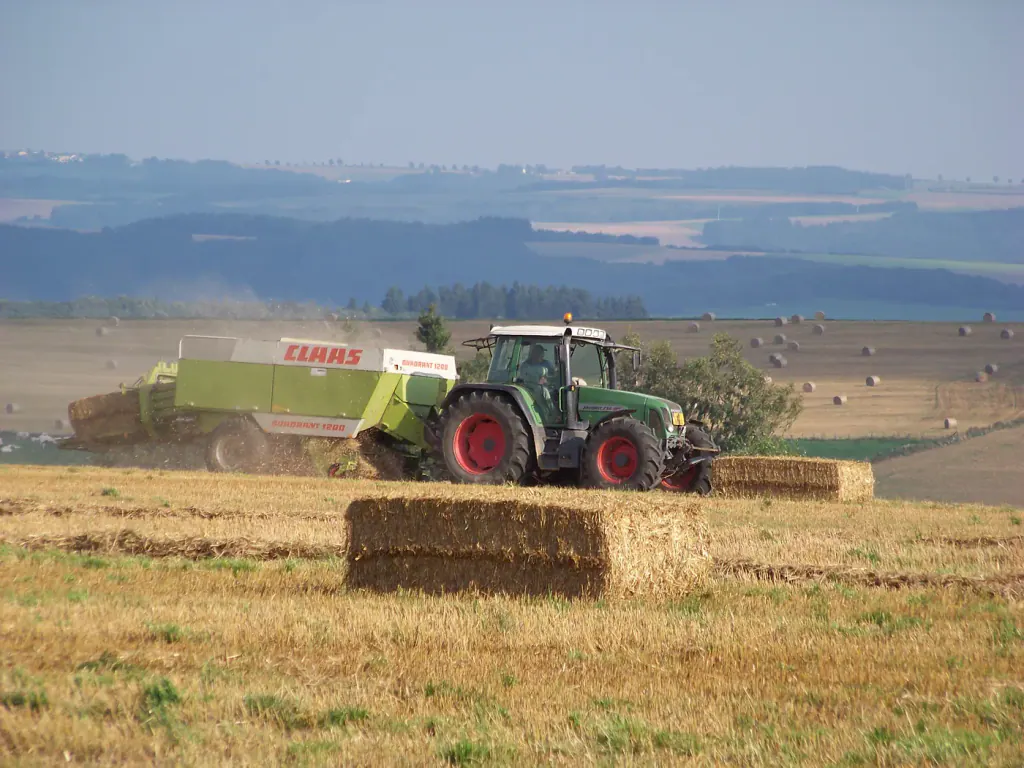
The crop is harvested between January and April, either cut with a mower-conditioner and baled or chopped with a forage harvester for chips. On our fields the harvest is in January and February. If the work is well organised, the harvest costs about €30 a tonne of bales. The ground must be firm enough to carry the machines in late winter.
In our own trade in 2026, a tonne of bales fetches €110-115 at the field edge, as baled, with the buyer collecting. Once stacked, the bales have a moisture content of 12-15%. In Germany chopped miscanthus sells for about €120 a tonne at the farm gate, in France for €110-160 a tonne of dry matter, mostly as animal bedding, and in Britain for £55-75. Ukrainian export listings at €40-55 are below the cost of growing a tonne, and we have found no record of a Ukrainian fuel buyer paying our price. The market is local and has few buyers. If there is no buyer, the bales can be burned in your own dryer or boiler, where a tonne replaces €173 worth of Ukrainian business gas or €255 worth of EU farm-scale gas at 2025 prices.
The Bavarian technology centre TFZ measured the net calorific value of Miscanthus × giganteus at 17.7 MJ per kilogram of dry matter, which is 4.9 kWh. At 15% moisture a bale delivers 14.6-14.7 MJ/kg, or 4.08 kWh per kilogram, so a tonne holds about 4 MWh and a 500 kg bale about 2 MWh. On a dry basis, wheat straw has 17.2 MJ/kg and spruce 18.8 MJ/kg.
A Ukrainian life-cycle study of a 500 kW chip boiler counted all the fossil energy used: the diesel, the fertiliser, the boiler's electricity and the manufacture of the boiler. Each unit of fossil energy yields 15.5 units of heat when the crop is grown beside the boiler, 10.4 when the chips are hauled 100 km and 5.3 at 400 km. On the same basis the ratio is 13 for forest wood chips, 3.3 for wood pellets dried with fossil fuel and 0.7 for a gas or oil boiler. If only the field, the harvest and storage are counted, the chips contain 37 times the fossil energy spent on them; a British review gives a ratio of 47 for the crop itself.
The EU's reference figure for heat from gas is 288 g of CO₂ per kilowatt-hour. A 2018 Ukrainian life-cycle study puts heat from miscanthus chips at 22 g at the field edge, 27 g with a 100 km haul and 43 g at 400 km. These are reductions of 92%, 91% and 85%, calculated with one fertiliser dressing at planting, four herbicide passes in 20 years and no credit for soil carbon. RED III applies to plants with a thermal input of 7.5 MW or more, and no EU rule requires a smaller plant to show a saving. A new plant must show a saving of 80%, and the study's supply chain still meets that requirement with a 600 km haul. The EU has no default value for miscanthus, so the operator of each plant calculates its own; a stand fertilised every year, or chips hauled across Europe, would show a smaller saving. In the EU emissions trading system (ETS), emissions from biomass are counted as zero. This is an accounting convention; the emissions calculated in the study are those given above.
About this article
We wrote this article ourselves. We grow miscanthus and sell planting stock, and we used the sources listed below and our own figures.
The information was current when the article was published. Prices and rules change, and errors are possible, so please check the figures before you rely on them.
If you find an error or have more accurate figures, write to us at info@miscanthus.eu or use the form below.

Sources
- TFZ Straubing, K. Reisinger. Thermische Verwertung von Miscanthus im Vergleich zu Holz (2009), Landtechnikbericht 154: net calorific value 17.7 MJ/kg DM; ash 3.9% (2.3-5.6); ash softening 973 °C; Cl 0.22%, K 0.72%; HCl and dust measurements; "no miscanthus in conventional chip or pellet boilers".
- TFZ, Anbauhinweise Chinaschilf (2007): harvest moisture ≤15% at a late harvest; site requirements.
- FNR, Basisdaten Bioenergie (2022): net calorific value 14.6 MJ/kg at 15% moisture; bulk densities.
- ISO 17225-1 (moisture correction), 17225-2 (wood pellets), 17225-6 and 17225-7 (non-woody pellets and briquettes); ENplus chlorine limits.
- Jensen, E. et al. (2017). Spring stem moisture, ash and chlorine across sixteen miscanthus genotypes. PMC5412913.
- Biosystems Engineering (2009), miscanthus bale study: January bales 45-50% moisture with 12-15% dry-matter loss; March 25-30%.
- Sood, K. et al. (2014). Nine-month storage of miscanthus bales, covered 0.77% vs uncovered 9.24% dry-matter loss. ASABE.
- Phyllis2 database (TNO), miscanthus samples #948, #3168, #3171, #2831 (ash deformation 835-890 °C); DBFZ (2008) chlorine range 0.04-0.37%.
- Frontiers in Energy Research (2025). Ash deposition in small biomass devices: chloride and potassium in miscanthus pellets vs softwood.
- LandTreff forum threads (2011, 2022, 2025); holzheizer-forum (2017), briquette slag case; Chambre d'agriculture Nouvelle-Aquitaine, recommandation miscanthus biocombustible (2026); CIBE note (2011).
- Guntamatic (Powercorn, Powerchip), Hargassner (Eco-HK), Ökotherm (Compact), ETA (Hack), Linka Energy, Reka: maker documentation, 2026.
- Eurostat, nrg_pc_202 (household gas), nrg_pc_203 (non-household gas, bands I3 and I5), nrg_pc_204 (electricity), data to 2025-S2, updated 24 September 2026.
- World Bank, Commodity Price Data, monthly to August 2026: TTF, Brent, coal; ECB reference rates; NBU official rates.
- Destatis, Statistischer Bericht Energiepreisentwicklung, table 61241-11 (heating oil, net of VAT; we added 19% VAT); DEPI/DEPV pellet price index (6 t, with VAT), 2020-2026.
- IEA, Coal 2025 and coal market updates (ARA prices); EUA prices, ICE, 2026.
- Naftogaz (household tariff 7.96 UAH/m³, valid to 30 April 2027); NERC; minfin.com.ua tariff archive; Ministry of Economy of Ukraine, monthly actual gas sale price, March 2022 to August 2026; Naftogaz Trading tariffs.
- IEA Oil Market Report (March 2026); World Bank, the Hormuz disruption (2026); CNBC, 22 and 28 September 2026 (US diesel export discussion).
- LWK Niedersachsen straw cost calculator via LAND & FORST (June 2025): haulage €6.50/t plus €0.155 per tonne-kilometre.
- OMAFRA, Reducing energy use in grain dryers (2024/2026); Antargaz Pro, séchage (2026); Deutsches Maiskomitee, MAIS 3/2005 (Hugger); Gas Institute NASU / K. Kostohryz, Agrobusiness-Ukraine 4/2020.
- Elevatorist, 27.01.2022 (293 dryers burned in 2020), 08.02.2022, 22.04.2022, 30.09.2022, 31.10.2022, 10.07.2023, 12.02.2024, 18.03.2024; Latifundist, 06.10.2022, 14.07.2023, 26.09.2023, 23.07.2025; Kurkul, 22.02.2023; SuperAgronom, 17.02.2024; agrarheute, 06.09.2022; topagrar.pl, 24.09.2026.
- Farmers Weekly, 19 March 2018 (Woodend Farm; Aberdeen Grain).
- GRECO, Kriger (TGm-6.0 list price, 2026), Novyi Elevator, BioFire (TPZ8 list price, 2026), Mecmar, LASCO, AMT, Agriconsult, Linka: maker documentation.
- Banque des Territoires (2 May 2023) and France Miscanthus (Bernwiller/Ammertzwiller); Biomass Connect case study (Burlerrow Farm); Hargassner reference brochure (Lechermann, Schützenhofer, Hebenstreit); LWK NRW, Haus Düsse (25 January 2007), Farwick straw plant: electricity and labour.
- Heizspiegel 2025/2026 (co2online): 127 kWh/m²/yr for a single-family house on gas; Kesselheld, heizung.de, Bosch (boiler prices, 2025); Agraventa (miscanthus pellet price).
- 1. BImSchV §3(1) no. 8, §5(3), §15; KÜO; BEG funding (FNR/BAFA); Ecodesign Regulation (EU) 2015/1189; Polish anti-smog resolutions; Austrian FAV 2019.
- Jensen, A. S. & Morin, B. (2015). Energy and the environment in beet sugar production. ESST; CEFS, Climate Neutrality Toolbox (2023); Astarta via agravery.com (17 February 2017); Ukrtsukor via Interfax-Ukraine (17 November 2023) and 2025/26 campaign data; Latifundist on plant fuels (2023).
- Tryboi, O. V. (2018). Efficient biomass value chains for heat production from energy crops in Ukraine (a 500 kW chip boiler, 33 ha, twenty years). Energetika 64(2), 84-92, Tables 5-7; comparator 80 g CO₂eq/MJ from SWD(2014) 259 and RED II Annex VI; Nussbaumer & Oser (2004), IEA Bioenergy Task 32 (reference wood chips 13, pellets 3.3, gas and oil boilers 0.7); McCalmont et al. (2017), GCB Bioenergy (crop energy ratio 47); JRC (2017), no default value for miscanthus.
- Bale prices: agrarheute (7 April 2026, Germany ex-farm); Novabiom and the Bernwiller contract (France); Farmers Weekly (2020) and Biosorb (2024) (Britain); Artmash export listings (Ukraine, 2026); our own field-edge price.
- Bioenergy Insight (26 September 2023), Pfeifer & Langen Könnern; Acor biomass plant announcement; Luzeal (reported, unverified); Elean/Ely and Sleaford straw plants; Novabiom contract terms; Navigant/BMWi (2020), dairy 7-10 GJ/t; UABIO, municipal biomass boilers.
- MCPD (EU) 2015/2193; IED 2010/75/EU; EU ETS Directive and ETS2; RED III, Directive (EU) 2023/2413, Art. 3 and Art. 29.
- Zelena Biomasna Energija, Miscanthus × giganteus CAPEX and OPEX structure: 1-hectare reference model, Croatia, September 2026 (planning-level; excludes financing, storage, transport, processing and plantation removal); run here with planting stock at list price.
- Hectare economics: miscanthus.eu/buy (planting-stock prices); our harvest cost, yields and price; LfL Bayern Deckungsbeiträge 2023-25; LfULG Sachsen (2014); Chambre d'agriculture de l'Oise (2025); Hastings, A. et al. (2017); Destatis land rents (2023); Poltava and Potash trial series behind the yield ladder.
- Photography: the photographs of our own fields are ours, from February 2026 and earlier winters; the others are credited in their captions.