



Grain drying with miscanthus: the cost of drying a tonne of maize
Drying a tonne of maize from 28% to 14% moisture takes about 210 kWh of heat. This heat can be supplied by 24 m³ of gas, at the calorific value used in Ukraine, or by 65 kg of miscanthus bales burned in a furnace. Grain elevators charge for drying by the tonne-percent. This article gives the cost of a tonne-percent in hryvnia for gas, chips, husk, willow and bales, and the cost of heat for a sugar factory.
Part one: the reference page · Part three: houses, farms and villages · If you have no field of your own, start here
Main findings for grain dryers and sugar factories
-
As a fuel for a grain dryer, a farm's own bales cost less than gas, and about the same once the furnace is counted.
If a farm's own bales are counted at their growing cost, the full cost of growing a tonne, the fuel for one tonne-percent of drying costs 16 hryvnia. With Ukrainian business gas the same tonne-percent cost 36-38 hryvnia in 2025 and 2026. When the furnace, its electricity and the hours spent tending it are counted, a farm that uses the furnace only for drying pays about the same for its heat as it would for gas. In 2024, when gas was cheaper, heat from bales cost €11 a megawatt-hour (MWh, 1,000 kWh) more. If the furnace also heats buildings in winter, heat from bales costs less than heat from gas at 2025 and 2026 prices. -
Ukrainian farms already burn chips, straw and willow in grain dryers, but none has published results from drying grain with miscanthus.
The fuels are orchard chips, chaff, straw and energy willow, burned in solid-fuel heat generators, as dryer furnaces are called in the Ukrainian trade. The farms that published a cost per tonne-percent paid 9-18 hryvnia in 2023 and 2024. We have not yet used our own bales to dry grain for a whole season either. -
In furnaces above one megawatt, bales have to be shredded and fed by machine.
A dryer that handles 10 tonnes of grain an hour needs 650 kg of bales an hour, continuously for three weeks. A batch furnace of less than one megawatt can be loaded with whole bales, one at a time. -
An average Ukrainian sugar factory would need bales from 1,400 hectares, and with a new boiler house its heat would cost more than gas.
It would burn 30,000 t of bales in a campaign, the 100-day slicing season. The bales would cost €3.3-3.9 million, against €5.4 million for gas at 2025 prices. A boiler house built to run only during the campaign adds about €50 a megawatt-hour to the cost of heat. The plants that would save money are those that already own a solid-fuel boiler, and we found none that burns miscanthus yet.
Counting the fuel alone, a tonne-percent costs about half as much with a farm's own bales as with Ukrainian business gas
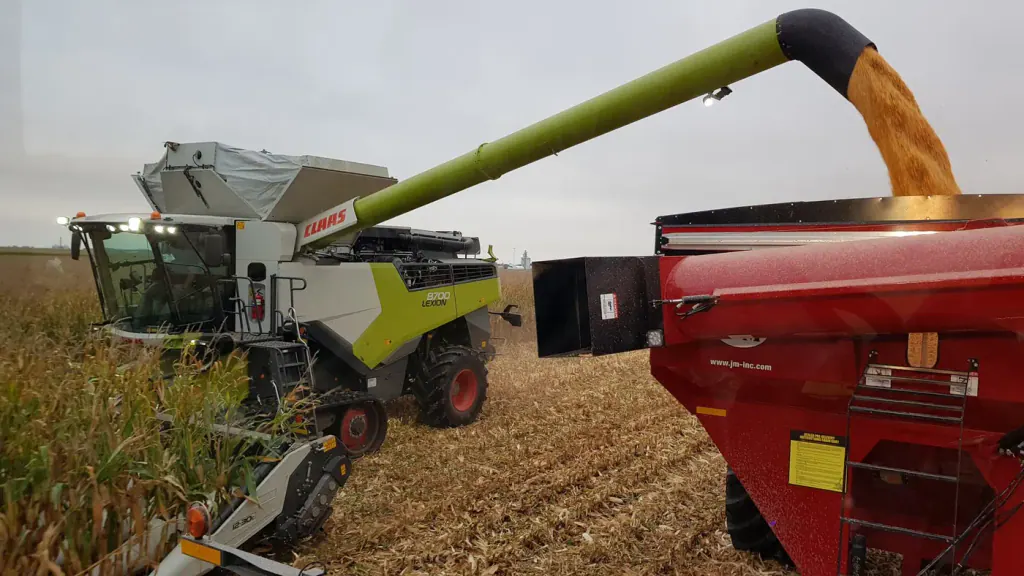
A tonne of maize harvested at 28% moisture and dried to 14% loses 163 kg of water. A modern tower dryer uses 0.9-1.4 kWh of heat for each kilogram of that water, and an old cross-flow dryer uses nearer 1.8 kWh. At 1.3 kWh per kilogram, drying the tonne takes about 210 kWh. A tonne-percent is the removal of one percentage point of moisture from one tonne of grain, so drying this tonne of maize takes 14 tonne-percent.
Hryvnia per tonne-percent, fuel only, own dryer
Bales bought at our field-edge price and collected by the buyer cost about as much per tonne-percent as gas did in 2024, and about 30% less than gas in 2025 and 2026. That is still more than the Ukrainian farms in chapter 03 pay for chips, husk and willow. Bales from your own field cost less. Until the stand has been paid for, they are counted at the full cost of growing them, and after that at the cost of the harvest alone. The farms in chapter 03 count their own willow and chips in the same way.
If you sold your bales at the field-edge price of €110-115 a tonne, your margin over the growing cost would be 10 hryvnia per tonne-percent, the difference between 26 and 16. If you burned them instead of gas at the 2025 and 2026 prices in the chart, the saving after the growing cost would be 20-22 hryvnia per tonne-percent, twice the margin from a sale. The cost of the furnace is not included here; it is counted in chapter 04.
Your dryer
- Gas, per tonne-percent
- 38 ₴
- Bought bales, per tonne-percent
- 30 ₴
- Own bales at €70/t growing cost, per tonne-percent
- 16 ₴
- Bales needed for the season
- 65 t
- Hectares at 18 t of dry matter
- 3.1
- Saving per season on own bales, after their growing cost
- 305,000 ₴
The calculation assumes 15 kWh of heat per tonne-percent, gas at 8.64 kWh/m³ direct-fired at 100% efficiency, bales burned in a furnace at 80% efficiency (4.6 kg per tonne-percent) and 51 hryvnia to the euro. The default gas price is the 2026 business price, and the default haulage cost is for about 50 km at straw haulage rates. The cost of the furnace and of labour is not included.
Read the detailBasis of calculation
- 1,000 tof wet maize, 28% → 14%
- 163 tof water to evaporate
- 212 MWhof heat at 1.3 kWh per kg
- 22,300 m³of gas at the EU value of 9.5 kWh a cubic metre, or 24,500 m³ at the Ukrainian value of 8.64 kWhor65 tof bales burned in a furnace at 80% efficiency
- 3.1 haat 18 t of dry matter a hectare, a normal yield on our fields · 2.5 on the best land · 4.1 on ordinary European land
Heat
One tonne-percent means evaporating 11.6 kg of water, which takes about 15 kWh of heat. A tonne of bales at 15% moisture contains 4,080 kWh. In Ukraine a cubic metre of gas is counted as 8.64 kWh, so a tonne-percent takes 1.7 m³ of gas or 4.6 kg of bales.
Furnace
In a gas-fired dryer the combustion gases are blown straight through the grain. Dryer makers call this direct firing, and all of the heat is used. Bales are burned in a furnace, and a heat exchanger, a steel wall between the flue gas and the drying air, transfers 80% of their heat to the air.
Cost
"Growing cost" is the full cost of growing a tonne of bales over a 20-year stand in our planning model, a budget for one hectare. It is €70 a tonne excluding land, €81 with Ukrainian rent and €124 on private land rented at €1,000 a hectare. Hryvnia (₴) are converted at 51 to the euro.
Field
A normal field yields 18 t of dry matter a hectare, which is 21 t of bales; dry matter is the weight of the crop without its water. One hectare of a normal field gives enough bales to dry about 330 tonnes of wet maize. The full set of assumptions is in the basis of calculation on the reference page.
Ukrainian farms burn chips, straw and willow in their grain dryers, but none has yet reported using miscanthus
The Ukrainian trade press has described three farms and one grain elevator that dry grain with fuels other than gas. The willow, husk and chip figures in the chapter 02 chart come from two of them, Agrotechnika and Shyrokostup. Mriya and the Khorostkiv elevator have reported results for whole seasons.
Farms, fuels and drying costs
- Sumy oblast (region) · 5,000 ha · 2024
TOV Mriya
12.5 → 2.5 million ₴The farm's drying cost for a season was 12.5 million hryvnia on propane and gas and 2.5 million on chips from its own orchard clearances. The first two chip generators it tried jammed; the third worked.
- Kyiv oblast · 7,000 t of maize · 2023
FG Shyrokostup
16-20 ₴The farm paid 16-20 hryvnia per tonne-percent for bought chips and about 10 when it chipped its own wood. An elevator charges 150-200 hryvnia per tonne-percent. The cost of the generator was recovered in one season.
- Volyn oblast · GRECO generators · 2024
Agrotechnika
≤ 9 ₴ a tonne-percentThe farm burns 3 kg of energy willow from its own plantation per tonne-percent.
- Ternopil oblast · 50,000 t elevator · 2022
Khorostkiv KHP
4 × 2.5 MWThe elevator has four 2.5 MW furnaces of its own design, with heat exchangers. Of the 70,000 t of grain it dried that year, three quarters were dried with chaff and straw and a quarter with gas.
- No farm on record · miscanthus · 2026
A dryer on miscanthus
none yetWe have not yet dried grain with miscanthus for a whole season ourselves. After establishment, a single planting yields about 20 tonnes of bales a hectare every winter.
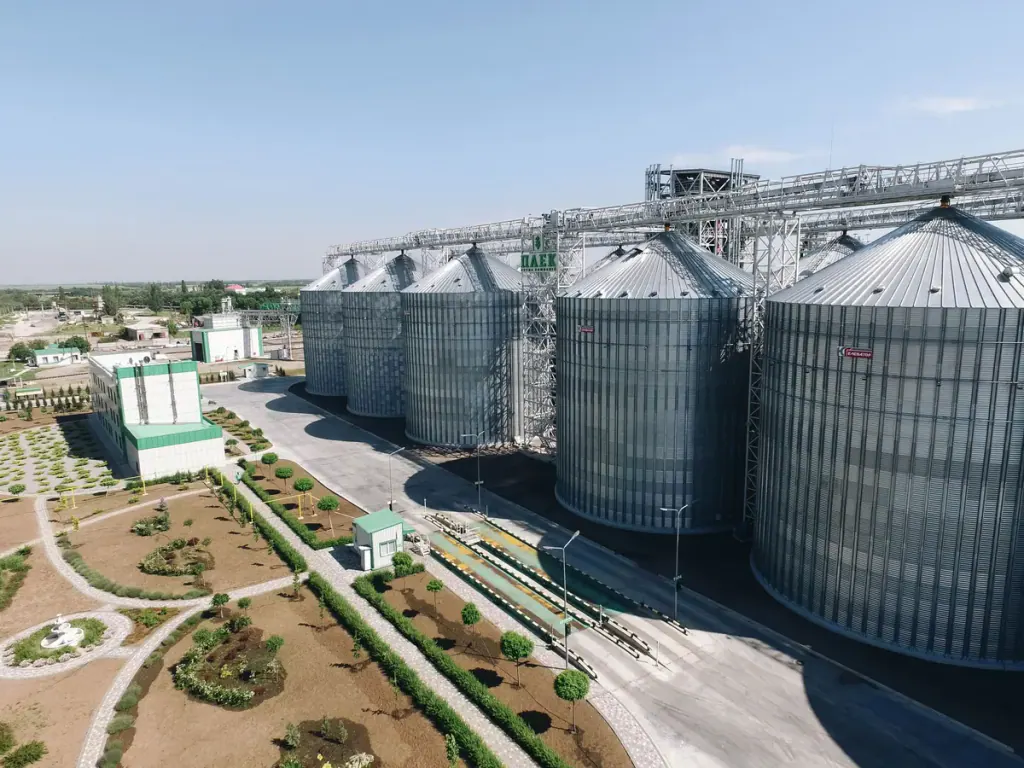
Willow
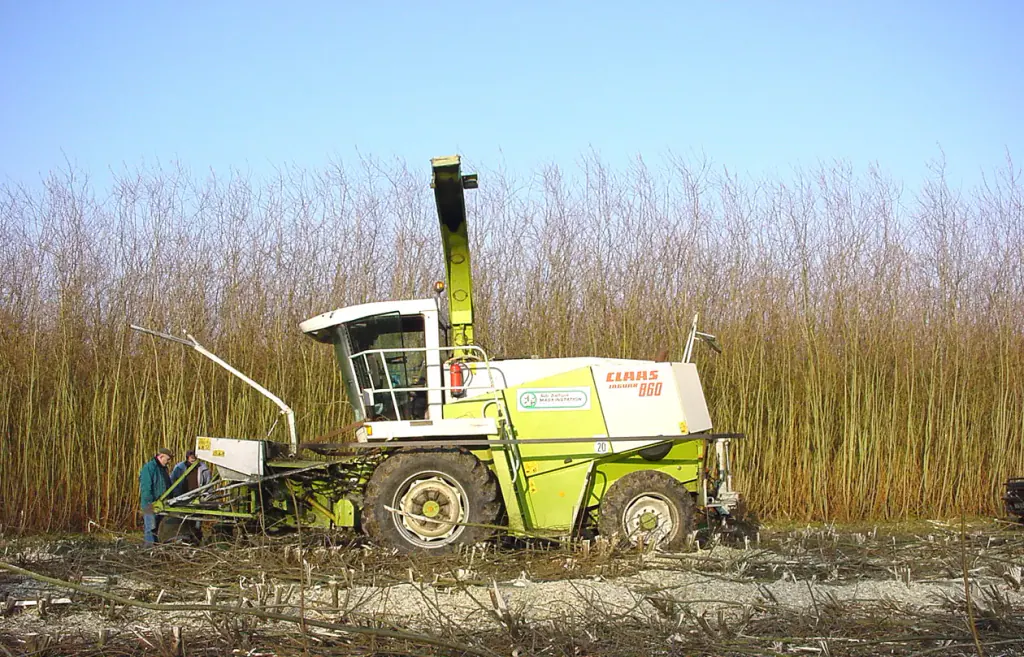
Agrotechnika is the closest published example of a farm that grows its own fuel for a dryer. Willow, however, is a woody crop that is cut every three years.
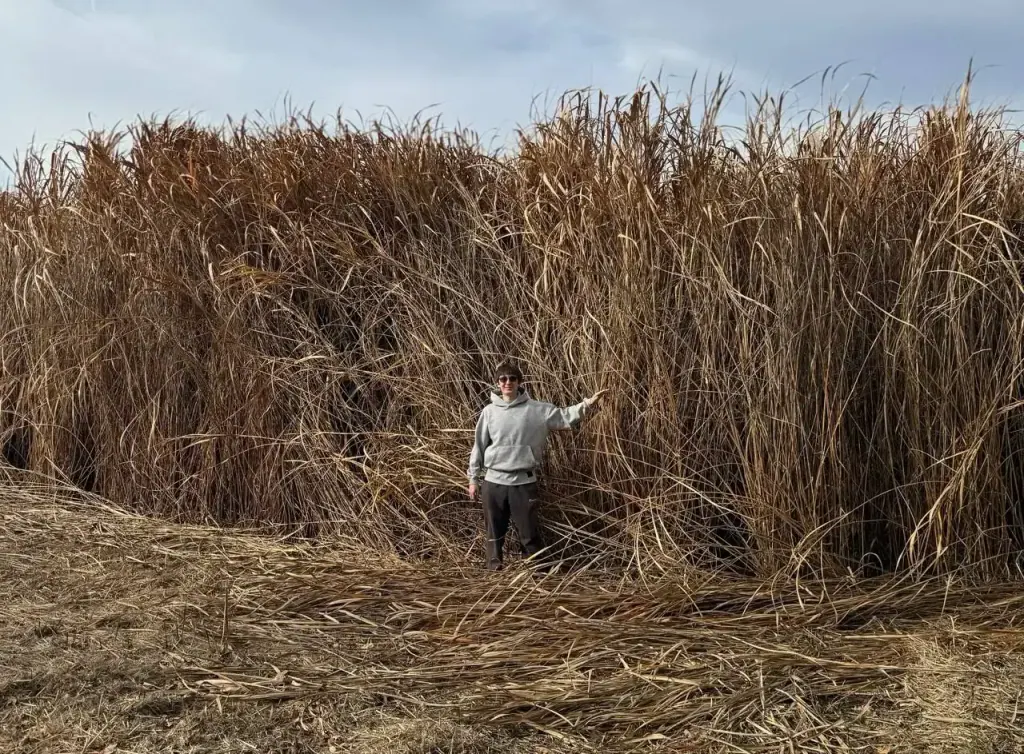
Straw and chaff
The Khorostkiv grain elevator dries grain with straw and chaff in solid-fuel furnaces. Like miscanthus, straw and chaff are fuels from grass crops.
Read the detailWhat to decide before buying a furnace
The points to settle are how the furnace will be fed, whether its warranty covers miscanthus, where the bales will be stored and whether the flue gas may come into contact with the grain.
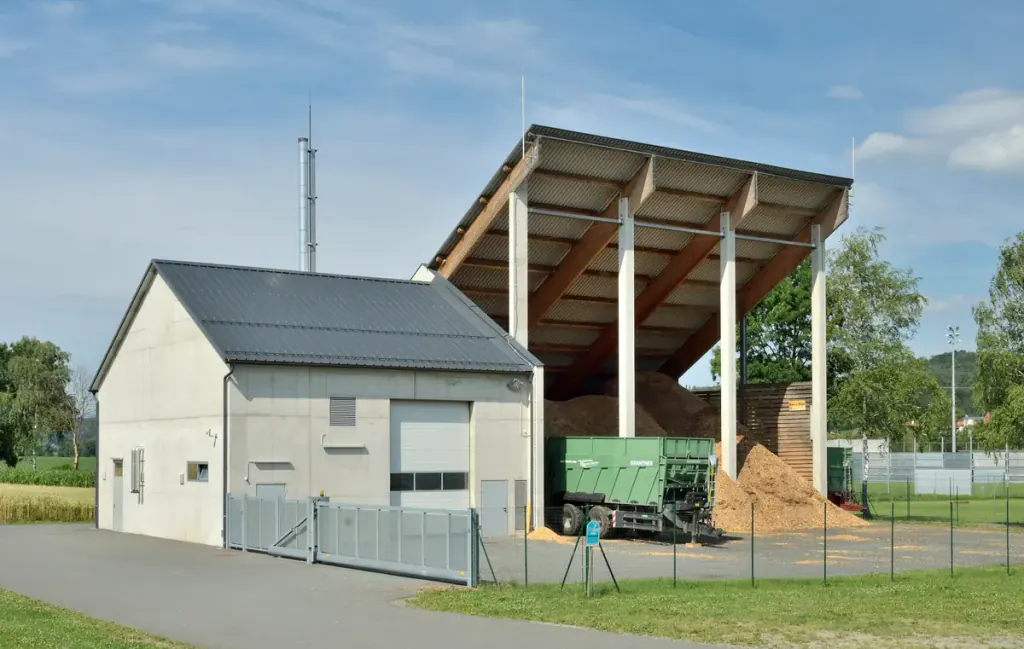
Before it installed a chip generator, FG Shyrokostup ran two hand-fed heat generators on straw bales, 2 MW in total. Each bale had to burn out before the next was loaded, so the temperature fell and rose again with every charge. Output was limited by how fast fuel could be fed into the fire. A dryer that handles 10 tonnes of grain an hour needs 2.6 MW of fuel, which is 650 kg of bales an hour, continuously for three weeks. At that rate the bales have to be shredded or chipped and fed by machine.
The figures are from FG Shyrokostup, where a new dryer was installed together with the chip-fed furnace.
Below a megawatt, a batch furnace of the Ukrainian type, which burns one whole bale at a time, is a practical choice; BioFire's 800 kW unit has a list price of about €13,500. Bale lines from the Danish straw-boiler maker Linka, which shred the bales and feed them by machine, start at a few hundred kilowatts. A 6 MW generator from the Ukrainian maker Kriger has a list price of about €320,000.
We found no published cost of a bale line for a 10-tonne-an-hour farm dryer in Ukraine. Miscanthus ash softens at about 970 °C, some 450 degrees below the softening point of spruce ash, and can fuse into hard lumps in a generator built for wood chips. Ask Kriger, GRECO and Novyi Elevator whether their warranty covers miscanthus. The ash and chlorine figures are in the reference page's fuel chapter. A dryer built for gas also loses up to 30% of its throughput when it runs on any solid fuel.
Storage
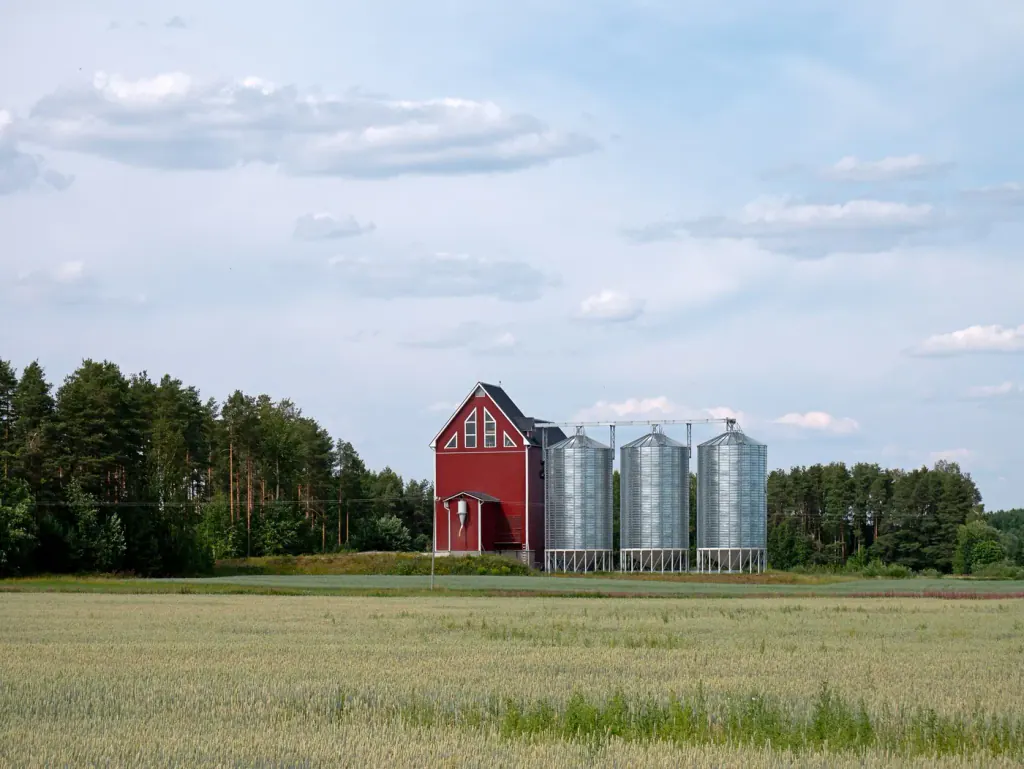
Miscanthus is baled in late winter and burned in October, so a season's fuel is kept for six to eight months in a roofed store with open ends, on pallets or gravel. The bales from 20 hectares, about 420 tonnes at 150 kg a cubic metre in the stack, need a building of about 2,800 m³.
Firing method
All the western makers we looked at (Mecmar, LASCO, AMT, Agriconsult and Linka) heat the drying air through a heat exchanger and send the flue gas up the chimney. GRECO and Kriger, the most common units in Ukraine, blow the flue gas through the grain, and we found no complaint about this in the Ukrainian trade press.
Flue gas
The Bavarian technology centre TFZ measured about 100 mg/m³ of hydrogen chloride in untreated miscanthus flue gas, more than in flue gas from wood. A farm whose grain goes to a European feed or food buyer should ask that buyer before choosing a direct-fired furnace.
With the furnace counted, heat from a farm's own bales costs about the same as Ukrainian business gas in 2025 and 2026, and less than gas at EU farm prices
In chapter 02 only the fuel is compared, and the furnace that burns it is left out. For gas nothing needs to be added, because the burner is already part of the dryer and needs no attendant.
| Bales burned in a furnace at 80% efficiency for 1,000 t of maize (212 MWh), at a growing cost from €70 a tonne excluding land to €124 on expensive rented land | €21-38 |
|---|---|
| A batch furnace with a heat exchanger, about €25,000, paid off over 15 years (our assumption) | ≈ €12 |
| Electricity and attendance | ≈ €10 |
| Heat, all-in | €43-60 |
| Business gas, Ukraine 2024 / 2025 / 2026, direct-fired through the grain | €36 / 48 / 50 |
|---|---|
| Business gas, EU farm-scale 2025, direct-fired through the grain | €70 |
| The gas burner already fitted to the dryer | €0 |
| Heat, all-in | €36-70 |
With Ukrainian land rent included and the furnace used only for the dryer, heat from bales costs about €47 a megawatt-hour in total. This is about the same as heat from Ukrainian business gas in 2025 and 2026, €11 more than heat from the same gas in 2024, and €23 less than heat from gas at EU farm prices in 2025. In a year like 2022, when heat from direct-fired Ukrainian gas cost €117 a megawatt-hour, heat from bales would have cost less than half as much.
What is counted
Because bales have to be grown, cut, stacked under a roof and fed into a furnace with a heat exchanger, the comparison counts the full cost of each fuel, in euros per megawatt-hour of heat. The bales are counted at their growing cost for the three kinds of land given under "Basis of calculation" in chapter 02. The furnace is counted as a yearly instalment over 15 years at 6% interest; at a Ukrainian interest rate of 12% the instalment would be €17 a megawatt-hour instead of €12. The cost of electricity and of attendance, the hours spent tending the furnace, is added to this. The cost of a barn, if you do not have one, is not included.
Read the detailA larger dryer
A dryer that handles 10 tonnes an hour is too large for a batch furnace. If the 6 MW Kriger generator priced in chapter 03 is used only for that dryer's 20-day drying campaign of about 1,100 MWh, it adds about €30 to the cost of each megawatt-hour, instead of €12 for a batch furnace.
If the generator also heats sheds and houses through the winter, as on the Austrian and British farms described on the heating page, and produces 4,000 MWh a year in total, it adds about €8. With €30 for the generator, heat from bales costs more than heat from Ukrainian gas in all three years in the table. With €8, it costs less than gas in 2025 and 2026.
At 2025 gas prices, a sugar factory saves money with bales only if it already owns a solid-fuel boiler
We searched in five languages and found no beet sugar factory in Europe or Ukraine that burns miscanthus, so the calculations below are our own. The saving on fuel would be a few million euros a year, and a new boiler house costs tens of millions.
A beet sugar factory uses about 250 kWh of fuel for every tonne of beet it slices. A good modern plant needs nearer 170 kWh; the Ukrainian average is about 285 kWh, which is 33 m³ of gas a tonne at the calorific value used in Ukraine. The lime kiln burns coke at over 1,100 °C, takes about 5% of that energy and would continue to run on coke. The rest of the energy goes into process steam and heat for the pulp dryers, which some plants already produce from solid fuel.
The break-even price is the price paid for a megawatt-hour of gas, multiplied by 3.64, the number of megawatt-hours of gas that a tonne of bales replaces.
Read the detailFuel costs, boilers, buyers and pulp
The average Ukrainian plant slices 400,000 t of beet a campaign. At the Ukrainian average fuel use, with the kiln still running on coke, it would need about 30,000 t of bales from 1,400 hectares at a normal yield.
At 2025 Ukrainian business prices, the plant's fuel for a campaign costs about €5.4 million, with the kiln's share included and all of it priced as gas. The cost was about €4.1 million in 2024 and €13.4 million in 2022. The bales would cost €3.3-3.9 million, at prices from €110-115 a tonne at the field edge to €125-130 delivered. The plant would also have to finance a season's stock from February to October.
An EU plant that slices a million tonnes of beet paid about €12.6 million for gas in 2025 and €4.3 million for the carbon allowances it must buy for that gas. It would have paid €7-8.5 million for about 65,000 t of bales, which carry no carbon price. The cost of a boiler house is given at the end of this chapter.
We found no published cost for fitting a bale line to an existing boiler. Pfeifer & Langen, a German sugar producer, converted both coal boilers at Könnern in Saxony-Anhalt to solid biomass between 2021 and 2023. Each boiler produces 80 tonnes of steam an hour, and the company has not disclosed the cost of the conversion. The Spanish sugar cooperative Acor is spending €70 million on a plant that burns 90,000 t of biomass a year and also sells electricity.
A coal boiler with a chain grate, the moving steel belt on which the fuel burns, can burn chopped bales or pellets together with coal, with the mix set as a share of the energy input. Miscanthus leaves less ash than coal per megawatt-hour, but its ash fuses on a hot grate, and the boiler loses part of its rated output.
The chlorine in the fuel corrodes the superheater, the tubes where the steam is hottest. The straw-fired power stations in Britain and Denmark were designed to deal with this.
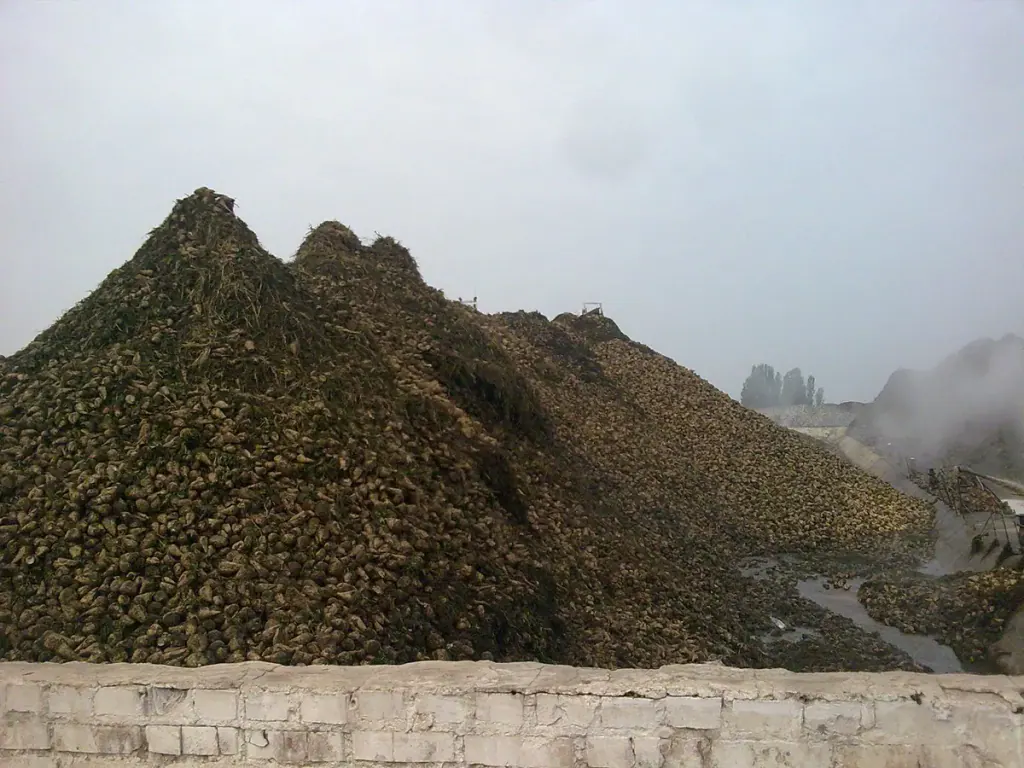
A plant that already owns a solid-fuel boiler or a solid-fuel dryer can switch to bales without building a boiler house. Ukrtsukor, the sugar producers' association, says that 30-40% of Ukrainian plants already run at least partly on fuels other than gas: coal, pellets, peat or fuel oil. Luzeal, a French plant that dries beet pulp and alfalfa, is reported to burn miscanthus from about 420 contracted hectares alongside coal in its dryers. Ukrainian plants already make some of their own fuel: seven of the 27 have biogas or biomethane projects, and the sugar group Astarta's plant at Hlobyne produces 150,000 m³ of biogas a day from pulp.
The number of sugar factories is falling: in the EU it went from 105 to 88 between 2012 and 2023, as the sugar quotas came to an end. In Ukraine 33 plants operated in 2021 and 23 in 2022, when business gas cost €117 a megawatt-hour and 10 plants stood idle because of it. In 2025, 27 plants operated. For a plant that kept operating through 2022, burning bales would reduce its exposure to the next sharp rise in gas prices. It would also mean building a supply chain. The straw-fired power stations in England buy their straw within a radius of 50-80 km on multi-year contracts, and the station at Ely is reported to burn miscanthus alongside straw. In France the miscanthus company Novabiom offers five-year contracts at about €80 a tonne for a first plantation. In Ukraine the statutory minimum term of a land lease is seven years, while a miscanthus stand lasts 20 years.
Process heat is the heat a factory uses to make its product, and the sugar factory is the largest example on this page. For other industries the calculation follows the same steps with smaller numbers.
The figure applies to a dairy that makes milk powder.
The boiler is therefore in use every month, which is not the case with a grain dryer.
Bioenergy already replaces this much gas in Ukraine, according to the Bioenergy Association of Ukraine.
Pulp
The pulp is sold as animal feed. If the pulp dryer blows its flue gas through the pulp, the plant should ask the feed buyer about it, in the same way as a farm asks its grain buyer about direct firing.
Other years
Against EU factory-scale gas, the break-even bale price was €72 a tonne at 2020 prices and €404 in late 2022. With the EU carbon price added, it was €245 at 2025 prices. Against Ukrainian gas it was €132 in 2024 and €173 in 2025.
The chain below gives the same calculation for a larger plant, one that slices 5,000 t of beet a day.
- 500,000 tof beet, 5,000 a day for 100 days
- 125 GWhof fuel at 250 kWh a tonne, 125,000 megawatt-hours
- 13 million m³of gas at the EU value of 9.5 kWh a cubic metre, kiln includedor32,700 tof bales, without the kiln's 5%
- 1,260-2,050 ha1,540 on a normal field at 21 t of bales a hectare; 1,260 on the best land, 2,050 on ordinary land
- 650 a daybig square bales of 500 kg on 20-30 trucks · 650-1,300 t of ash a campaign, at 2-4% of the fuel
Boiler efficiency
A factory burns its gas in a boiler at 92% efficiency, so a megawatt-hour of heat costs about 9% more than a megawatt-hour of the gas burned to produce it. For this reason heat from Ukrainian gas costs more here than in the dryer tables of chapter 04, where the gas is direct-fired through the grain.
A new boiler house compared with a boiler the plant already owns
Both tables are in euros per megawatt-hour of heat.
| Contract bales delivered at €125-130 a tonne | ≈ €38 |
|---|---|
| A new boiler house used for a 100-day campaign: €70 million, the price of a year-round biomass plant, repaid over 25 years at 6% and spread over the campaign's 109 GWh of heat | ≈ €50 |
| Operation and ash handling (our assumption) | ≈ €8 |
| Heat, all-in, new boiler house | ≈ €96 |
| Heat, all-in, in a solid-fuel boiler the plant already owns | €46 + the conversion |
| Business gas, EU factory-scale 2025, through a boiler at 92% | €55 |
|---|---|
| EU carbon allowances at €85 a tonne of CO₂ | ≈ €18 |
| Business gas, Ukraine 2025 / 2022, through a boiler at 92% | €52 / €128 |
| Heat, all-in | €52-128 |
New boiler house
At this scale the boiler house costs more per megawatt-hour than the fuel. The €70 million is the price of Acor's plant in Spain, which runs all year and also sells electricity. If a boiler house at that price is used only for a 100-day campaign, heat from bales costs more than heat from gas in every recent year except 2022.
Existing boiler
In a solid-fuel boiler or dryer that the plant already owns, bales and ash handling come to €46 a megawatt-hour, plus the cost of conversion, for which we found no published figure. At 2025 prices, gas cost €73 in the EU with its carbon price and €52 in Ukraine. Work on the supply chain has to start three campaigns before the first bales are burned.
Air-emissions permits for dryer furnaces in Ukraine and the EU
The carbon rules apply only to large plants, such as a sugar factory.
Ukraine
In Ukraine a dryer furnace or a boiler counts as a stationary combustion source and needs an air-emissions permit from the regional (oblast) environment department. The class of the source, and therefore the paperwork, depends on what it emits, whatever the fuel. Solid biofuel is subject to VAT but not to excise duty, and heat from biomass may be sold at up to 90% of the gas heat tariff (Law 1959-VIII).
EU
In the EU a furnace of 1 MW or more falls under the Medium Combustion Plant Directive, and the boilers of a sugar plant fall under the Industrial Emissions Directive.
Carbon rules
Under the EU renewable energy directive, RED III, a plant with a thermal input of 7.5 MW or more that started operating after November 2023 has to show, by its own calculation, a greenhouse-gas saving of 80%. According to a Ukrainian life-cycle study, heat from miscanthus meets that requirement even when the fuel is hauled 400 km. The EU emissions trading system covers plants of 20 MW or more and counts emissions from biomass as zero if the biomass meets the renewable-energy criteria. For this reason the bales in chapter 05 carry no carbon price, while the gas does.
The study covers a 500 kW chip boiler and is described in chapter 06 of the reference page.
Against Ukrainian business gas at 2025 prices, the establishment cost of a hectare is recovered in year five, not counting the furnace
A hectare is planted once with 17,800 rhizomes, the pieces of underground stem from which the crop grows, set into ground prepared as for maize. The first bales are cut in the January after the second season and burned from the third autumn onwards. The stand is then cut every winter for 20 years.
In our planning model, with rent counted and the furnace left out, the establishment cost of a hectare whose bales replace Ukrainian business gas at 2025 prices is recovered in year five. At the 2024 price it is recovered in year seven. Against the frozen household tariff, the Ukrainian household gas price held at 7.96 hryvnia a cubic metre, it is not recovered within the 20 years of the stand. The furnace is counted in chapter 04. The full 20-year budget, the cash-flow chart and the market for bales are in chapter 07 of the reference page.
Do not plant for a dryer if
- the furnace would be used only during the six weeks of drying and gas is bought at Ukrainian business prices, because the cost of the furnace then cancels out the saving on fuel;
- there is no dry barn for a season's bales, of the size given in chapter 03;
- the dryer has to stop using gas before the third autumn.
If the furnace also heats buildings in winter or gas is bought at EU farm prices, and there is a barn, it is worth planting for the dryer. Choose the furnace before the rhizomes are planted.
Planting area and timing for a dryer or a factory
A farm with a dryer
Three hectares give enough bales to dry 1,000 tonnes of maize, and 15 hectares are enough for a dryer that handles 10 tonnes an hour over its 20-day campaign. A field planted in spring 2027 gives its first fuel for the 2029 campaign and a full crop from 2030.
A factory
A factory that already owns a solid-fuel boiler or dryer needs 1,000 hectares or more grown under contract nearby, planted in phases of 300-500 hectares.
Our capacity
We produce planting stock for about 1,000 hectares a year. This is enough to plant about 70% of the 1,400 hectares that an average Ukrainian plant needs in one season, and all of them in two seasons. Our stock is booked early, so planting for a factory has to be pre-ordered three campaigns in advance. A factory can start with a pilot planting of 300 hectares in one spring.
Miscanthus as fuel: the other two parts of the series
The page covers the fuel specification, the price of heat by fuel and country since 2020, the energy return and carbon emissions, the rules and the 20-year budget for a hectare.
Read it Houses, farms and villagesHeating a house, a farm or a village with miscanthusThe page compares the yearly cost of heating in euros with gas, oil and pellets, and covers the boiler required, farms and villages that already heat with miscanthus, the rules by country and the cases in which it is better to keep gas.
Read itFrequently asked questions
Yes, bales can be burned in a solid-fuel furnace to dry grain, as Ukrainian farms already do with chips, straw and willow. Drying a tonne of maize from 28% to 14% moisture takes about 210 kWh of heat, the amount supplied by 65 kg of bales burned in a furnace with a heat exchanger. At a growing cost of €70 a tonne, the fuel for each tonne of maize costs about €4.50, compared with about €10 for Ukrainian business gas at 2026 prices. When the furnace, its electricity and the hours spent tending it are included, drying costs about the same with either fuel.
We found no sugar factory in Europe or Ukraine that already burns miscanthus. An average Ukrainian plant slices 400,000 t of beet in a campaign, its 100-day processing season. To replace all the fuel it burns except the coke in the lime kiln, it would need about 30,000 t of bales from 1,400 hectares. The bales would cost €3.3-3.9 million at 2026 prices, against €5.4 million for gas at 2025 prices, not counting the boiler. A plant that already owns a solid-fuel boiler can burn bales in it alongside its present fuel. In a normal year, a new boiler house built for a 100-day campaign adds more to the cost of each megawatt-hour than is saved on fuel.
A dryer that handles 2,000 t of maize a season needs a bale store of roughly 900 m³, and the bales from 20 hectares need about 2,800 m³. For the same amount of heat, bales take up four to five times as much space as pellets. The bales are stored in a roofed barn with open ends, stacked on pallets or gravel.
A standing crop can burn in a dry spring, and so can a stack of bales. Keep extinguishers on the harvester, keep stacks away from buildings and follow the national rules for straw storage. Grain dryers can catch fire whatever the fuel; in Ukraine 293 dryers burned in 2020.
Neither maker lists whole bales as a fuel. GRECO lists pellets, chips and husk, and Kriger lists chips, pellets, husk and crop residues. Whole bales are burned in batch furnaces of less than a megawatt, such as BioFire's 800 kW unit, which takes one 600 kg round bale per charge. A larger furnace needs a bale line that shreds the bales, such as Linka's. A dryer that needs 2.6 MW of fuel burns 650 kg of bales an hour, and at that rate the bales have to be shredded and fed by conveyor.
We found no study that has measured this on grain dried with miscanthus. A US study from the 1980s reported the same levels of polycyclic aromatic hydrocarbons (PAH), compounds present in smoke, in maize dried by direct firing with biomass as in maize dried by direct firing with gas. Flue gas from miscanthus contains more hydrogen chloride and dust than flue gas from wood: the Bavarian technology centre TFZ measured about 100 mg/m³ of hydrogen chloride in the untreated gas. All the western dryer makers we looked at heat the air through a heat exchanger. GRECO and Kriger blow the flue gas through the grain, and we found no report of a problem with this in the Ukrainian trade press. Ask the grain buyer before choosing a direct-fired furnace.
About this article
We wrote this article ourselves. We grow miscanthus and sell planting stock, and we used the sources listed below and our own figures.
The information was current when the article was published. Prices and rules change, and errors are possible, so please check the figures before you rely on them.
If you find an error or have more accurate figures, write to us at info@miscanthus.eu or use the form below.

Sources
- TFZ Straubing, K. Reisinger. Thermische Verwertung von Miscanthus im Vergleich zu Holz (2009), Landtechnikbericht 154: net calorific value 17.7 MJ/kg DM; ash 3.9% (2.3-5.6); ash softening 973 °C; Cl 0.22%, K 0.72%; HCl and dust measurements; "no miscanthus in conventional chip or pellet boilers".
- FNR, Basisdaten Bioenergie (2022): net calorific value 14.6 MJ/kg at 15% moisture; bulk densities.
- Eurostat, nrg_pc_202 (household gas), nrg_pc_203 (non-household gas, bands I3 and I5), nrg_pc_204 (electricity), data to 2025-S2, updated 24 September 2026.
- World Bank, Commodity Price Data, monthly to August 2026: TTF, Brent, coal; ECB reference rates; NBU official rates.
- Naftogaz (household tariff 7.96 UAH/m³, valid to 30 April 2027); NERC; minfin.com.ua tariff archive; Ministry of Economy of Ukraine, monthly actual gas sale price, March 2022 to August 2026; Naftogaz Trading tariffs.
- LWK Niedersachsen straw cost calculator via LAND & FORST (June 2025): haulage €6.50/t plus €0.155 per tonne-kilometre.
- OMAFRA, Reducing energy use in grain dryers (2024/2026); Antargaz Pro, séchage (2026); Deutsches Maiskomitee, MAIS 3/2005 (Hugger); Gas Institute NASU / K. Kostohryz, Agrobusiness-Ukraine 4/2020.
- Elevatorist, 27.01.2022 (293 dryers burned in 2020), 08.02.2022, 22.04.2022, 30.09.2022, 31.10.2022, 10.07.2023, 12.02.2024, 18.03.2024; Latifundist, 06.10.2022, 14.07.2023, 26.09.2023, 23.07.2025; Kurkul, 22.02.2023; SuperAgronom, 17.02.2024; agrarheute, 06.09.2022; topagrar.pl, 24.09.2026.
- Farmers Weekly, 19 March 2018 (Woodend Farm; Aberdeen Grain).
- GRECO, Kriger (TGm-6.0 list price, 2026), Novyi Elevator, BioFire (TPZ8 list price, 2026), Mecmar, LASCO, AMT, Agriconsult, Linka: maker documentation.
- Jensen, A. S. & Morin, B. (2015). Energy and the environment in beet sugar production. ESST; CEFS, Climate Neutrality Toolbox (2023); Astarta via agravery.com (17 February 2017); Ukrtsukor via Interfax-Ukraine (17 November 2023) and 2025/26 campaign data; Latifundist on plant fuels (2023).
- Tryboi, O. V. (2018). Efficient biomass value chains for heat production from energy crops in Ukraine (a 500 kW chip boiler, 33 ha, twenty years). Energetika 64(2), 84-92, Tables 5-7; comparator 80 g CO₂eq/MJ from SWD(2014) 259 and RED II Annex VI; Nussbaumer & Oser (2004), IEA Bioenergy Task 32 (reference wood chips 13, pellets 3.3, gas and oil boilers 0.7); McCalmont et al. (2017), GCB Bioenergy (crop energy ratio 47); JRC (2017), no default value for miscanthus.
- Bale prices: agrarheute (7 April 2026, Germany ex-farm); Novabiom and the Bernwiller contract (France); Farmers Weekly (2020) and Biosorb (2024) (Britain); Artmash export listings (Ukraine, 2026); our own field-edge price.
- Bioenergy Insight (26 September 2023), Pfeifer & Langen Könnern; Acor biomass plant announcement; Luzeal (reported, unverified); Elean/Ely and Sleaford straw plants; Novabiom contract terms; Navigant/BMWi (2020), dairy 7-10 GJ/t; UABIO, municipal biomass boilers.
- MCPD (EU) 2015/2193; IED 2010/75/EU; EU ETS Directive and ETS2; RED III, Directive (EU) 2023/2413, Art. 3 and Art. 29.
- Zelena Biomasna Energija, Miscanthus × giganteus CAPEX and OPEX structure: 1-hectare reference model, Croatia, September 2026 (planning-level; excludes financing, storage, transport, processing and plantation removal); run here with planting stock at list price.
- Hectare economics: miscanthus.eu/buy (planting-stock prices); our harvest cost, yields and price; LfL Bayern Deckungsbeiträge 2023-25; LfULG Sachsen (2014); Chambre d'agriculture de l'Oise (2025); Hastings, A. et al. (2017); Destatis land rents (2023); Poltava and Potash trial series behind the yield figures.
- Photography: the photographs of our own fields are ours, from February 2026 and earlier winters; the others are credited in their captions.