



Miscanthus as a growing medium: crops of market quality in pot mixes with up to 30% fibre, and vegetable yields on fibre slabs as high as on stone wool
Chopped miscanthus has been tested in growing media since 1997. In pot and container mixes, crops reached market quality with 15-30% fibre, and the German research trials used up to 40% with extra nitrogen. In Bonn, tomatoes and cucumbers on slabs of the fibre alone gave the same marketable yield as on stone wool, and a German demonstration nursery grows its crops on a mix with 15% fermented fibre. The fibre needs extra nitrogen and more frequent watering than peat. The article also covers processing, costs, peat policy and the product we are preparing from our own fields.
The mulch: miscanthus mulch · The crop: what is miscanthus · The trials: chapter 02
Main points for growers, substrate makers and gardeners
-
Crops reached market quality in pot and container mixes with 15-30% miscanthus fibre.
Hydrangea, Aster and Spiraea reached market quality in pots at up to 30% in the Polish trials, and Dutch nurseries have grown Thuja at 30%. A German demonstration nursery grows its crops on a mix with 15% fermented fibre, and the German research trials used up to 40% with extra nitrogen. -
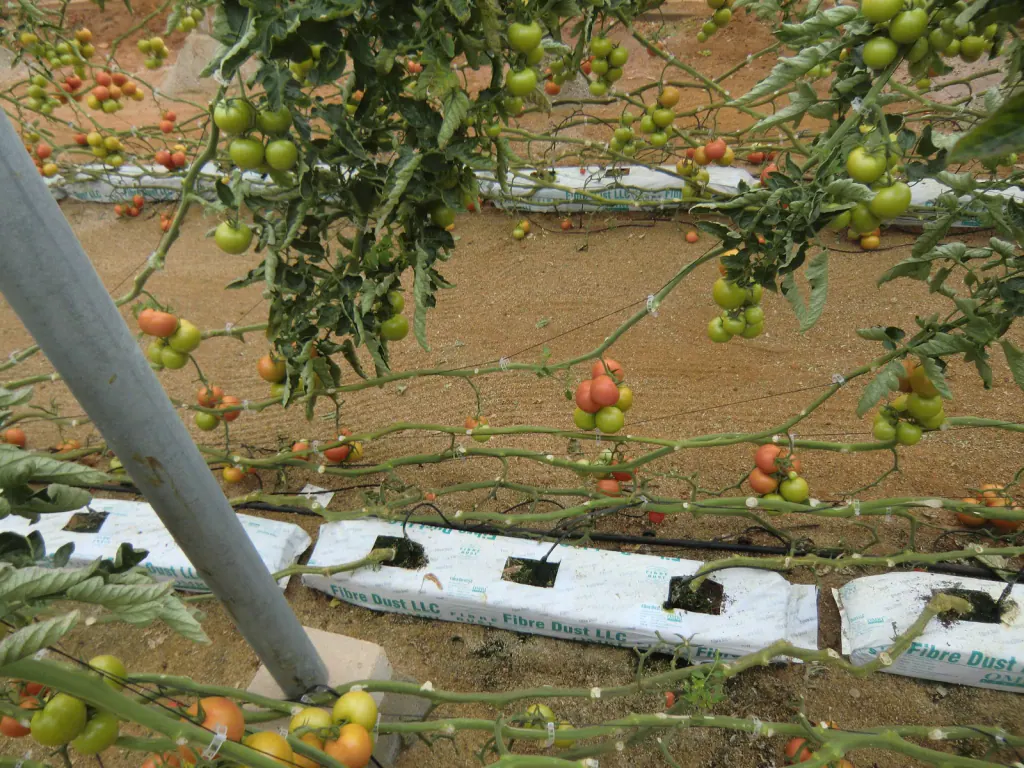
On fertigated vegetable slabs, the fibre alone gave the same yield as stone wool.
In Bonn, tomatoes and cucumbers grown on chopped miscanthus gave the same marketable yield and fruit quality as on stone wool, with the crop management unchanged. In later trials, tomato yield was highest on coir, then on miscanthus and then on stone wool, and blossom-end rot was half that on stone wool. -
Raw fibre ties up nitrogen, and composting, extrusion or a nitrogen pre-charge reduce the amount of extra nitrogen required.
In a Belgian test, raw straw immobilised 70% of the added nitrogen within a week, extruded fibre 40% and peat none. The practical rule derived from the German trials is about 50 mg of extra nitrogen per litre of mix for every 10% of raw fibre over a crop. -
The fibre holds less water than peat, and mixes with it are watered more often.
Its air capacity is higher and its water capacity lower than those of white peat, and milling to pass 3-5 mm brings the water-holding into the peat range. The pH is near neutral and weakly buffered, and the stems release a lot of soluble potassium. -
Fibre for a substrate maker pays more than fuel only when the buyer is close to the field.
Raw chips at the €150-200 a tonne one Dutch grower reported come to about €10-26 a cubic metre, against €21-50 for peat delivered to a German works, before milling, treatment, nitrogen and haulage. By our calculation, fibre collected by the buyer earns €1,250-3,700 a hectare over the harvest costs and fuel bales €750-1,780; delivery over 300 km removes most of the difference, and over 1,000 km all of it. -
Peat use is being reduced through voluntary targets, without a ban in any of the countries reviewed.
Germany aims for peat-free hobby soils by 2026 and largely peat-free professional substrates by 2030, and the Dutch covenant met its 2025 targets. A Swiss life-cycle study puts miscanthus fibre at about 11 kg of CO2 equivalent per cubic metre and peat at 254 kg; a 2025 paper and a 2026 review that qualify the figures for peat are covered in chapter 07.
Since 1997, trials in pots, on slabs and in nurseries have found the shares of fibre at which crops reach market quality
Since 2023, nurseries in Germany and the Netherlands have grown commercial crops on mixes with 15-30% miscanthus. Before that, substrate trials in Belgium, Denmark, Poland, Germany and the United States had tested the fibre, raw or composted, in pot and container mixes to find how large a share a crop tolerates, and the University of Bonn had tested it as the sole medium for soilless vegetables, in place of stone wool. The table lists the trials in order, with each result as published.
| Year | Where | What was tested | Result | Source |
|---|---|---|---|---|
| 1997 | Germany | Shredded and fibrous miscanthus in peat, tested on two shrub species in pots | Described as "promising"; the first published trial. | Cárthaigh et al., Acta Horticulturae 450 |
| 2001 | Denmark | Pot plants on straw composted for five months with urea or pig slurry | Shoots grew as long as on fertilised peat, but the dry weight was about 30% lower; the slurry compost contained excess salts. | Jensen et al., Acta Horticulturae 549 |
| 2011 | USA, Ohio | Hibiscus in nursery containers, ground straw replacing 0-80% of pine bark | Each step raised the air space and lowered the water-holding and the bulk density; growth fell as the share rose, most at 80%. | Altland & Locke, Journal of Environmental Horticulture 29 |
| 2015-17 | Germany | Extruded fibre at 20, 30 and 40% in a mix of wood fibre and peat, tested on cabbage, Weigela, Fuchsia and poinsettia | Plants grew better in the peat controls, except Weigela, which grew as well at 20%. Of the three raw materials tested (miscanthus, cup plant and paulownia), miscanthus gave the best results. A nitrogen pre-charge of horn shavings was the most effective single measure, and the dry matter of cabbage remained stable up to a 40% share. | Gramoflor and University of Bonn, FNR project 22016314 |
| 2018 | Germany, Bonn | Tomatoes and cucumbers on chopped or defibrated miscanthus instead of stone wool, then combustion of the spent slabs | Marketable yield and fruit quality did not differ from those on stone wool, and the crop management was not changed. | Kraska et al., Scientia Horticulturae 235 |
| 2018 | Belgium, ILVO | Strawberries with 20% straw in place of peat, the straw raw, extruded, or extruded with Trichoderma | No effect on yield in one experiment and 35% less yield in the other, caused by nitrogen shortage; the straw with Trichoderma reduced grey mould on the fruit. | Debode et al., Frontiers in Plant Science 9 |
| 2018-23 | Poland, Wrocław | Rooting of shrub cuttings, and potted Hydrangea, Aster and Spiraea, in mixes with raw straw | Cuttings rooted at 30-70% straw, and potted plants reached market quality at up to 30%; growth was best in pure peat. | Bąbelewski & Pancerz 2018; Pancerz et al. 2019, 2023 |
| 2021-22 | Germany, Bonn | Tomatoes on slabs of three miscanthus genotypes, and milling to 3-15 mm for stand-alone media | Tomato yield was highest on coir, followed by miscanthus and then stone wool, and blossom-end rot was half that on stone wool. Milling to 3-5 mm brought the water-holding into the peat range, while pH and nitrogen demand hardly changed. | Nguyen et al., Acta Horticulturae 1305; Agronomy 12 |
| 2023-25 | Germany, Netherlands | Practice: a demonstration nursery with 15% fermented fibre, a substrate maker's test with 20%, and Thuja at 30% in Dutch nurseries | Crops of good quality at 15%, with watering and feeding adjusted; Thuja at 30% grew 10-20% less in 2024 and grew well in 2025. | FNR ToSBa report 2024; Floragard 2024; CLOSECYCLE 2025 |
On tomato and cucumber slabs, where water and nutrients are supplied continuously, the fibre alone gave the same yield as stone wool and halved blossom-end rot, although tomatoes yielded less than on coir. In pots, where the mix has to hold water and nutrients between waterings, crops reached market quality with 15-30% fibre, and growth fell as the share of raw fibre rose further. Depending on the crop and the nitrogen supply, plants stopped reaching market quality at a share of between 20 and 40%. The yield loss in the Belgian strawberry trial was caused by a shortage of nitrogen, which is usually corrected with extra nitrogen, and in the German research trials a nitrogen pre-charge of horn shavings added at extrusion was the most effective single measure.
We found no trial of miscanthus in vegetable plugs other than tests with Chinese cabbage seedlings, and none in mushroom casing or in green-roof substrates. According to the Swiss data, tray-grown seedlings are the most difficult case for any peat substitute, and there is as yet no basis for describing the fibre as proven for seedlings.

A mix with miscanthus needs extra nitrogen and more frequent watering than a peat mix
The demonstration nursery that grows its crops on 15% fibre adjusted both its feeding and its watering, and the German research trials raised the nitrogen supply to reach 40%. Processed miscanthus belongs, with wood fibre and flax shives, to the substitutes that raise the air capacity of a mix and tie up nitrogen. Compared with peat, it has a near-neutral pH, a high content of soluble potassium from the stems and a low bulk density. The table sets out its measured properties beside those of peat and coir.
| Property | Processed miscanthus | Peat | Coir |
|---|---|---|---|
| Bulk density | 70-160 kg/m³ | about 220 | about 90 |
| Air capacity, % by volume | 40-65 | 28 (white peat) | high |
| Water capacity, % by volume | 30-55; fine milling reaches the peat range | 67 (white peat) | above fine miscanthus |
| pH | about 7 in water, 5.1-6.1 in CaCl2; weakly buffered | 3-4 unlimed, 5.5-6.5 limed | about 6.5 |
| Salt, EC of the extract | 0.3-0.7 dS/m, moderate | low | variable, can be high |
| Soluble potassium | high, 1,000-1,900 mg per litre of extract | about 4 | about 30 |
| Nitrogen tie-up | strong: index 0.2-0.4; raw straw 70% in a week | none: index 0.9 | moderate: index 0.6 |
| Wettability | low, reversible water repellence | repellent when dry | good |
| Stability | breaks down more slowly than wheat straw; high biological activity, mould if stored damp | very stable | stable |
| Seed and pathogens | no miscanthus seed, as the clone sets none; field weeds and soil possible; hygienised only by extrusion or hot composting | clean | depends on origin |
Nitrogen tie-up
Microbes that begin to decompose the fibre take nitrogen from the mix, away from the plants. Milling, washing and steaming do not change this. Composting, extrusion and a nitrogen pre-charge reduce it (chapter 04), and extra nitrogen in the feed covers the rest (chapter 05).
Water-holding
The fibre drains quickly. In the German demonstration nursery, a mix with 15% fermented fibre held a quarter less water than white peat, and the nursery shortened its watering intervals.
Potassium and salts
The stems release a lot of soluble potassium in the first weeks, and the salt content of the fibre is moderate. Straw composted with slurry carries too much sodium and chloride for salt-sensitive crops.
pH
The fibre is near neutral and weakly buffered, so the pH of a mix with miscanthus follows that of the irrigation water. A near-neutral pH suits vegetables and most ornamentals.




How the fibre behaves in a mix depends on how it is milled and treated
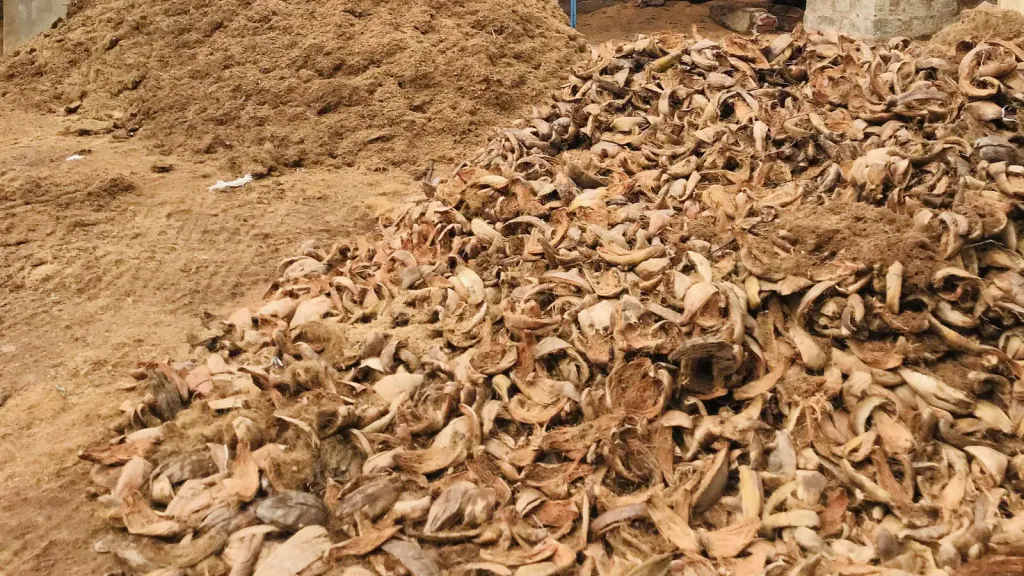
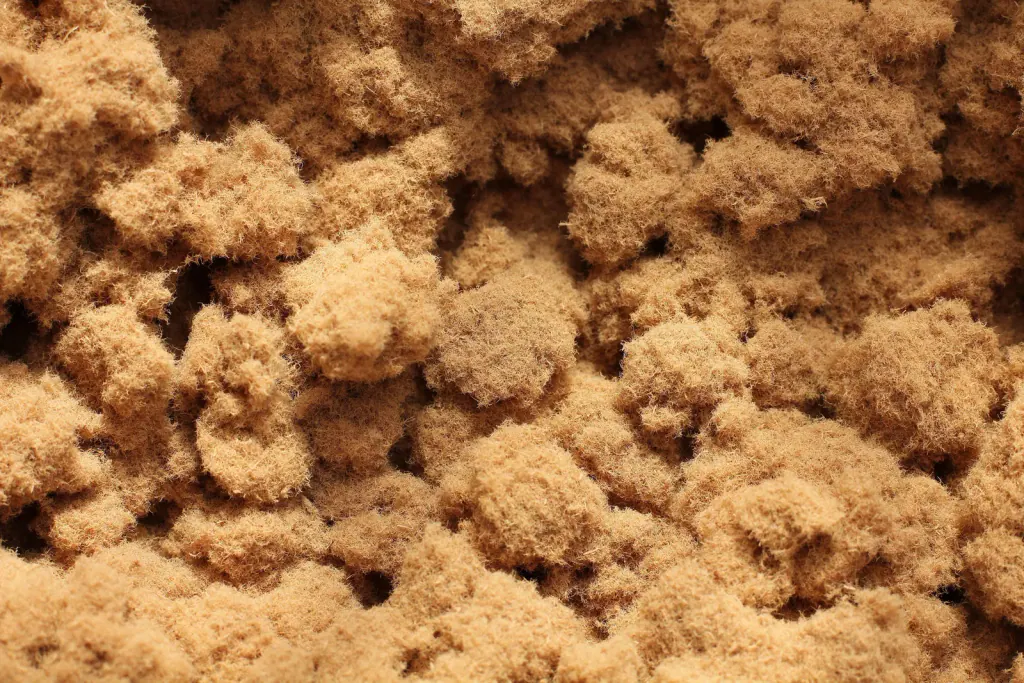
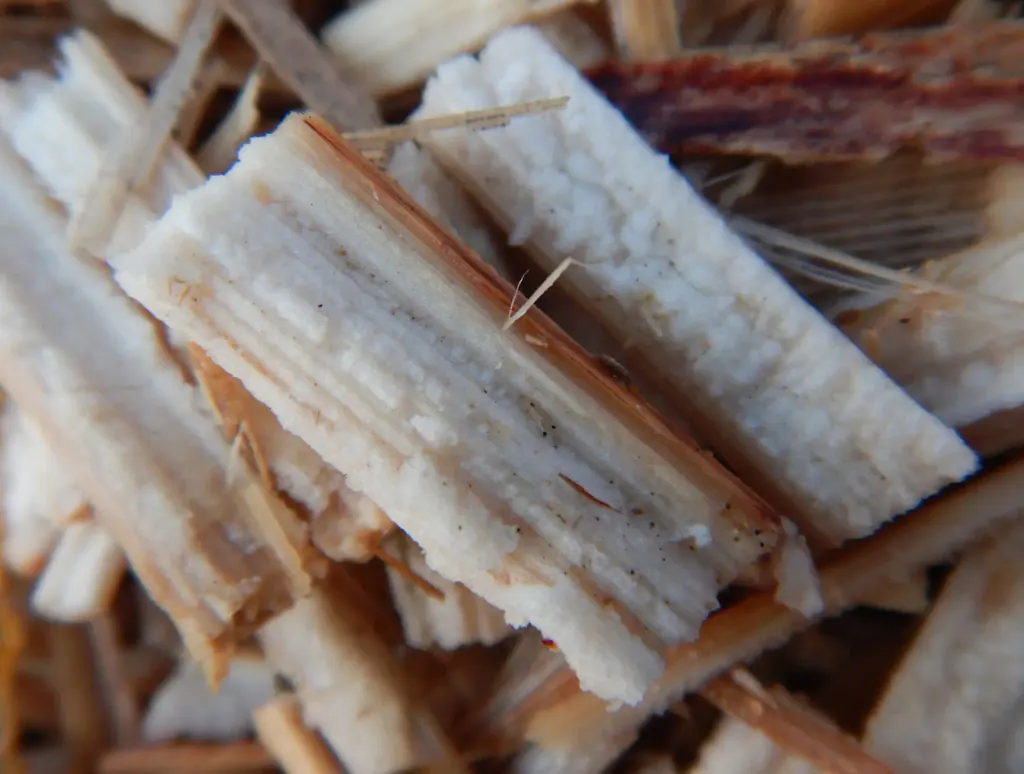
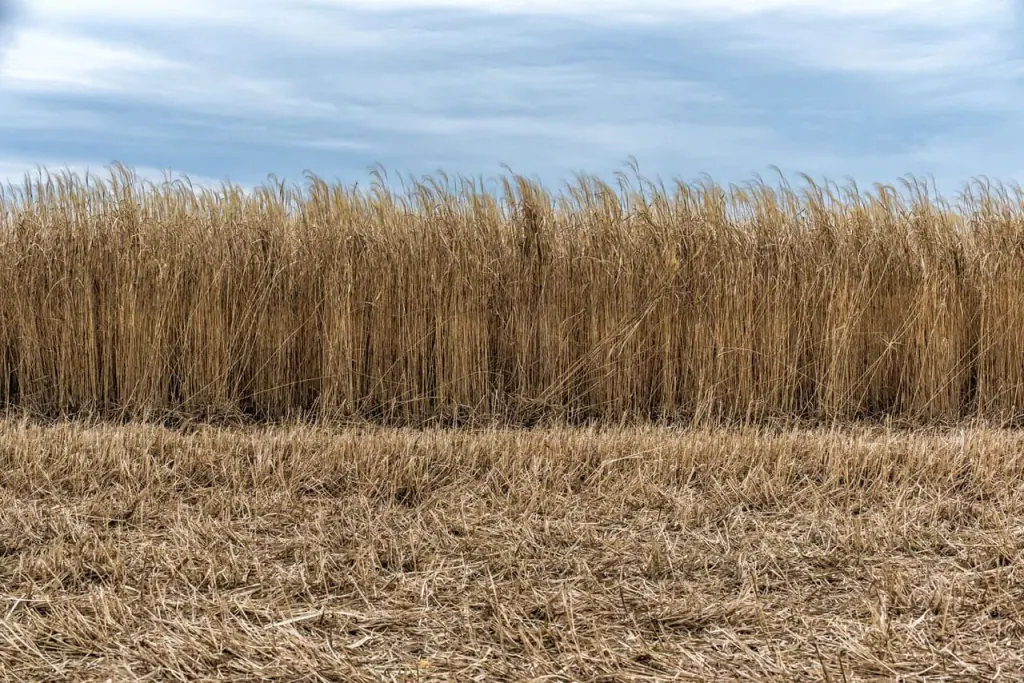
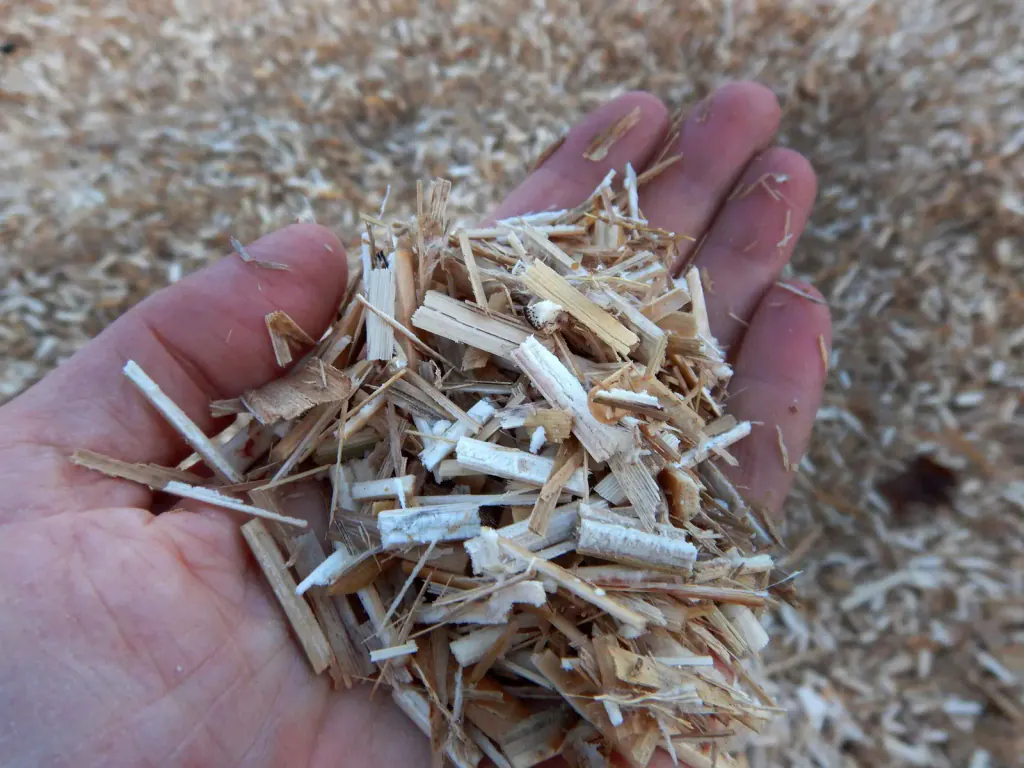
The crop is harvested dry in late winter and chopped in the field or milled afterwards. The particle size determines how much water the fibre holds, and the treatment after milling determines how much nitrogen it ties up.
- HarvestFebruary to April, at 15-20% moisture; in an Irish store, chips cut at 42% moisture heated up to 69 °C, while chips cut at 20% stayed cool
- Chop or millhammer-mill screens of 3-5 mm for pot and seedling mixes and 10-15 mm chips for slabs and free-draining containers; unmilled field chips drain too fast for pots
- Treatextrusion above 100 °C lowers the nitrogen tie-up and hygienises the fibre; composting for about five months with a nitrogen source lowers the carbon-to-nitrogen ratio to 19-27, against about 96 for straw composted with water only; horn shavings can be added at extrusion as a nitrogen pre-charge
- Blend15-20% for sensitive potted crops and seedlings, 20-30% as the general upper limit without special feeding, 30-40% with feeding adjusted for nitrogen, and up to 70% for rooting woody cuttings

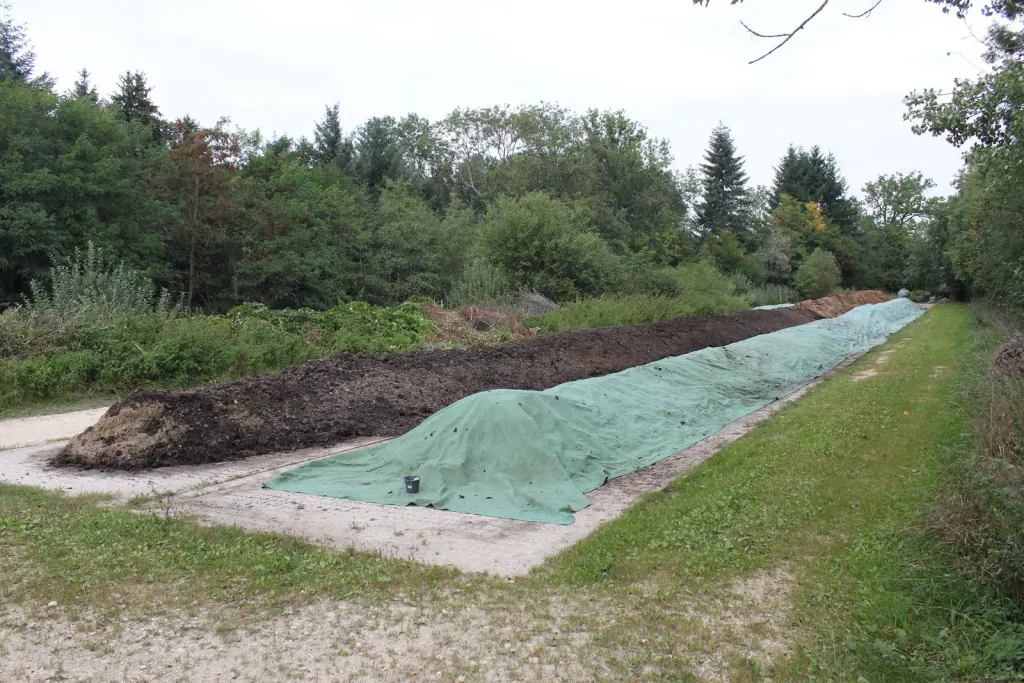

Extrusion is the standard industrial process for making wood fibre, and the same twin-screw extruders can process miscanthus. In the Belgian work, extrusion lowered the nitrogen tie-up of the straw from 70% to 40% without changing its pH, and in a parallel test on flax shives the heat of the process killed a soil-borne fungus. Steam explosion lowered the pH of the fibre and increased the tie-up. Acidification to a pH of 2.5-4.7 reduced microbial activity, but it is not used commercially. Composting, the oldest method, takes about five months and needs space for a heap. In the Danish trial, pot plants on straw composted with urea or pig slurry grew shoots as long as on fertilised peat, although their dry weight was about 30% lower.
The treatment a product has received determines how it can be used, so a buyer should ask how it was treated.
Treatment and share in practice
The German demonstration nursery grows its crops on a mix with 15% fermented fibre, and a German substrate maker has tested its own miscanthus mix at 20% on Chinese cabbage. The Polish trials used raw milled fibre at up to 30%, with fertiliser premixed, and extruded fibre with a nitrogen pre-charge reached 40% in the German research trials.
Labels and standards
The Dutch RHP scheme has no product class for miscanthus; in 2025 it said it was developing certification for new substrate materials. The German RAL quality mark covers bark, wood fibre, peat, perlite, coir and compost and lists miscanthus under "in future". A miscanthus constituent sold today carries neither label.
Guidance on blending, feeding and watering for nurseries and gardeners
The guidance below is based on the trials and on the experience of the demonstration nurseries. The crops that have been tested are listed by name, and for any other crop a mix should first be tried on a few plants.
Blending, feeding and watering
- Share. Use 15-20% fibre in mixes for seedlings and sensitive potted crops; without special feeding, 20-30% is the upper limit. With the feed adjusted for nitrogen the share can rise to 30-40%, mixes for rooting woody cuttings can contain up to 70%, and 100% fibre is used only on fertigated vegetable slabs.
- Nitrogen. Raw fibre needs about 50 mg of extra nitrogen per litre of mix for each 10% of fibre over the crop, so a blend with 30% raw fibre needs about 150 mg per litre more than a peat mix. Extruded or composted fibre needs about half as much. Use a feed weighted towards nitrogen and watch the older leaves, where a shortage shows first.
- Potassium. Reduce the potassium in the feed for the first weeks, and do not use slurry-composted fibre for salt-sensitive crops.
- pH. Do not lime the mix, and acidify it for ericaceous plants.
- Water. Irrigate at shorter intervals and with smaller doses than a peat mix.
Crops tested with the fibre
- Tomato and cucumber on fertigated slabs of 100% fibre gave yields equal to those on stone wool, and tomato yielded less than on coir.
- Strawberry can be grown at 20% in peat if extra nitrogen is given.
- Spiraea, Taxus, Euonymus and Cotoneaster rooted as cuttings in mixes with 30-70%, Thuja has been grown at 30%, and Weigela grew as well as in the control at 20% and less at 30-40%.
- Hydrangea, Aster and Spiraea reached market quality in pots at up to 30%.
- Hedera and Fatsia were grown on straw composted for five months with a nitrogen source.
- Chinese cabbage seedlings were grown in blends with 20-40% fibre; on the fibre alone germination was the same as on peat, but emergence was slower and growth lower.
- Hibiscus in nursery containers grew less as the share of ground straw rose, most at 80%.
Seedlings, cuttings, pot plants and container stock: the crop groups tested with the fibre
- Seedlings · Chinese cabbage
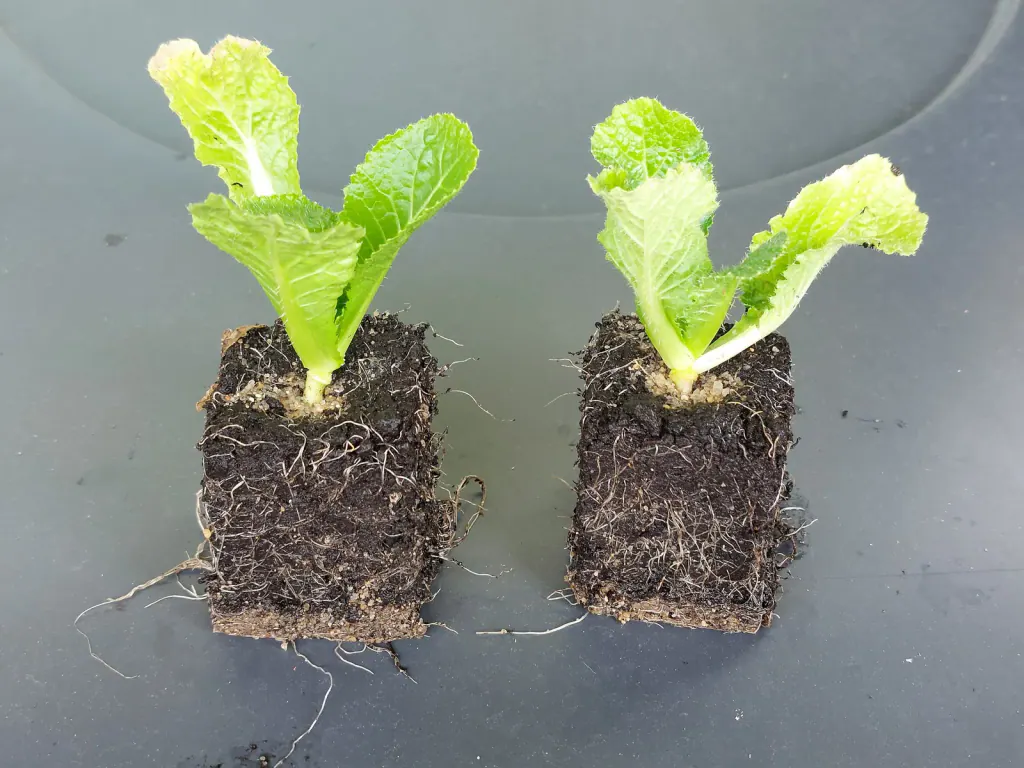
Chinese cabbage seedlings raised in pressed blocks of growing medium, 2025; the crop of the seedling tests with miscanthus. Photo by Schlaghecken Josef, via Wikimedia Commons, CC BY-SA 4.0.
- Seedlings · broccoli
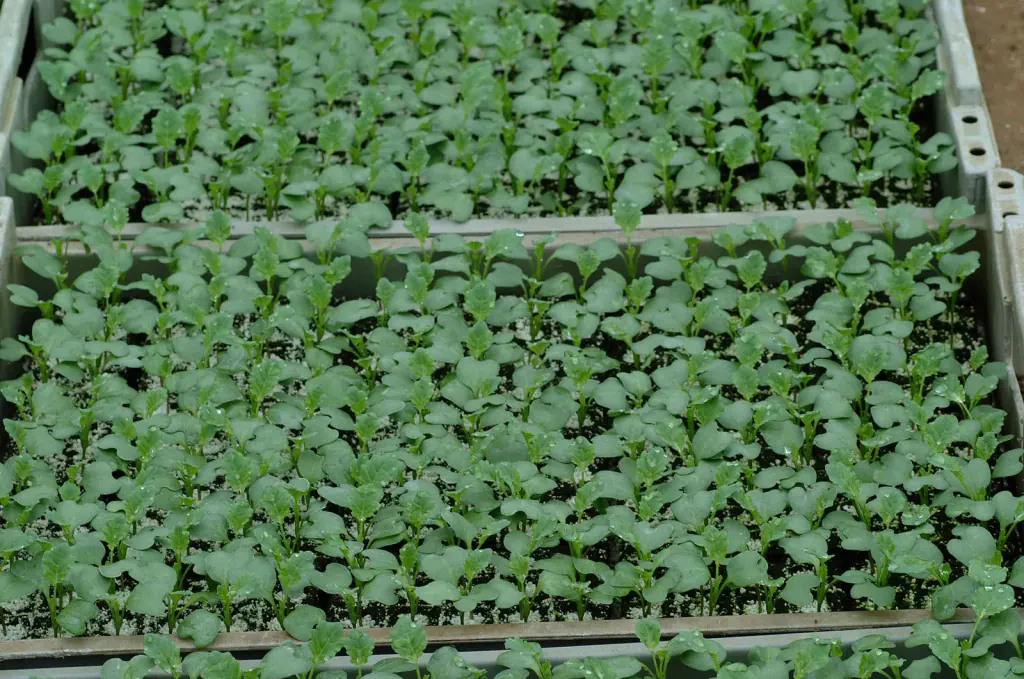
Broccoli seedlings in small pressed blocks of growing medium, packed in a box for planting out, 2003. Photo by Schlaghecken Josef, via Wikimedia Commons, CC BY-SA 4.0.
- Plugs · parsley
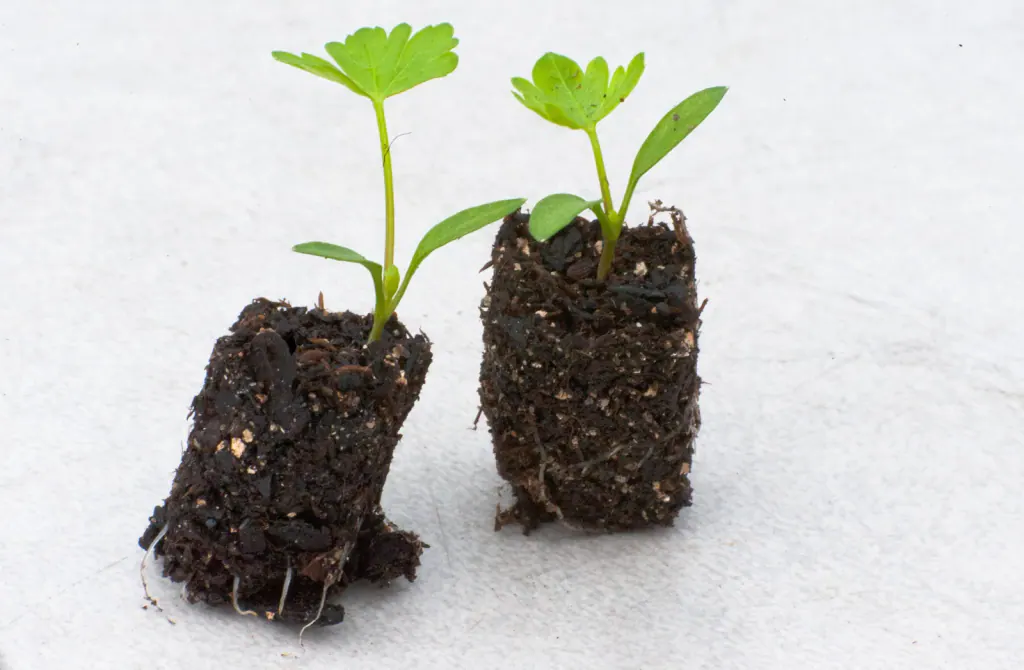
Parsley plugs lifted from a tray, the roots holding the growing medium together, Massachusetts, 2012. Tray-grown seedlings are the most difficult case for any peat substitute. Photo by Dwight Sipler, via Wikimedia Commons, CC BY 2.0.
- Cuttings · geranium
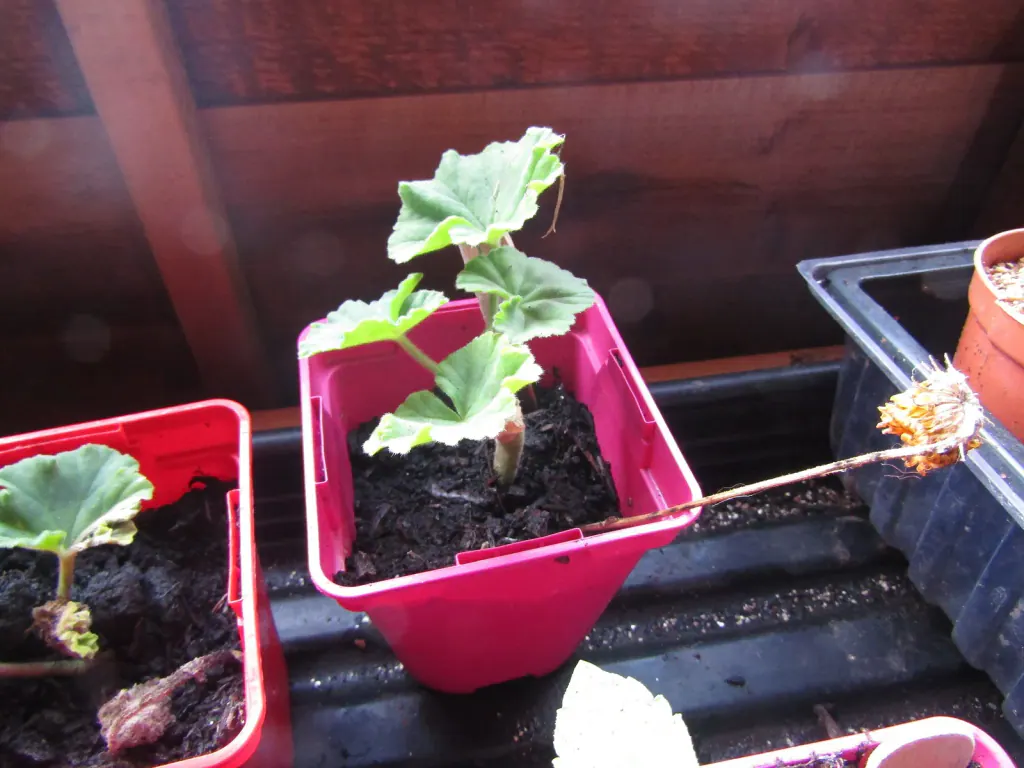
Rooted geranium cuttings potted up in a shed at Trimingham, Norfolk, in November 2019. Cuttings of several shrubs were rooted in mixes with miscanthus in the Polish trials. Photo by Kolforn, via Wikimedia Commons, CC BY-SA 4.0.
- Pot plants · chrysanthemum
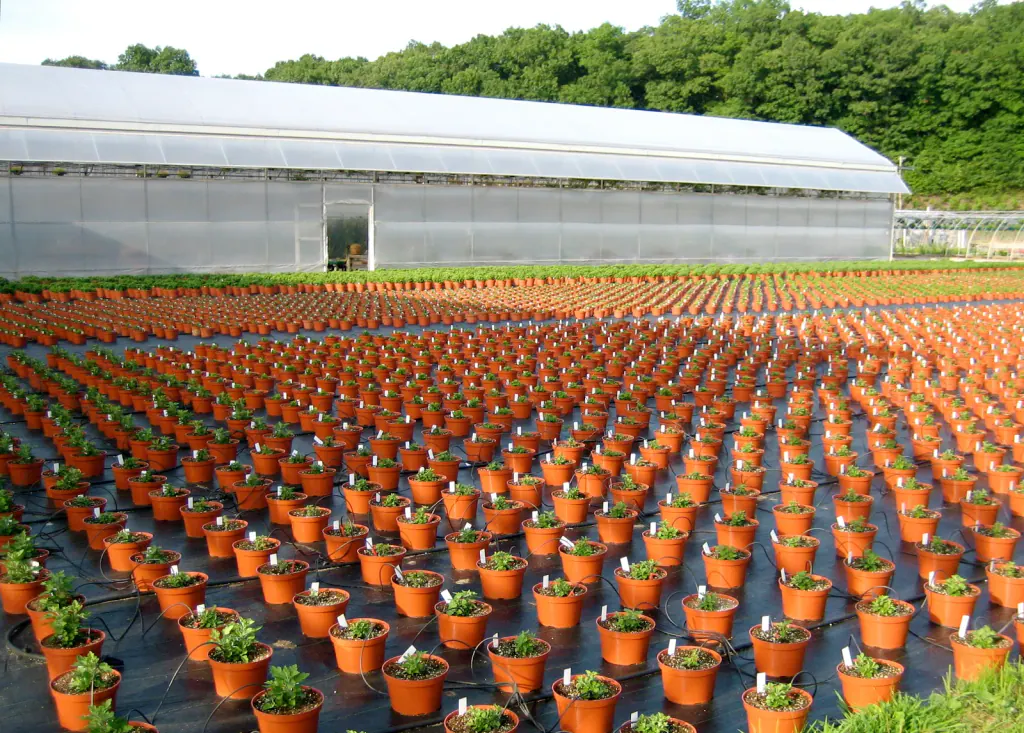
Potted chrysanthemums standing out on ground cover at a plant nursery, 2007. Photo by liz west, via Wikimedia Commons, CC BY 2.0.
- Potting · young conifers
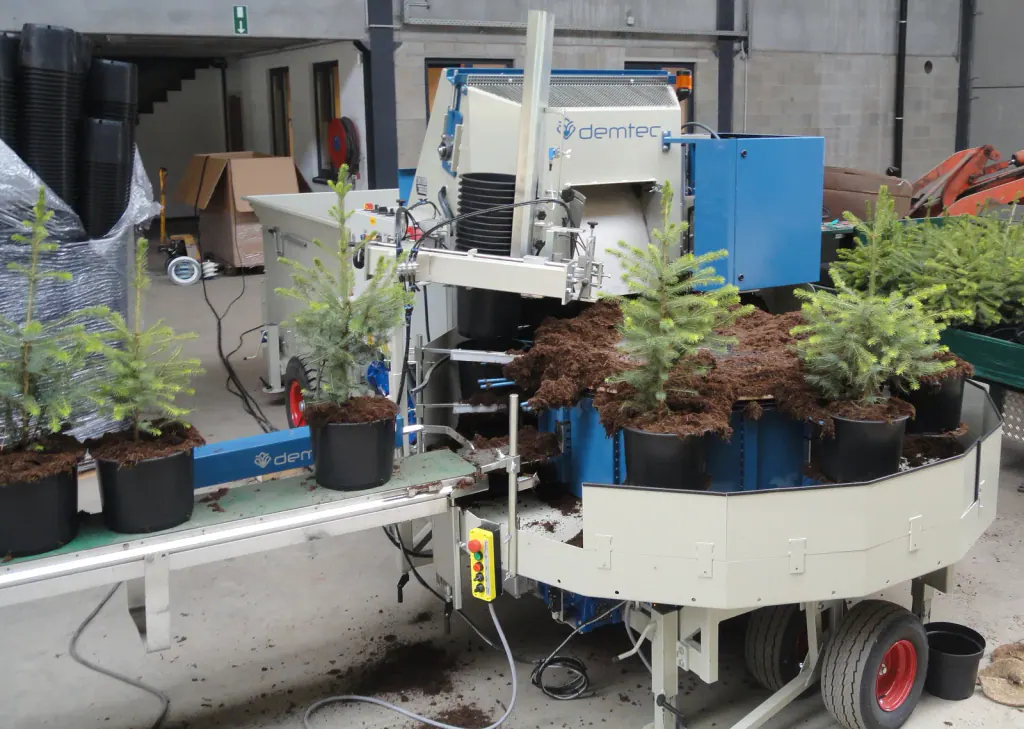
A potting machine filling containers with growing medium and potting young conifers, 2013. Photo by stefaan vandaele, via Wikimedia Commons, public domain (CC0).
- Container stock · fruit trees
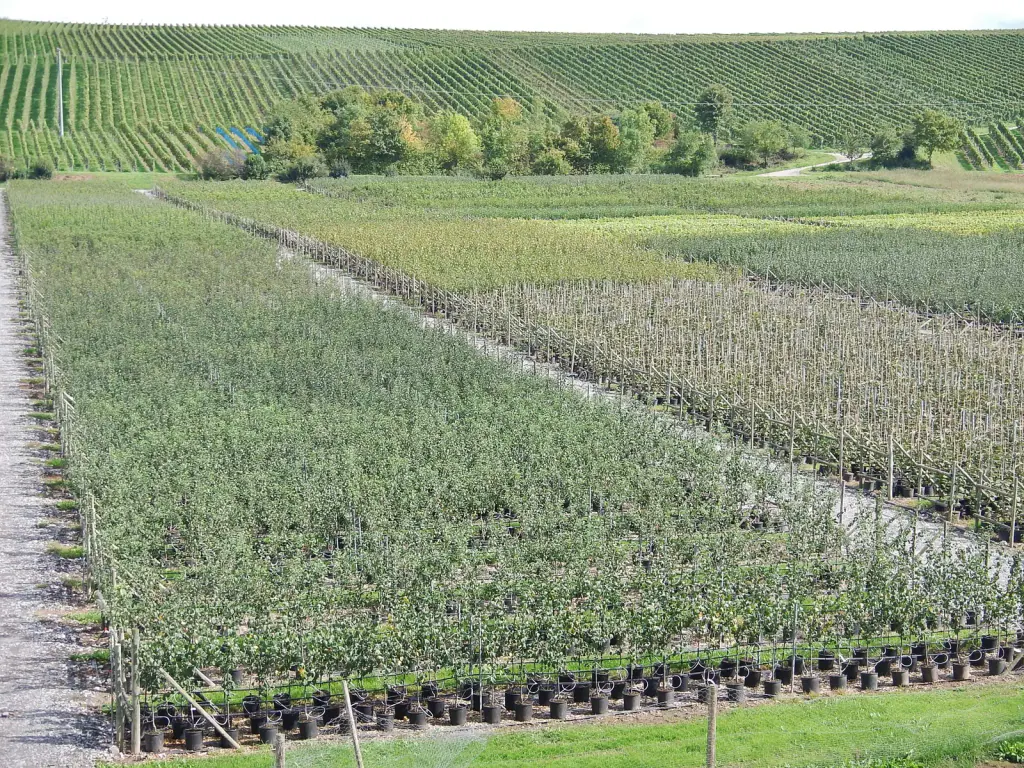
Fruit trees grown in containers at a nursery in Lauffen am Neckar, Baden-Württemberg, in September 2014. Photo by qwesy qwesy, via Wikimedia Commons, CC BY 3.0.
- Container stock · under glass
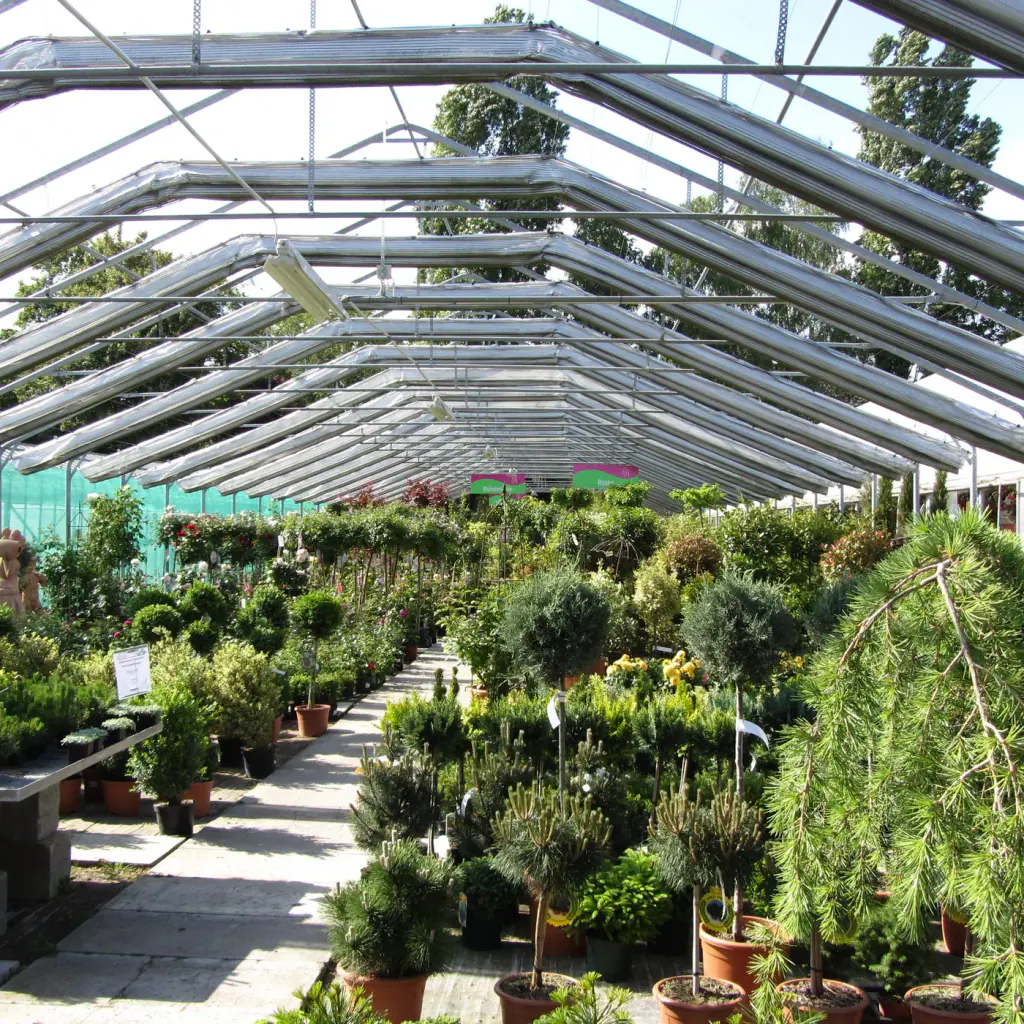
Container-grown nursery stock under glass in Austria, a crop of the kind grown on miscanthus mixes in German and Dutch nurseries. Photo by Karin Weigel, via Wikimedia Commons, CC BY-SA 3.0.


.jpg)
.JPG)


Use in the garden
Chopped canes from a hedge or a field can be used in a potting mix in two ways. They can be composted for five months with a nitrogen source: the Danish trial used urea, ammonium sulphate or pig slurry, and in a garden grass clippings or manure can serve, although that has not been tested with miscanthus. We suggest using the compost for up to a third of the mix. Finely chopped raw canes can make up 20% of a mix, but the plants then need a nitrogen feed from the start. The chips should be stored dry, because fresh miscanthus is biologically active and goes mouldy in a damp heap. The watering rule in the list above applies to garden mixes as well, whether the canes are raw or composted.

What the constituents of a growing medium cost, and what a hectare of fibre earns against fuel
German potting-soil works paid typical prices of €17-60 a cubic metre for the main constituents in 2022-23, delivered to the works. Raw miscanthus chips come to less per cubic metre, but they are not yet a constituent: they still have to be milled, possibly extruded or composted, charged with nitrogen and hauled. The second table is our calculation of what a hectare of fibre earns against selling the same harvest as fuel.
Constituents of growing media, € per cubic metre, typical price (range)
| Constituent | € per m³ | What the price covers |
|---|---|---|
| Green compost | 17.1 (7.5-33.4) | delivered to the works |
| Peat, white and black | 32.8 (21.3-49.9) | delivered to the works |
| Wood fibre | 35.0 (23.5-51.4) | delivered to the works |
| Composted bark | 36.8 (18.1-48.4) | delivered to the works |
| Coir, mostly pith | 60.0 (55.0-72.5) | delivered to the works; the price always includes transport |
| Raw miscanthus chips | 10.5-26 | ex farm, before milling, treatment, nitrogen and haulage; our calculation from €150-200 a tonne at 70-130 kg per m³ |
One hectare a year, fibre for a substrate maker against fuel bales: our calculation
| Per hectare and year | Range | Assumption |
|---|---|---|
| Dry matter harvested | 12-18 t | a mature crop; 14-21 t as harvested at 14% moisture |
| Raw chips by volume | 92-257 m³ | 70-130 kg of dry matter per m³ |
| Harvest by forage harvester, haul to the store, covered storage and loading | €510-540 | harvest €140-250 and haul €60 a hectare, storage €12 a tonne, loading €60-65 a hectare |
| Revenue at €150-200 a tonne, buyer collects | €1,800-4,190 | one Dutch grower's price for several uses; whether per tonne of dry matter or as harvested is not stated |
| Margin, buyer collects | €1,250-3,700 | before establishment, rent, maintenance, overheads, own labour and selling costs |
| Margin, fibre delivered 300 km | about -€500 to +€2,000 | loose chips, 9-12 t a load, €1.58-1.93 a km, empty return included |
| Margin, fibre delivered 1,000 km | a loss | haulage €263-429 a tonne |
| For comparison: bales sold as fuel at €110-115 a tonne at the field edge | €750-1,780 | buyer collects; harvest and baling €30-56 a tonne as baled |
A 92 m³ truck carries only 9-12 t of loose chips, so over 1,000 km haulage costs €263-429 a tonne, more than the fibre is sold for. Baling for transport roughly halves the cost. French processors buy miscanthus within 80 km, and Dutch and German substrate makers work with growers in their own region.
Not included
The margins are before establishment, rent, maintenance, overheads, own labour and selling costs, which are at least as high for fibre as for fuel. Milling to 3-5 mm takes 13-22 kWh of electricity a tonne in laboratory tests, about €2.6-4.4 at €0.20 a kWh (our calculation). No substrate maker publishes its cost of extrusion, composting or the nitrogen charge.
European countries are reducing peat in growing media, mostly through voluntary targets
Under the accounting rules, all the carbon in extracted horticultural peat counts as emitted in the year of extraction, and peat therefore accounts for most of the carbon footprint of growing media. The position in each country as of October 2026 is summarised in the table.


| Where | Status in 2026 | Source |
|---|---|---|
| European Union | There is no ban and no EU strategy. Germany asked the Commission for one in May 2022, and from 2026 peat extraction is included in the land-use accounting. | Council note 9219/22; Regulation (EU) 2018/841 |
| Germany | The Peat Use Reduction Strategy of 2022 aims for a peat-free hobby sector by 2026 and for commercial horticulture without peat "as far as possible" by 2030, all on a voluntary basis. In 2023 peat still made up 41% of consumer soils and 73% of professional substrates. | BMEL 2022; IVG evaluation 2024; FNR status report 2025 |
| Netherlands | A covenant of November 2022 sets quantified targets for the share of renewable materials: 35% in professional media and 60% in consumer soils by 2025, and 50% and 85% by 2030. The report for 2025 shows 36% and 60%. | Staatscourant 2023-7102; Jaarverslag 2025 |
| England, Scotland, Wales | The announced dates are "by 2024" for a ban on retail sales (announced in 2022) and "by 2026" for professional use; neither is law as of 2026. The government says it will legislate "when Parliamentary time allows", and Scotland and Wales are waiting for a UK-wide bill. Northern Ireland's strategy of 2025 sets 2030 for phasing out horticultural peat. | Defra 2022; Peat Free Partnership timeline; Scottish Government letter, January 2026 |
| Switzerland | The phase-out has been voluntary since 2012 and is based on declarations of intent. They limit peat to 5% in bagged hobby soils (about 4% was reached in 2020) and in ornamentals by 2030 (42% in 2022), to 40% in vegetable seedlings by 2028 and to 25% in berries by 2030. | BAFU, Torfausstiegskonzept and fact sheet 2024 |
| Ireland | Commercial extraction largely stopped after a court ruling in 2019. In 2022 a working group recommended ending retail sales of peat by 2025 and all horticultural use by 2030-2035. The government has taken no decision, and peat has been imported from Latvia since 2021. | DAFM working group 2022; Oireachtas committee, June 2026 |
| France and Ukraine | We found no target, charter or ban in either country. France extracts about 300,000 m³ of peat a year for growing media, and Ukraine extracts peat mainly for fuel and imports Baltic peat for substrates. | OFB; Ukrainian Peat Association |
The emission figures for peat depend on the method of calculation. In the German industry's own accounting, the use phase alone is put at 183 kg of CO2 equivalent per cubic metre of white peat and 257 kg per cubic metre of black peat, and Defra uses 235 kg. The Swiss life-cycle study that compared nine substitutes arrived at 254 kg for peat over its whole life, against about 11 kg for miscanthus fibre, 15 kg for flax shives and 17 kg for hemp fibre. An Austrian study of 2024 found a small global warming potential for miscanthus, whose processing chain is short and needs little energy.
Two recent studies qualify these figures. A 2025 paper shows that peat in pots and beds decomposes over decades, so that the convention of counting all its carbon as emitted in the year of extraction overstates the actual emissions about threefold. A 2026 review from North America, where peatlands are still accumulating carbon, finds the impacts of several alternatives similar to or greater than those of peat. Neither study has changed the direction of European policy, and none of the life-cycle studies cited here shows that any growing-medium material is carbon-neutral.
The figure comes from a 2026 Dutch assessment of about 130 candidate materials. In the FNR's status report of 2025, the industry names a severe shortage of raw materials as the main constraint on replacing peat.
Miscanthus in the substitute market
The Dutch covenant's report for 2025 is the first to count cultivated plant fibres, miscanthus and reed canary grass, as a separate category. Dutch substrates used about 10,000 m³ of them, the output of roughly 40-110 hectares by our calculation, against a professional market of more than six million cubic metres. Germany's strategy describes the miscanthus trials as promising and the material as having no market significance so far. Most of the peat is being replaced by wood fibre, compost, bark and coir, and miscanthus is one of the new fibres grown for this purpose.
Potting soils containing miscanthus are sold in four countries, and we are preparing a product of our own
Peat-free and peat-reduced potting soils with a share of miscanthus are sold in Germany, the Netherlands, Belgium and France. The ingredient is usually listed as "miscanthus fibre" or as the maker's own "miscanthus mix", next to compost, coir and wood fibre, and its share is rarely printed. In the Netherlands, substrate makers buy chopped fibre from growers near their works.
We are preparing a growing-medium component and a mulch for retail sale, both made from miscanthus from our own fields in Croatia, where no pesticides are used after the planting year.
The first products will be sold in the markets closest to our fields. Loose chips are light and fill a truck long before it reaches its weight limit, so over long distances the haulage costs more than the fibre (chapter 06). For a substrate maker further away, growing the fibre near its own works is the cheaper route, and we supply planting stock of the clone for it.
Reported in the Dutch trade press in March 2026, which describes demand from substrate makers as growing fastest. No price paid by a substrate maker has been published; the €150-200 a tonne given there is one grower's price for fibre sold for bedding, garden mulch, insulation and 3D printing.
Claims on the bag
The bag will state the share to blend, the nitrogen to add at that share, the moisture, the dry matter and the origin. It will carry only the claims that the trials support, so it will not describe the material as peat-equivalent, sterile or carbon-neutral.
Who should write to us, and about what
Substrate makers and growers
We can supply chopped fibre from our harvest by the tonne, by arrangement, and planting stock of the clone for growing the fibre near your works. Please tell us the volume, the intended use, the particle size, the treatment you have in mind and where your works is.
Garden centres and retailers
If you are interested in the first batches of the growing-medium component and the mulch, please leave your details, and we will send you the specification once it has been fixed.
Gardeners
If you leave your e-mail address, we will let you know when the product goes on sale in your country. How chopped canes can be used in a garden mix in the meantime is described in chapter 05.
Related articles on the mulch, the hedge and the crop
Trial results on weed control and soil moisture, the depth of the layer, and a comparison with bark, straw and wood chips.
Read it Green hedgeA miscanthus hedge: layouts from one to five rowsSpacing, growth through the year, the law on boundaries and uses for the canes cut each winter.
Read it The cropWhat miscanthus is, where it grows and what it is used forAn introduction to the plant, the climate it needs and its uses.
Read itFrequently asked questions
Miscanthus fibre can replace part of the peat. In pot and container mixes, crops reached market quality with 15-30% fibre, and the German research trials used up to 40% with extra nitrogen. On fertigated slabs, tomatoes and cucumbers grown on the fibre alone gave the same yield as on stone wool. Pure miscanthus is not suitable as a potting soil, because it ties up nitrogen and holds less water than peat: even a mix with 15% fermented fibre held about a quarter less water than white peat.
The fibre has a wide carbon-to-nitrogen ratio, and the microbes that begin to decompose it take nitrogen from the mix. In a Belgian test, raw straw tied up 70% of the added nitrogen within a week, extruded fibre 40% and peat none. The German trials put the extra demand at about 50 mg of nitrogen per litre of mix for every 10% of raw fibre over a crop. Composting with a nitrogen source, extrusion and a nitrogen pre-charge such as horn shavings reduce this demand, but none of them removes it completely.
Per litre of mix, the fibre holds less water than peat. Processed miscanthus holds 30-55% water by volume against about 67% for white peat, and a nursery mix with 15% fermented fibre held a quarter less water than pure white peat. Milling to pass 3-5 mm brings the water-holding into the peat range, while coarse chips drain too fast for pots.
Miscanthus fibre is not acidic. Its pH is near neutral: about 7 measured in water and 5.1-6.1 in calcium chloride, and it is weakly buffered. This suits vegetables and most ornamentals, and a mix with miscanthus needs none of the lime that peat mixes require. For plants that need an acid soil, the mix has to be acidified.
The clone sets no seed, so the fibre carries no miscanthus seed. Because the crop is grown in a field, the material can contain field weeds and soil unless the harvest is clean and the material is screened. No published product test supports a claim that the fibre is free of disease. Extrusion above 100 °C and hot composting are the treatments for which there is evidence of a hygienising effect.
No price paid by substrate makers for miscanthus fibre has been published. One Dutch grower reported €150-200 a tonne in 2026 for fibre sold for bedding, garden mulch and insulation, which at 70-130 kg per cubic metre comes to about €10-26 for a cubic metre of raw chips. German potting-soil works paid €21-50 a cubic metre for peat and €24-51 for wood fibre in 2022-23, delivered to the works. The raw fibre still has to be milled, treated, charged with nitrogen and hauled before it can be compared with them, and it holds less water than peat.
A Swiss life-cycle study put miscanthus fibre at about 11 kg of CO2 equivalent per cubic metre and peat at 254 kg, most of it from the carbon that peat releases in use. An Austrian study found a small global warming potential for miscanthus, whose processing chain is short and needs little energy. A 2025 study argues that the accounting convention overstates the emissions of peat, because peat in pots decomposes over decades while the convention counts all its carbon in the year of extraction. A 2026 review from North America finds the impacts of several alternatives similar to or greater than those of peat.
As of 2026 there is no EU ban, and none of the countries reviewed in this article has banned peat. Germany's targets, peat-free hobby soils by 2026 and professional horticulture largely peat-free by 2030, are voluntary. The Dutch covenant sets quantified targets, and its 2025 targets for the share of renewable materials were met. England announced a retail ban for 2024 that has not been legislated, and Scotland and Wales are waiting for a UK-wide law. Switzerland relies on declarations of intent. In Ireland, commercial extraction largely stopped after a court ruling in 2019, but no end date has been set for the use of peat. France and Ukraine have no target or ban.
Potting soils with a share of miscanthus are sold in Germany, the Netherlands, Belgium and France, although the share is rarely printed on the bag. We are preparing a growing-medium component and a mulch from our own fields for retail sale, and anyone who leaves their details in the form on this page will be informed when the first batches are ready.
About this article
We wrote this article ourselves. We grow miscanthus and sell planting stock, and we used the sources listed below and our own figures.
The information was current when the article was published. Policies and products change, and errors are possible, so please check the figures before you rely on them.
If you find an error or have more accurate figures, write to us at info@miscanthus.eu or use the form below.

Sources
- Council of the European Union (2022). Peat reduction in horticultural growing media, information from the German delegation, note 9219/22. Hirschler, O. et al. (2022). Peat replacement in horticultural growing media: availability of bio-based alternative materials. Thünen Working Paper 190. Hirschler, O. & Osterburg, B. (2025). Resources, Conservation and Recycling 220: 108330 (prices of growing-media constituents delivered to German works, and shelf prices of potting soils with and without peat).
- BMEL (2022). Going peat-free, protecting the climate: the Peat Use Reduction Strategy. IVG (2024). Evaluation of German growing media production 2023. FNR/BMEL (2025). Statusbericht Torfminderung im Gartenbau.
- Staatscourant 2023 nr. 7102, Convenant milieu-impact potgrond en substraten; Jaarverslag 2025 of the covenant. Blok, C. et al. (2026). Future directions of the global growing media industry. Frontiers in Horticulture 5: 1791241. Nieuwe Oogst, 5 March 2026 (Dutch miscanthus area; one grower's fibre price, for bedding, garden mulch, insulation and 3D printing). Kekkilä-BVB (2023). Cultivating Miscanthus, an alternative raw material for growing media.
- Defra (2022). Sale of horticultural peat to be banned. Peat Free Partnership, legislation timeline (2025-2026). Scottish Government, letter on horticultural peat, 20 January 2026. BAFU (Switzerland), Torfausstiegskonzept and Faktenblatt Zwischenbilanz, 2024. RTÉ, 24 June 2026 (Oireachtas committee on horticultural peat).
- IPCC (2006). Guidelines for National Greenhouse Gas Inventories, Vol. 4, Ch. 7. Stichnothe, H. (2022). Life cycle assessment of peat for growing media. International Journal of Life Cycle Assessment 27: 1270-1282. Sharma, B., He, H. & Roulet, N. T. (2025). Carbon Management 16(1). Altland, J. E. & Bugbee, B. G. (2026). Frontiers in Plant Science 17: 1856037.
- Stucki, M. et al. (2019). Erweiterung der Studie "Torf und Torfersatzprodukte im Vergleich". ZHAW. Fuhrmann, M. & Strasser, C. (2024). Ökobilanzierung von Torfersatzstoffen in Österreich. Land Niederösterreich. Ruett, J. et al. (2024). Sustainable Production and Consumption 49: 163-178.
- Cárthaigh, D. et al. (1997). Acta Horticulturae 450: 57-62. Jensen, H. E. K., Leth, M. & Iversen, J. J. L. (2001). Acta Horticulturae 549: 137-146. Altland, J. E. & Locke, J. C. (2011). Journal of Environmental Horticulture 29(3): 114-118.
- Kraska, T. et al. (2018). Cascading use of Miscanthus as growing substrate in soilless cultivation of vegetables and subsequent direct combustion. Scientia Horticulturae 235: 205-213, as reported in Kraska, T. & Pude, R. (2019). Obstbau 11/2019. Nguyen, V. T. H. et al. (2021). Acta Horticulturae 1305: 301-308. Nguyen, V. T. H. et al. (2022). Agronomy 12: 420.
- Debode, J. et al. (2018). Trichoderma-inoculated Miscanthus straw can replace peat in strawberry cultivation. Frontiers in Plant Science 9: 213. Vandecasteele, B. et al. (2017). Acta Horticulturae 1168: 149-160; (2018). Journal of Cleaner Production 203: 1143-1154.
- Gramoflor GmbH and University of Bonn (2018). Schlussbericht FKZ 22016314, Entwicklung von Torfersatzstoffen auf Basis von nachwachsenden Rohstoffen. FNR. FNR/ToSBa (2024). Erfahrungsberichte der zehn Demonstrationsbetriebe. Grießer, S. (2024). Nachhaltiges Wachstum, regionaler Torfersatz. FNR workshop. Interreg North Sea CLOSECYCLE (2025), tree-nursery results.
- Bąbelewski, P. & Pancerz, M. (2018). Acta Horticulturae 1191: 175-182. Pancerz, M. & Bąbelewski, P. (2019). Acta Horticulturae 1266: 237-242. Pancerz, M., Czaplicka, M. & Bąbelewski, P. (2023). Plants 12(8): 1639.
- Everard, C. D. et al. (2013). Evaluation of self-heating in Miscanthus x giganteus energy crop clamps. Energy 58: 350-356. Wegener, U. (2023). Torfersatzstoffe und deren Anwendungspotenziale, Gütegemeinschaft Substrate für Pflanzen. Słomka, A. et al. (2012). Acta Biologica Cracoviensia Series Botanica 54(1): 113-120 (sterility of the clone).
- Agrex Consulting for FranceAgriMer (2020). Étude sur la formation des prix dans la filière française de production du miscanthus (harvest, field transport, storage and loading costs; processors' sourcing distance). Chambre d'agriculture de la Gironde (2024). Fiche diversification miscanthus. Maschinenring Westfalen-Lippe / LWK NRW (2024). Erfahrungssätze. Winkler, B. et al. (2020). Implementing miscanthus into farming systems. Renewable and Sustainable Energy Reviews 132: 110053 (truck loads of light chips). TimoCom road-freight rates, Q4 2025, via transport-online.de. Naimi, L. J. & Sokhansanj, S. (2018). Fuel Processing Technology 173: 81 (hammer-mill energy). The fuel price and the baling cost: our article on miscanthus as fuel.
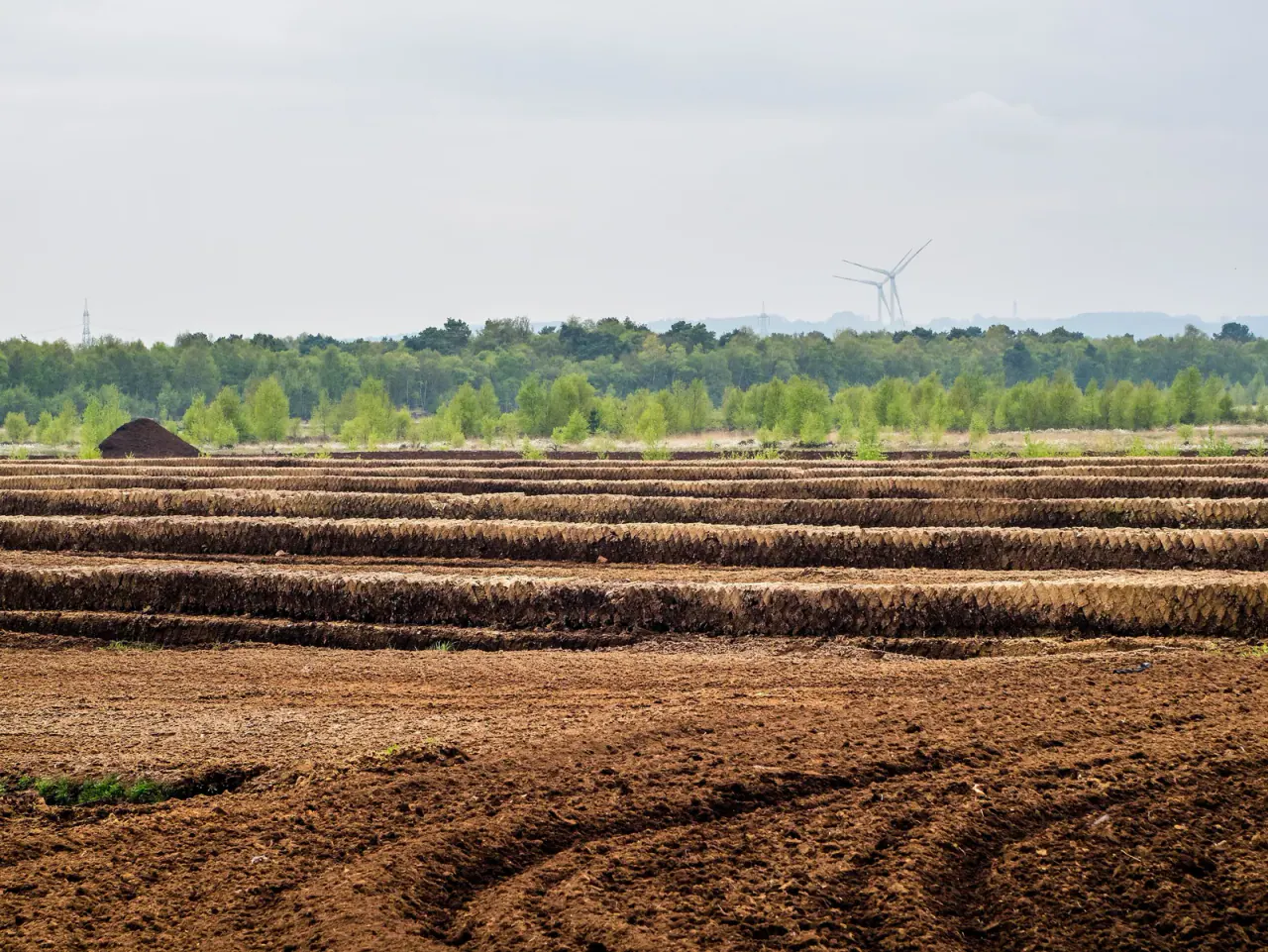
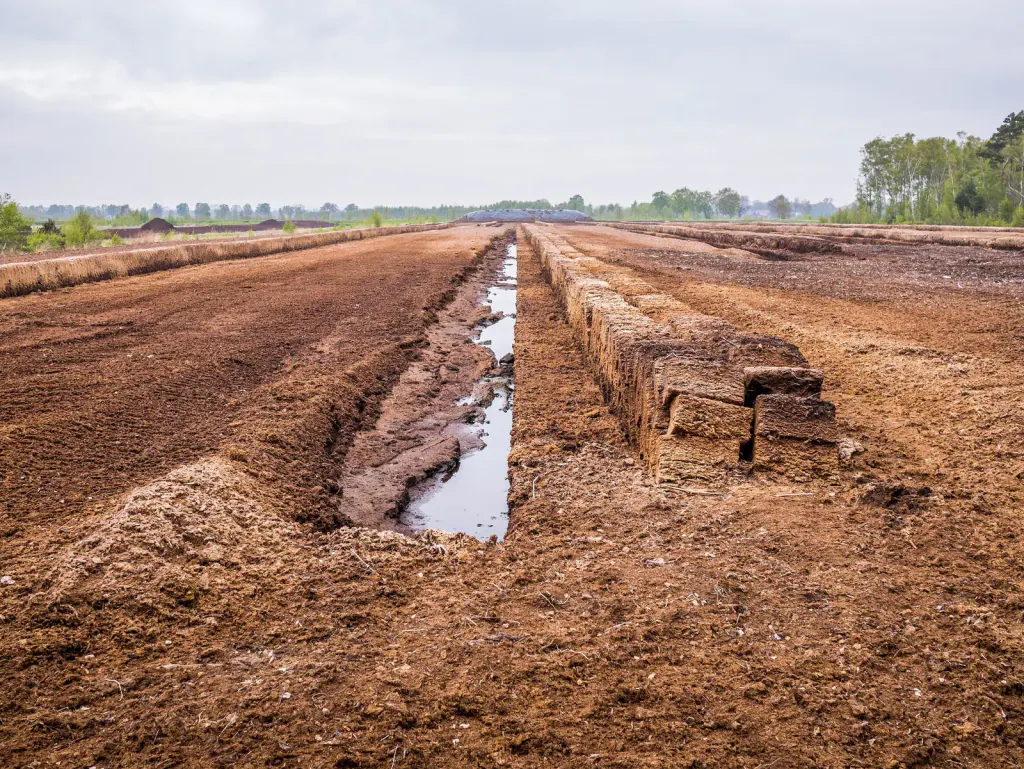
- Photography: the hero, Basotxerri via Wikimedia Commons, CC BY-SA 4.0 (Venner Moor, Lower Saxony, April 2017). The other Wikimedia Commons photographs are credited in their captions. The harvest photograph in chapter 04 and the field in the note above are our own.
- Zelena Biomasna Energija: our fields, harvest and product plans; our calculation of the costs and margins per hectare.