



A miscanthus hedge: layouts of one to five rows, height through the year, boundary distances and uses of the canes
Giant miscanthus grows into a tall green screen every summer and stands as dry canes through the winter until it is cut back. This article describes the layouts we recommend for a screen, from a single row to five staggered rows at 50, 75 or 100 cm between plants, the appearance of the hedge in each month, the rules on the distance from a neighbour's boundary and the uses of the canes cut each year.
Planting in a field: the planting article · The crop: what is miscanthus · The layouts: chapter 03
Main points for planning a miscanthus hedge
-
A miscanthus hedge forms a screen from early summer until the cut in late winter and is open in spring.
The clone grows to 3-4 m by late summer and stands as dry canes through the winter. After the cut the new shoots take until early summer to reach head height. The Royal Horticultural Society lists the plant under hedging and screens as a deciduous grass. -
A dense screen needs two or three staggered rows at 50-75 cm, while a single row at 100 cm forms a thin screen.
No advisory service has published a layout for a miscanthus screen. The layouts in chapter 03 are our own recommendation and are based on the growth of the clumps on our fields. -
On our fields a clump stops widening at about 70 cm at the base, so the hedge extends at most about 35 cm beyond the line of each outer row.
Chapter 03 shows the clumps by age. The clone sets no viable seed, but pieces of rhizome moved with soil can grow into new plants, and sources in the United States describe a wider spread, so the line of the hedge is checked once a year (chapter 05). -
The legal distance from the boundary is 2 m in France and Bavaria and 1 m in North Rhine-Westphalia; in other countries and Länder the local rule has to be checked.
Where the distance depends on the height of the plant, as in France and the German Länder, a hedge that stands over 2 m high for most of the year falls under the larger distance. Chapter 05 gives the rules for France, four German Länder, Austria, England and Wales, Ukraine, Croatia and Slovenia. -
The canes cut each winter can be used as mulch, as a growing-medium component or for quick fires in a fire basket, but not as fuel in a hand-fed stove.
A 30 m single row yields roughly 30-120 kg of dry canes a year. This is enough to mulch 6-22 m² of beds for two seasons; burned in a fire basket, it lasts a few evenings. In Germany straw-like fuels may be burned only in automatic boilers built for them.
The hedge is green from June to October, stands as dry canes from November until the cut and is open in spring
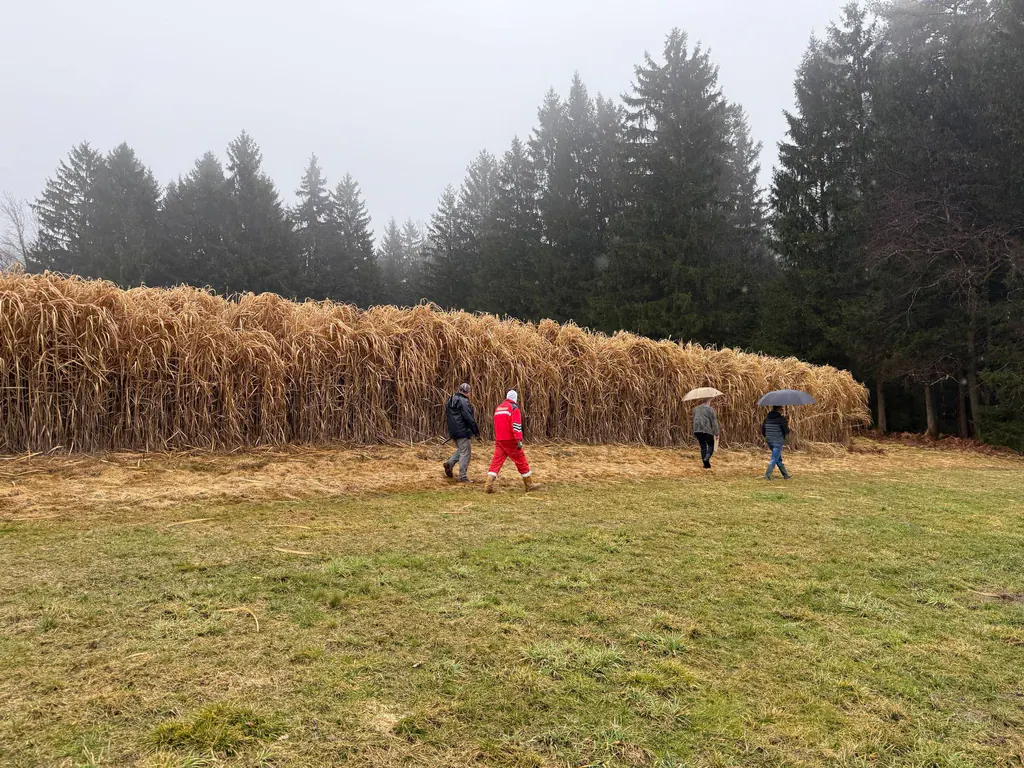
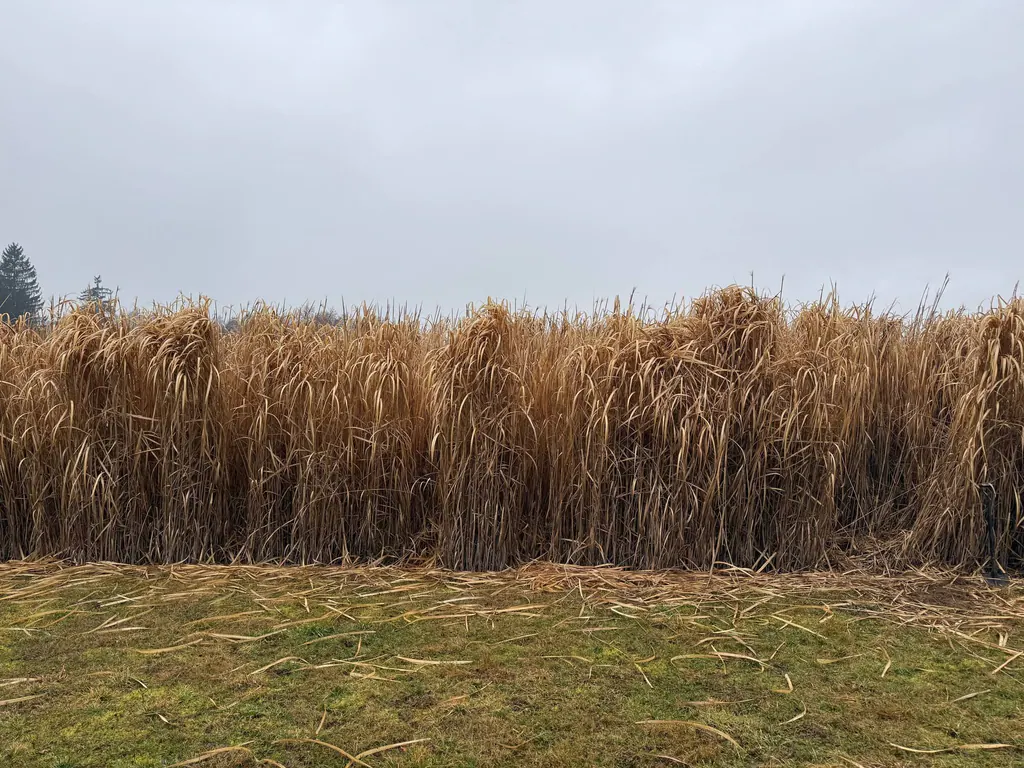
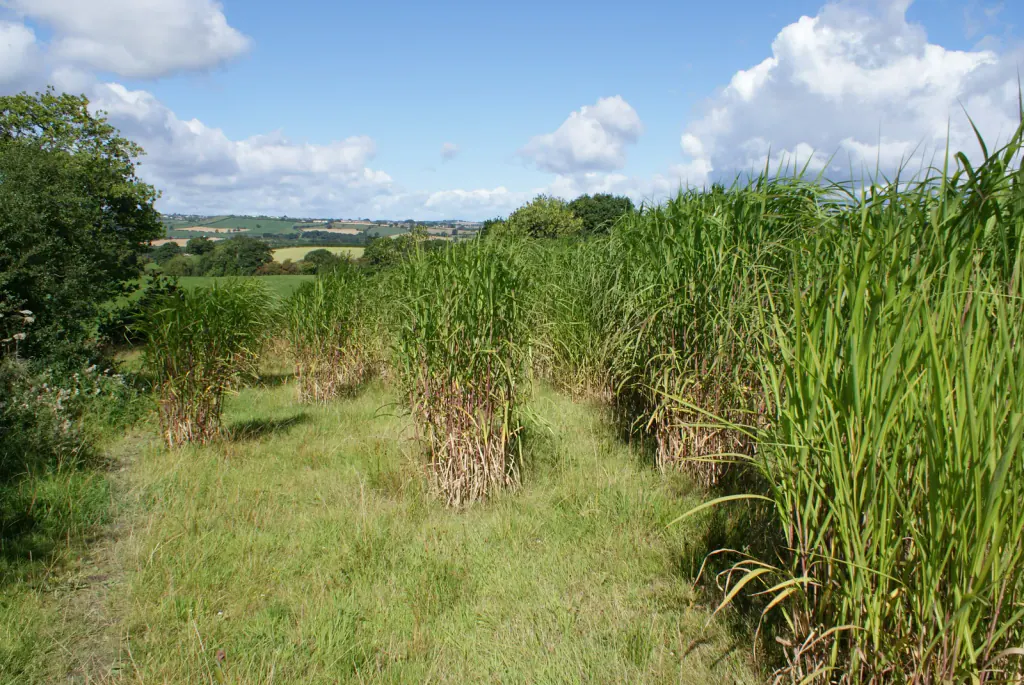
A miscanthus hedge changes more through the year than a hedge of shrubs. New shoots appear in April or May. In trials in Bavaria growth was strongest between May and July, and by August a mature hedge is 3-4 m high and in full leaf. In autumn the leaves turn and fall, and by December the hedge consists of bare, straw-coloured canes. The canes stand until they are cut in February or March. For two or three months after the cut there is only stubble and then a row of young shoots, which do not yet form a screen.
A new hedge takes several years to reach its full height. In trials at six European sites the canopy height in the third summer ranged from 1.8 m in Wales and Moscow to 2.6 m in the Netherlands, and in a Ukrainian trial it reached 2.9 m. From these trials and our own observations we expect a new hedge to form a low screen in its first summer and a screen at eye level in its second or third summer. It reaches full height between the third and the fifth year, sooner on deep, moist soil and later on dry or cold sites.
In cool climates the clone rarely flowers. In long, warm summers it carries pale plumes in autumn, and in either case it sets no viable seed. About a quarter of the autumn dry matter is lost over the winter, mostly as leaves. The leaves fall on both sides of the hedge and form a mulch beneath it that suppresses most weeds along the line.
Full height follows one or two years later.
Year-round privacy
From the cut until early summer the hedge is open. Where privacy is needed in those months, a fence, a wall or a row of evergreens has to be added behind the miscanthus. The miscanthus then provides the height and the summer screen that evergreens take years to reach.
Miscanthus screens from August to March
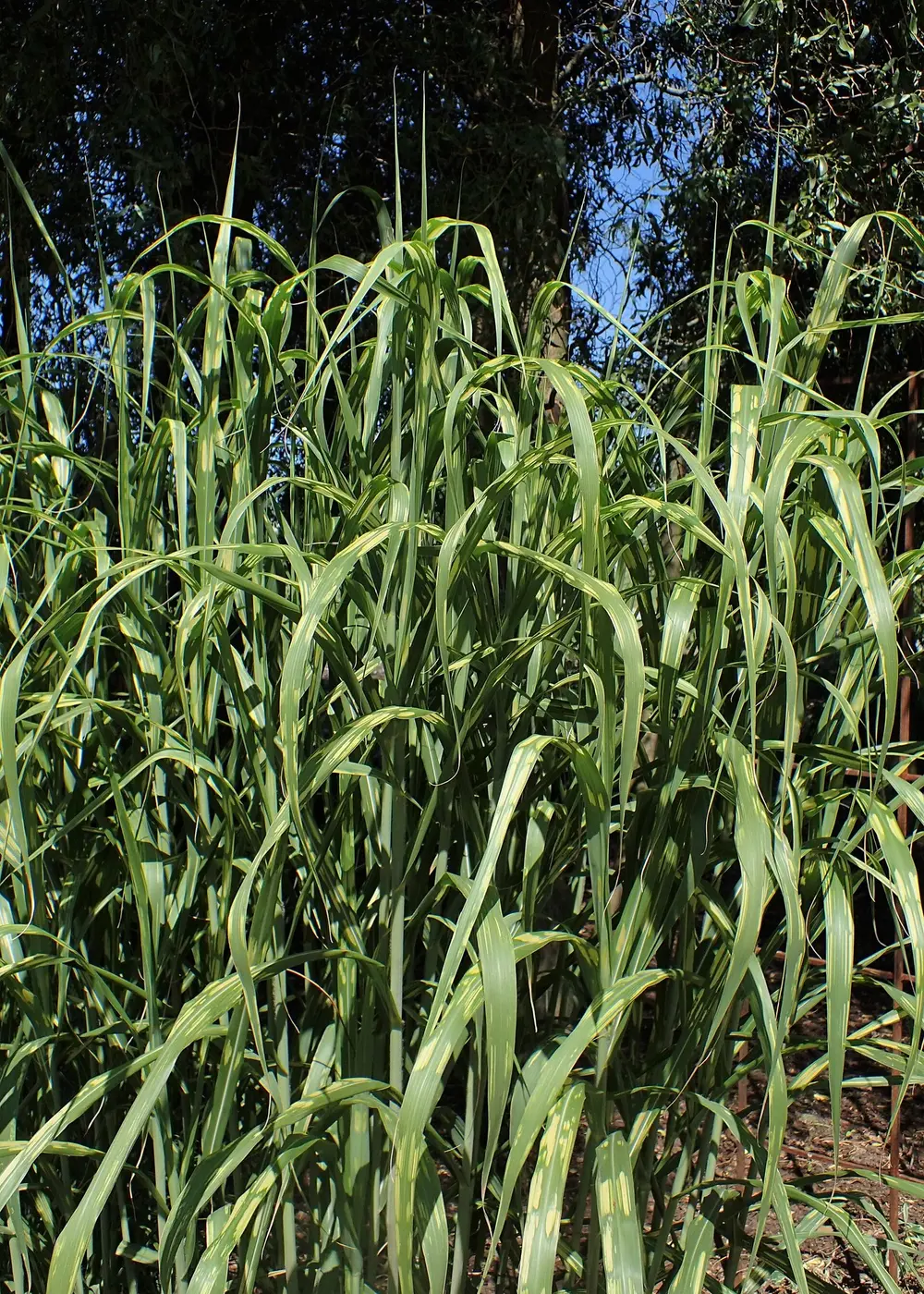
- August · Washington, D.C.

Miscanthus in full leaf in the Power Plant garden of the U.S. National Arboretum, Washington, D.C., in August 2008. Photo by the U.S. Department of Agriculture, via Wikimedia Commons, public domain.
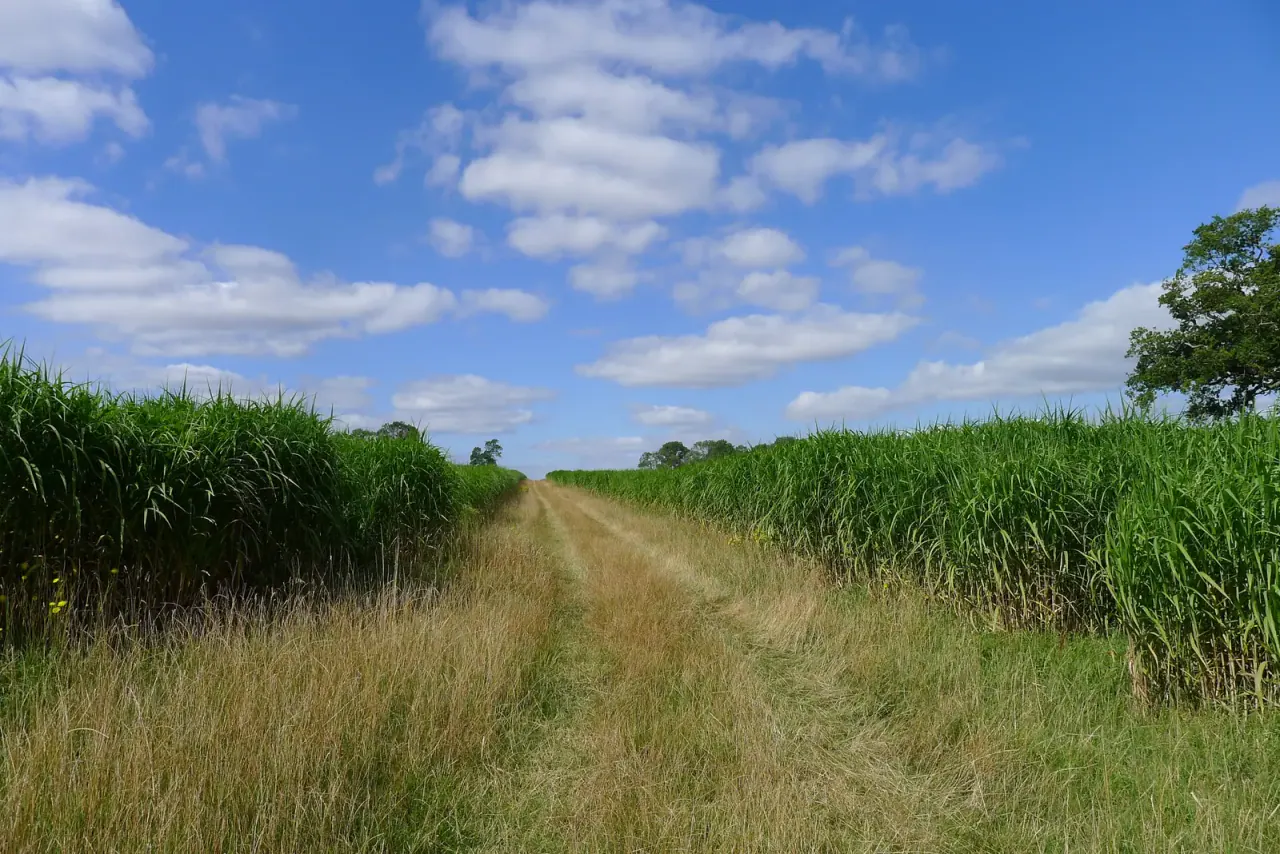
- September · Devon
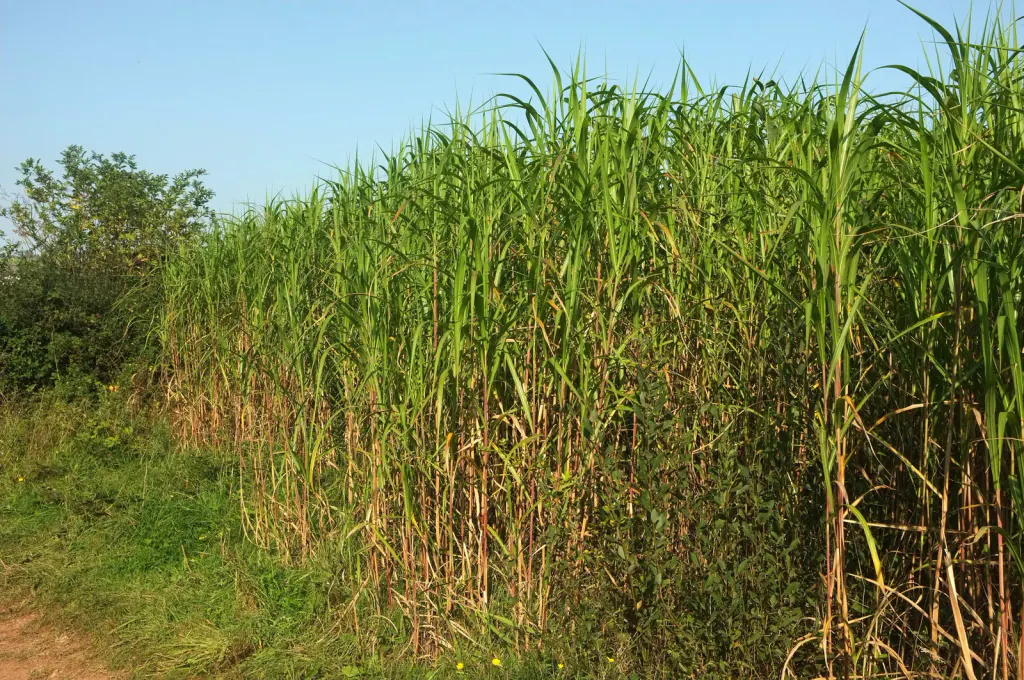
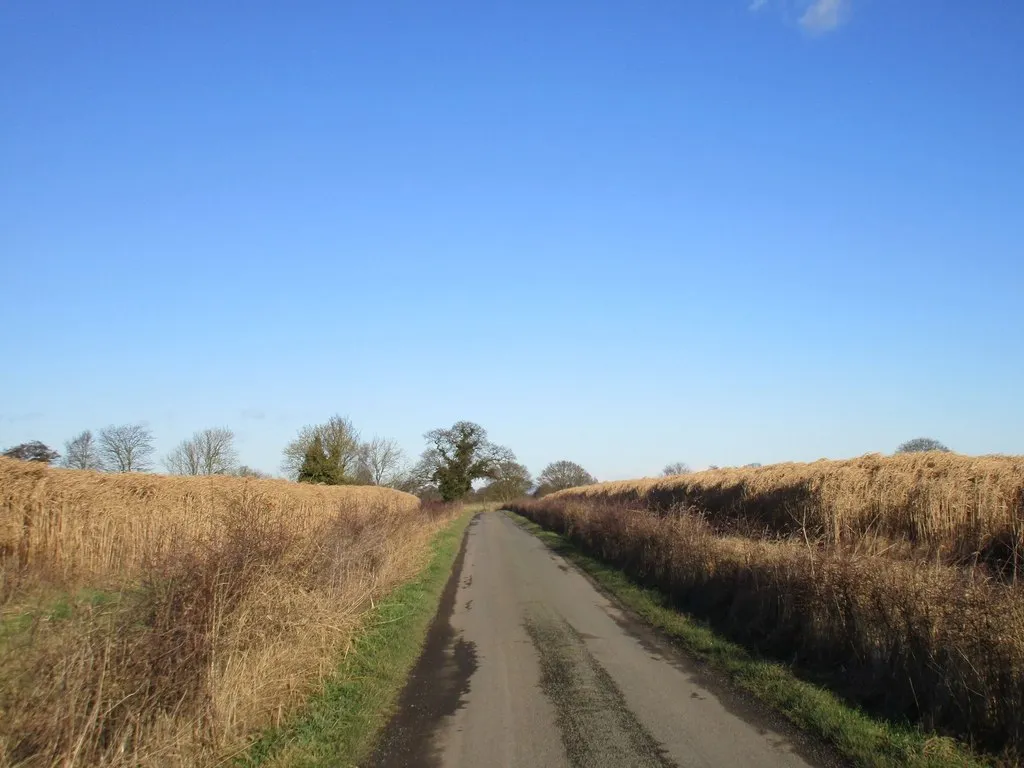
A green wall of miscanthus beside a farm track east of Netherton House, Devon, in September 2020. Photo by Derek Harper, via Wikimedia Commons, CC BY-SA 2.0.
- October · Paris
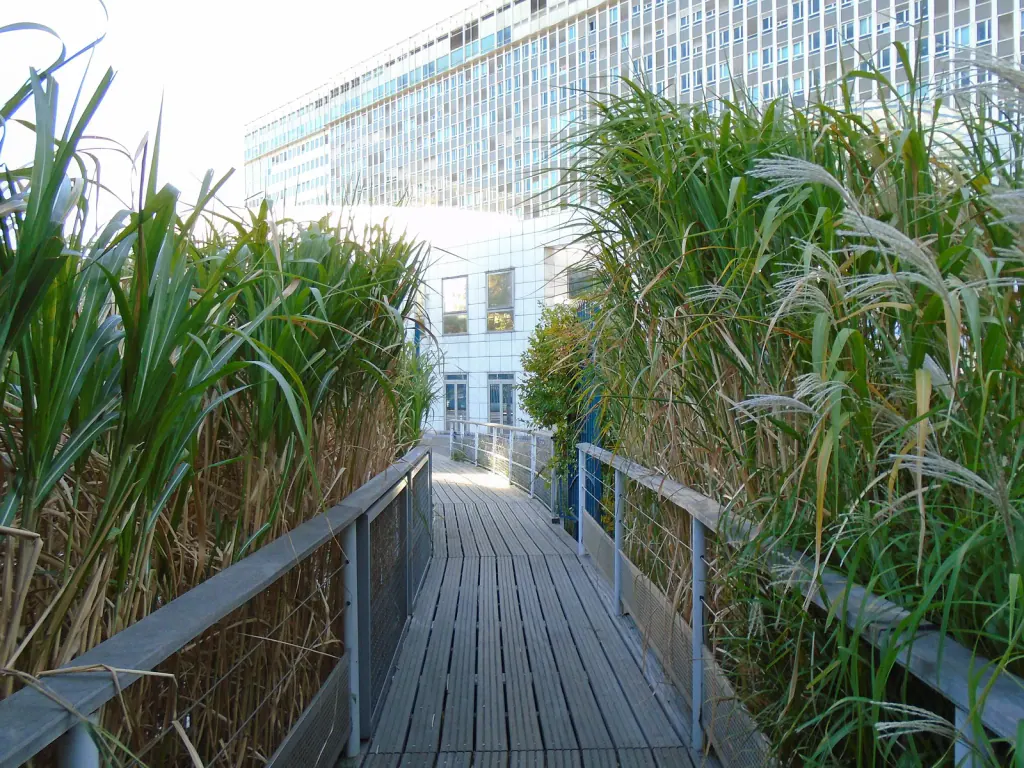
A boardwalk between tall green miscanthus in the Jardin Atlantique, Paris, in October 2016. Photo by Guilhem Vellut, via Wikimedia Commons, CC BY 2.0.
- December · Paris
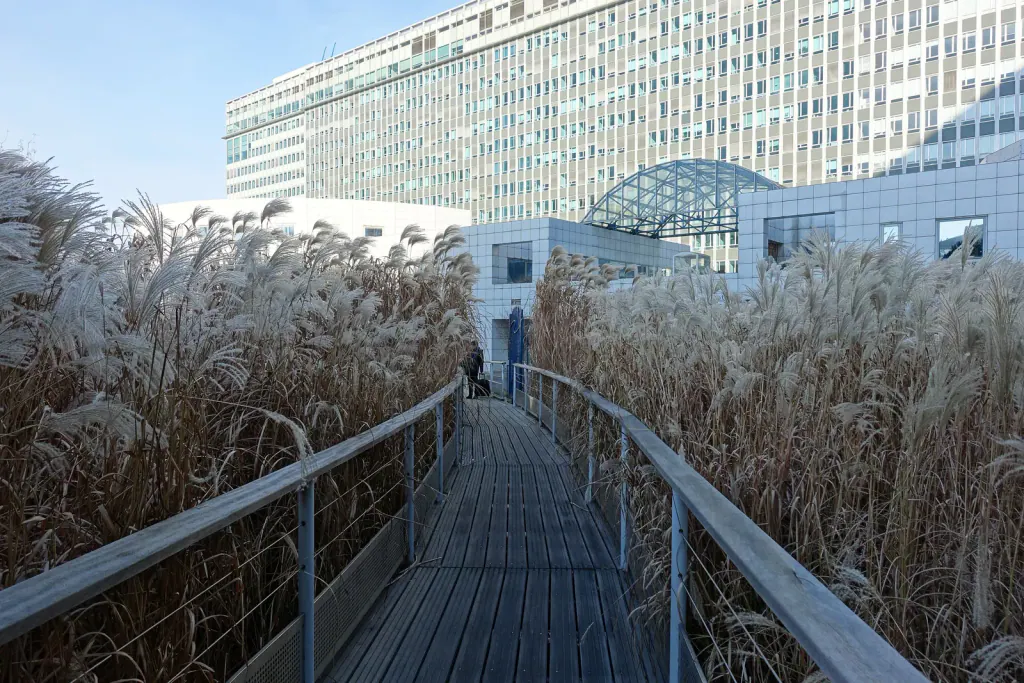
A boardwalk between banks of dry miscanthus in the same garden on 26 December 2015. Photo by Guilhem Vellut, via Wikimedia Commons, CC BY 2.0.
- January · Hampshire
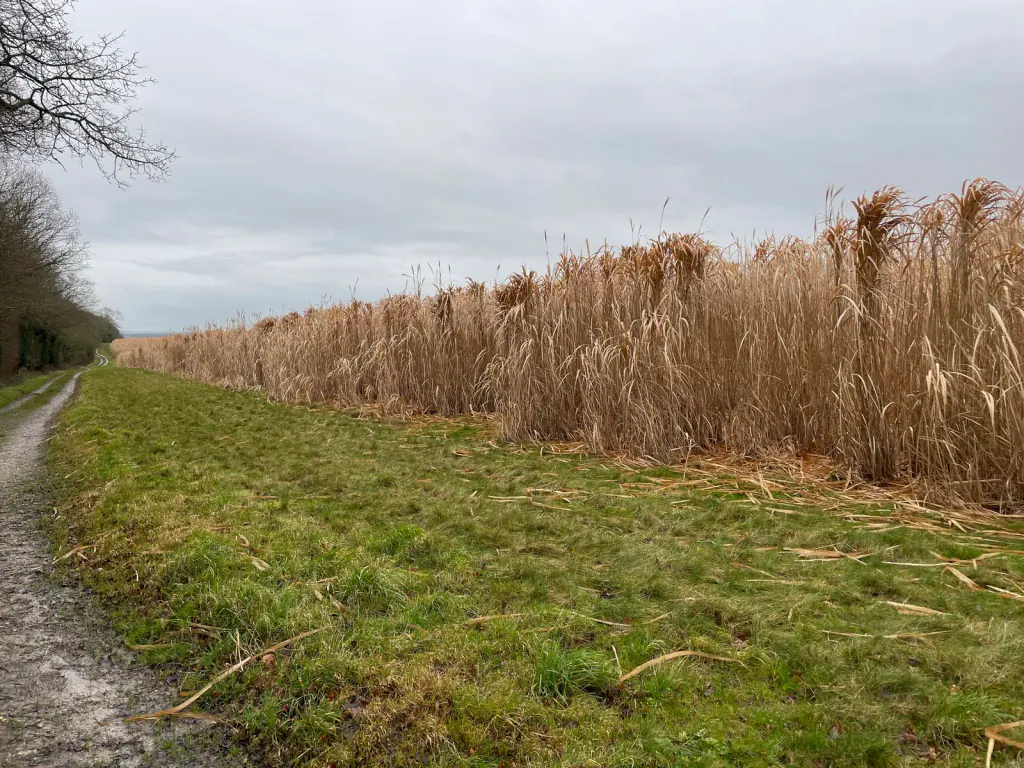
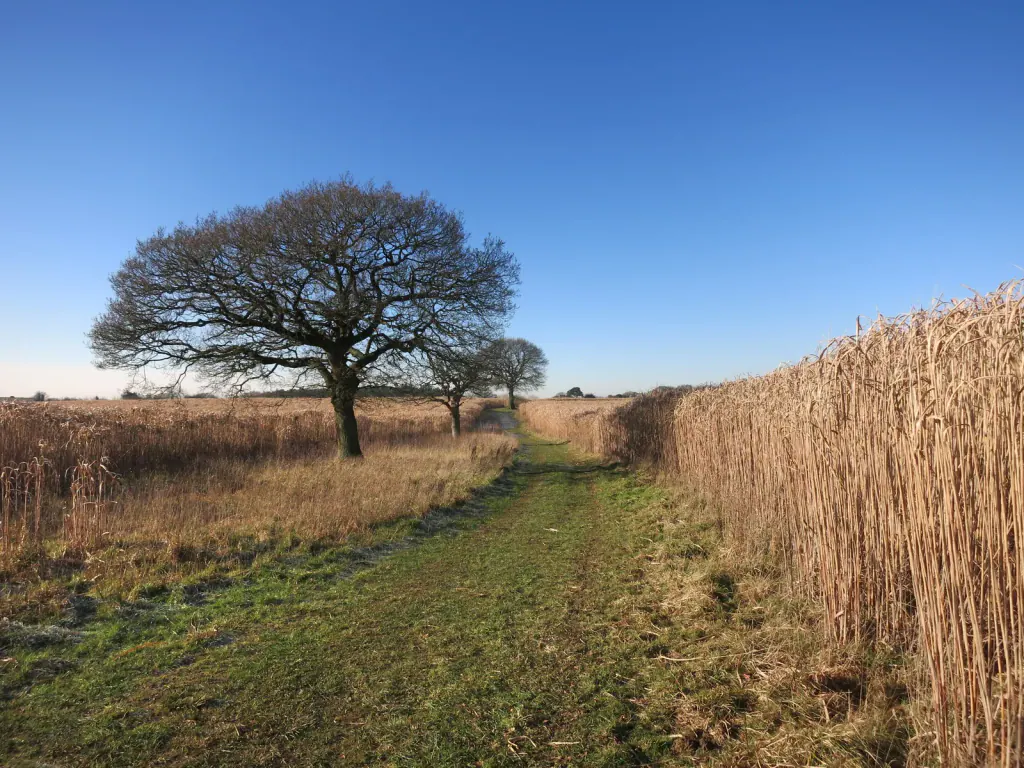
Dry miscanthus along a bridleway across Preston Farms, Hampshire, on 1 January 2024. Photo by Mr Ignavy, via Wikimedia Commons, CC BY-SA 2.0.
- February · Northamptonshire
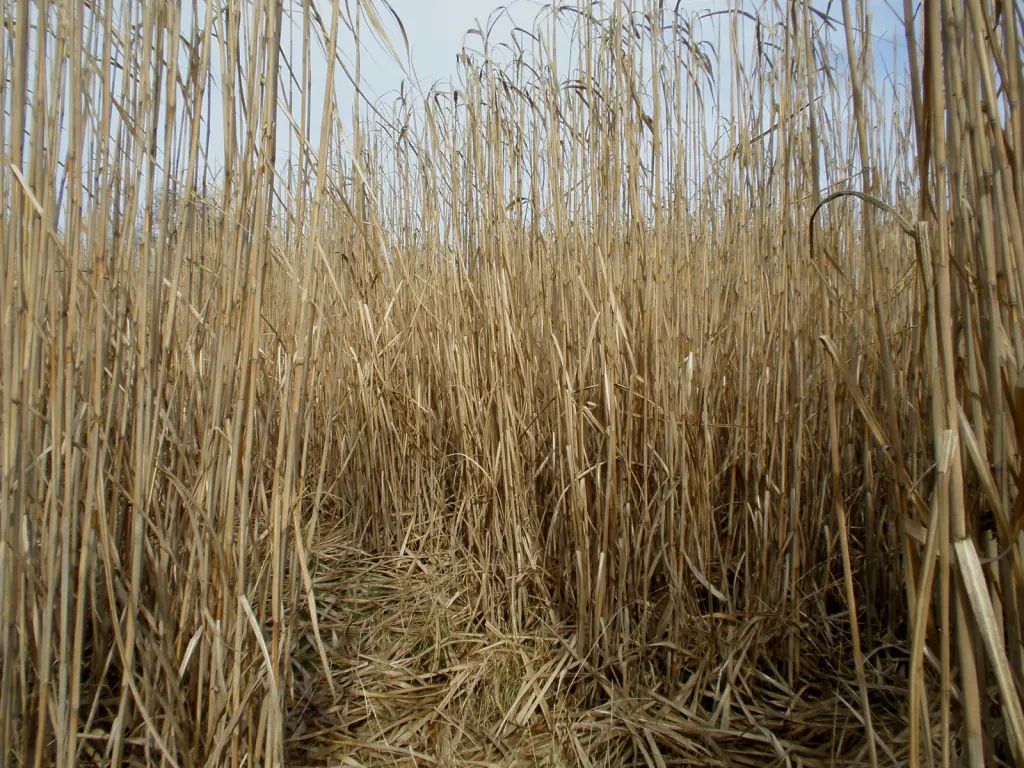
Dry miscanthus canes in the garden at Coton Manor, Northamptonshire, in February 2011. Photo by Amanda Slater, via Flickr, CC BY-SA 2.0.
- March · Devon
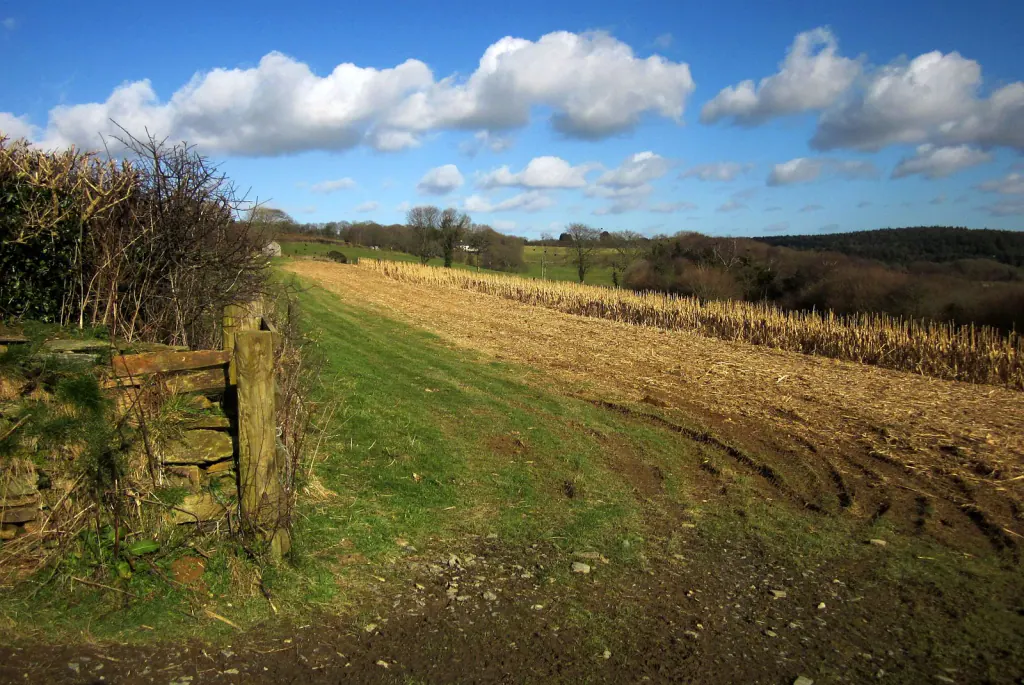
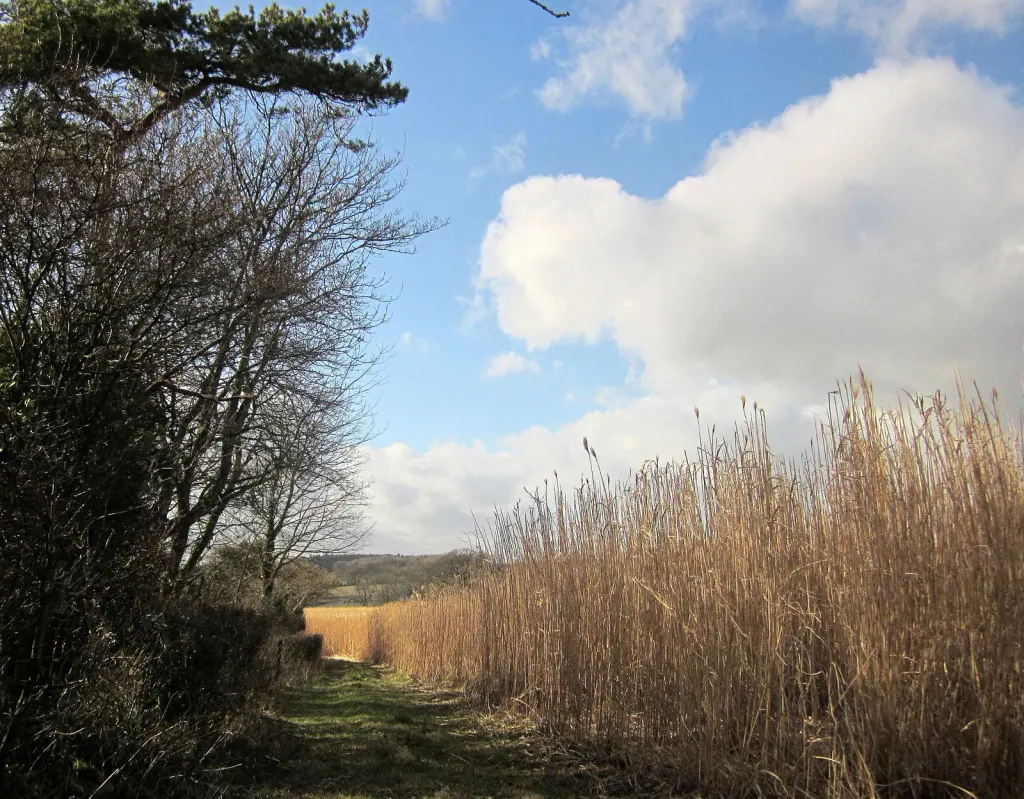
A partly harvested miscanthus field near Lamerhooe, Devon, in March 2015. Photo by Derek Harper, via Wikimedia Commons, CC BY-SA 2.0.
.jpg)

.jpg)
.jpg)


Recommended layouts of one to five staggered rows at 50, 75 or 100 cm
No advisory service or chamber of agriculture has published a layout for a miscanthus screen, and the figures that circulate online come from sellers. The layouts below are our own recommendation and are based on the growth of the clumps on our fields. A clump is about 20 cm across at the base in its second year, about 40 cm in its third and about 60 cm from its fourth. Where there is room it reaches about 70 cm, the largest clump we see, and where it meets its neighbours it stops growing. The figure shows the base of the clumps at each age. The leaves spread wider than the base, so the screen closes at eye level before the clumps meet, and the plants of a second and a third row, offset by half the spacing, cover the gaps in the first row.
| Layout | Rhizomes per 10 m | Width at the base from the fourth year | Screen closed at eye level | Typical use |
|---|---|---|---|---|
| One row, 50 cm | 20 | about 0.5 m | Second or third summer | A garden boundary where space is short |
| One row, 100 cm | 10 | about 0.6 m, later up to 0.7 m | Third or fourth summer | A thin windbreak between fields, with the fewest rhizomes |
| Two rows, 75 cm | 27 | about 0.8 m | Second summer | A screen along a property line |
| Three rows, 50 cm | 60 | about 1.0 m | Second summer | A dense visual screen beside a road or a yard |
| Five rows, 75 cm | 67 | about 1.7 m | Second summer | A windbreak or a wildlife strip on a farm |
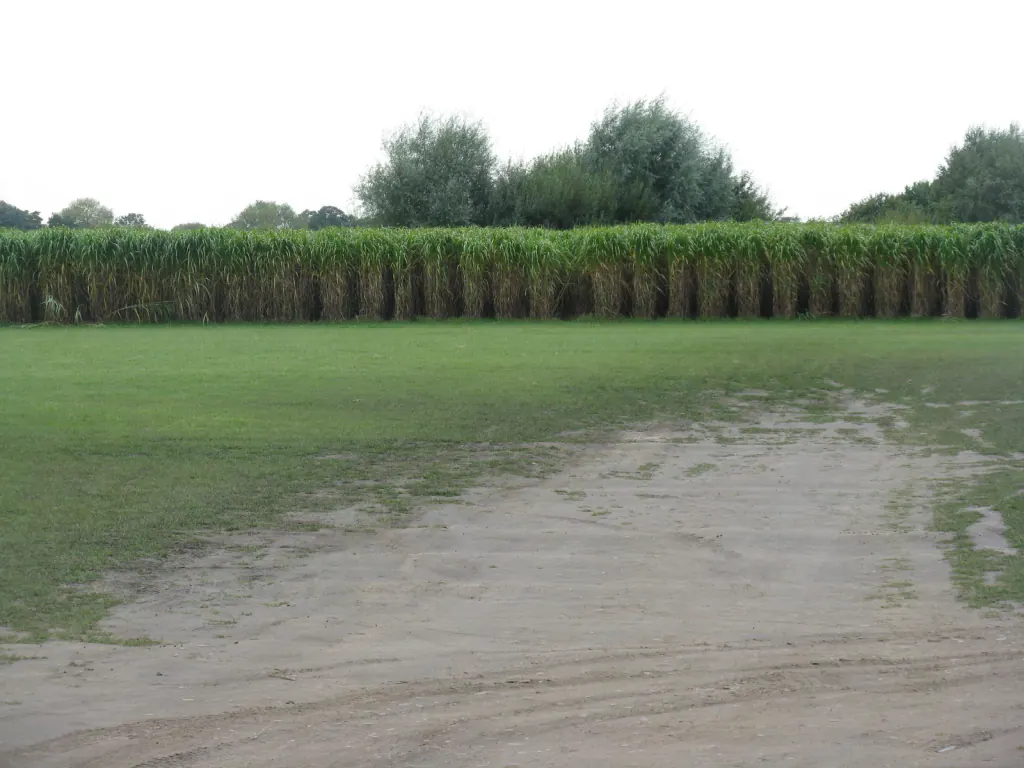

A screen beside a house or garden
Two or three rows at 50-75 cm suit a garden. Such a hedge is about 0.7-1.1 m wide at the base, and its canes can be cut with hand tools. Its outer row is planted at the legal distance from the boundary plus the width the clumps gain beyond it (chapter 05). Beside a road the hedge hides the traffic from view but probably does little to reduce the noise: measurements of thick evergreen hedges found a reduction of 1-4 decibels for light traffic, and nothing has been measured for miscanthus.
A windbreak between fields
Between fields we recommend one or two rows at 75-100 cm. Windbreak guidance for crops specifies a porosity of 40-60%, at which a windbreak shelters a strip of about ten times its height. A dense single row causes turbulence on its lee side. A miscanthus row is dense in full leaf and forms a porous screen of canes in winter, and after the cut there is no windbreak until June. In Normandy, strips of miscanthus 4-8 m wide are planted across slopes to slow run-off and hold the soil.
Cover for wildlife
For wildlife cover three to five rows at 75 cm are suitable. A Bavarian study found that roe deer and hares used a miscanthus stand through the whole winter as a substitute for hedges and copses, that small mammals lived in it and that eight bird species used it, one of them nesting. In surveys in south-west England the crop held more birds than wheat in winter and summer, but of fewer species, most of them birds of woodland and scrub rather than of open farmland.
The hedge is planted by hand in spring, in a strip kept free of weeds for two years
A hedge is planted at the same time of year and by the same rules as a field. The planting date, the depth and the handling of the rhizomes are described in the planting article; this chapter covers what is different for a hedge of a few dozen metres.
Soil quality matters less for a hedge than for a biomass field, because the hedge is not grown for its yield. The plant still needs drained ground: it does not tolerate standing water for long, and it grows slowly on dry sand. Growth is densest in full sun. A hedge on the north side of a house casts its shadow away from the house.
Fertile miscanthus sold as seed, as plugs or as garden cultivars is a different plant. Miscanthus sinensis and Miscanthus sacchariflorus, the parents of the clone, set seed and are on Germany's list of potentially invasive plants. The sterile clone sets no viable seed and grows only from its rhizomes, which are dealt with in the next chapter.
Rhizomes keep for weeks in a cold store and only for hours in the open, so they are planted on the day they arrive.
Shade and water on nearby beds
On the south side of a garden the hedge shades the beds to the north of it in summer, in our experience from about July. Its roots reach more than 2 m deep and take water from these beds.
Planting a hedge step by step
- The strip. Dig or rotovate a strip the width of the hedge plus 50 cm on each side, and clear it of perennial weeds. Couch grass and bindweed in the strip are the usual cause of a thin first year.
- Depth and spacing. Plant the rhizomes 10-15 cm deep, buds upwards, at the spacing of the layout, with the rows offset by half the spacing. A spade or a bulb planter is enough, and for a long row a trench is quicker.
- Firming and watering. Tread the soil down over each rhizome and water the strip if the spring is dry. How well the plants establish depends on the soil moisture between May and August.
- Weed control. Hoe the strip through the first and the second summer, or mulch it with chopped canes once the shoots are up. From the third year the canopy shades the strip.
- Fertiliser. No fertiliser is applied in the first year, because nitrogen delays the ripening of the young plant and promotes weed growth. In later years the hedge needs none on most garden soils.
- The first winter. The thin first-year canes can be left standing through the winter and cut in spring. From the second winter onwards the hedge is cut every year.

Distance from the boundary, width of the clumps and fire risk
The position of the hedge depends on the legal distance from the boundary, on the width the clumps reach and on the fire risk of the dry canes, which stand from autumn until the cut and burn readily. In France and the German Länder the legal distance depends on the height of the plant. The statutes in the table do not name miscanthus; they set general rules, which are given here with their sources.
| Country | Distance from the boundary | Source |
|---|---|---|
| France | Plants over 2 m high at least 2 m from the dividing line, lower plants 0.5 m; local regulations and recognised usages prevail (Paris allows planting to the line). | Code civil art. 671-673; Service-Public.gouv.fr, fiche F614 |
| Germany, Bavaria | Plants over 2 m high at least 2 m from the boundary, otherwise 0.5 m. | Art. 47 AGBGB |
| Germany, North Rhine-Westphalia | Hedges over 2 m high 1 m from the boundary, hedges up to 2 m 0.5 m; public-law rules prevail. | § 42 Nachbarrechtsgesetz NRW |
| Germany, Hesse | Hedges over 2 m high 0.75 m, up to 2 m 0.5 m, up to 1.2 m 0.25 m; double towards vineyards, farmland, commercial and allotment gardens. | §§ 39-40 Hessisches Nachbarrechtsgesetz |
| Germany, Baden-Württemberg | Hedges up to 1.8 m 0.5 m from the boundary; higher hedges the extra height on top (a 3.5 m hedge: 2.2 m). | § 12 Nachbarrechtsgesetz BW |
| Austria | No minimum planting distance in the Civil Code. A neighbour may cut roots and branches that cross the line, and may object to plants that take light or air beyond what is locally usual. | §§ 364 (3) and 422 ABGB |
| England and Wales | No statutory planting distance. The high-hedge rules apply only to lines of evergreen or semi-evergreen plants over 2 m; a deciduous grass is outside them. | Anti-social Behaviour Act 2003, Part 8 |
| Ukraine | On new estate and dacha plots, shrubs 1 m and trees 4-6 m from the neighbour's boundary. A grass is not named; 1 m is the nearest analogue. | ДБН Б.2.2-12:2019, clause 6.1.41 |
| Croatia and Slovenia | No planting distance in the ownership acts; a neighbour may remove roots and branches that cross the line. Municipal rules may add distances. | Zakon o vlasništvu, čl. 104-105; Stvarnopravni zakonik, 81.-83. člen |
In France a plant taller than 2 m must stand 2 m from the line, and a hedge kept below 2 m may stand at 0.5 m. A miscanthus hedge is taller than 2 m from early summer until the cut, so the 2 m distance applies unless a local usage provides otherwise, and a neighbour may demand the removal of a hedge planted closer without proving any harm. In Germany the distances are set by each Land and, for hedges over 2 m, range from 0.75 m in Hesse to 2 m in Bavaria; in Baden-Württemberg the distance grows with the height of the hedge. The civil law of Austria, Croatia and Slovenia and the law of England and Wales set no planting distance. In these countries the neighbour may cut roots and branches that cross the line, and in Austria may also object to plants that take an unusual amount of light.
Half of the largest clump we see, which is about 70 cm across at the base.
Planting distance of the outer row
We recommend adding this width to the legal distance, so that the base of the clumps does not come closer to the line than the law allows. For a distance of 2 m the outer row is planted about 2.35 m from the line. The leaves fall on both sides of the line in any case.
Checking the hedge line
On our fields a clump of the clone grows to about 70 cm across at the base and no wider. Sources in the United States describe a wider spread. The University of Maryland Extension gives about 30 cm of clump diameter a year for the first three years, a study in Illinois measured about 15 cm a year at the edge of four-year-old clumps, and in a model of field edges a 3 m buffer left unattended was outgrown within 11-15 years. We therefore recommend mowing a strip along both sides every year and digging out any shoot that appears outside the line.
Rhizome fragments and removal
Pieces of rhizome can grow into new plants: in experiments, 0-42% of the fragments established. Soil dug from the hedge line should therefore stay on the line, and the hedge should not be planted on the bank of a stream or of a ditch that floods, because water carries fragments downstream. Removing a hedge takes two seasons: the canes are cut, the rhizomes are rotovated or treated, and the regrowth is dealt with in the following year.
Fire risk of the dry canes
From November until the cut the hedge consists of dry, straw-like canes. In a test of landscape mulches, straw ignited from a charcoal briquette in most trials, while bark hardly ever did. Standing miscanthus fields have burned in spring. We recommend keeping the hedge several metres from buildings and wood stores, cutting it before the spring fire season and not lighting fires beside it.



The hedge is cut once a year in late winter, close to the ground, with garden tools
A hedge is cut by hand at the time of year when a field is harvested with a mower and a baler: in February or March, after the canes have dried and before the new shoots appear. The Bavarian advisory service notes that the cut can still be made when the first shoots are showing. For deciduous grasses the Royal Horticultural Society advises cutting close to the ground; we cut at about 10 cm. In its first two or three years a young stand can be mulch-mown.
Tools for cutting and shredding
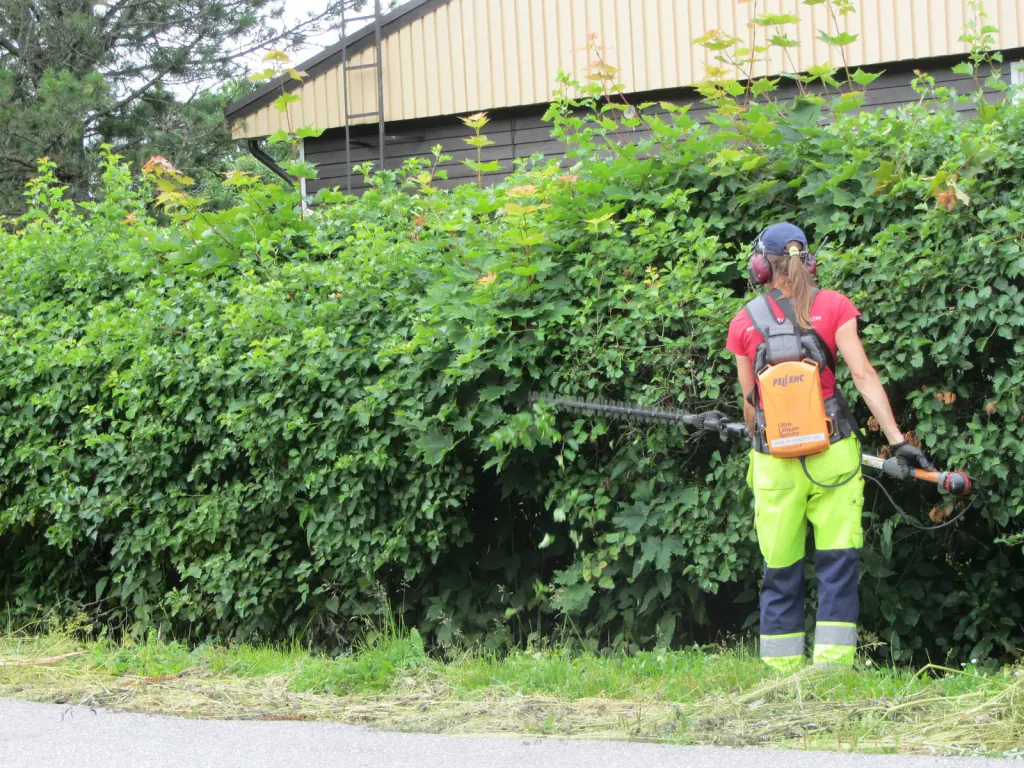
- A hedge trimmer with a long blade cuts a row of dry canes quickly. The canes fall in the direction of the cut and are gathered with a rake.
- A brush cutter with a blade is suitable for a thick hedge of several rows. A nylon line does not cut dry canes of this thickness.
- Loppers or shears are enough for ten metres of hedge, cut cane by cane.
- Gloves and eye protection are needed, because the leaf edges are sharp and the dry canes splinter.
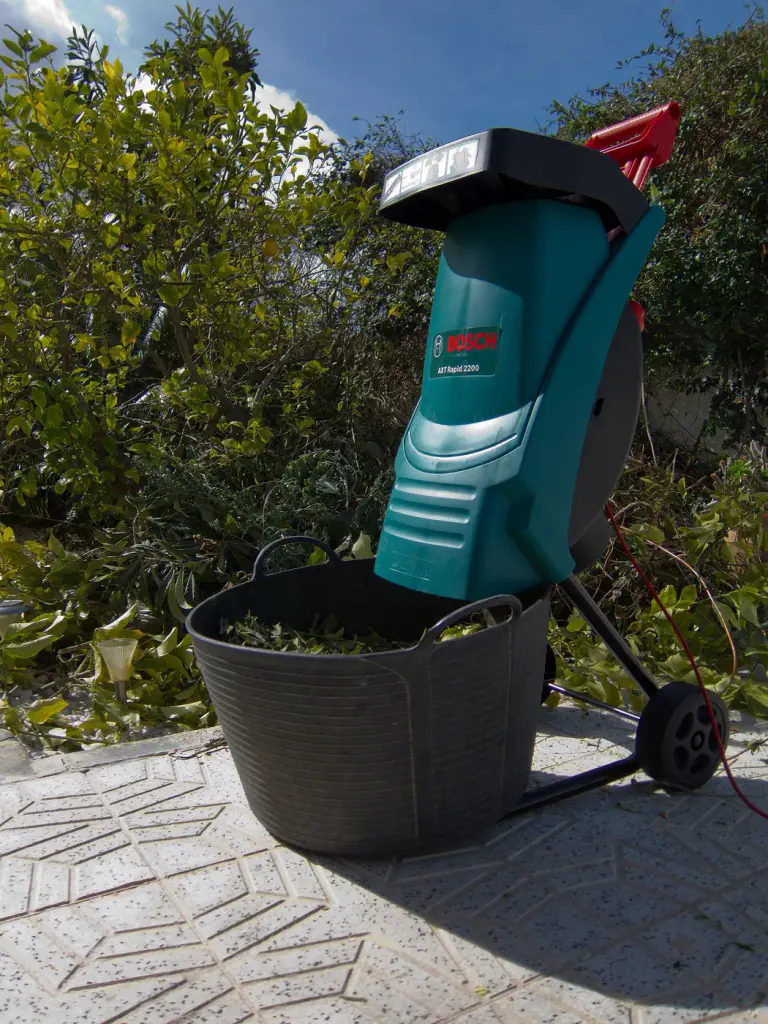
- A garden shredder turns the canes into chips for mulch or compost. A small electric shredder can handle canes of this diameter, and for a long hedge a petrol chipper can be hired for the day.
The canes should be cut on a dry day, because wet canes clog a shredder and a wet pile heats up. By the time of the cut the leaves are already on the ground, and they are left there as mulch.

The cut canes can be used as mulch, in growing media and compost, and in a fire basket
The canes are dry when they are cut: the Bavarian TFZ measures under 15% moisture for a cut between February and May, and they are the same material that is baled from a field. In a garden they are used chopped, as mulch or as material for compost or a potting mix. As fuel they are suitable only for kindling and for quick fires in a fire basket.
| Use | How | Evidence |
|---|---|---|
| Mulch on beds | Chop to 1-3 cm and spread 5 cm deep on clean soil; water it in so the top layer binds | In a French municipal trial, a 5 cm layer kept weed numbers more than 80% below those of bare soil for 18 months and was visibly decomposing after two years. A German orchard trial rates its durability at two growing seasons. A 30 m single row yields 0.3-1.1 m³ of chips, enough for 6-22 m² of beds. |
| A peat-free potting component | Chop finely and compost for about five months with a nitrogen source, or blend 20% raw chips into a potting mix and feed more nitrogen | In a Danish trial, pot plants grew nearly as well in miscanthus straw composted for five months with urea or slurry as in peat. Raw straw ties up nitrogen: a peat mix with 20% straw needed extra feeding, and without it the yield in one strawberry trial fell by a third. |
| Compost and paths | Mix the chips into a compost heap as the carbon-rich bulk, or spread them on paths | The chips rot more slowly than wheat straw and keep a heap open; on paths they last a season or two. |
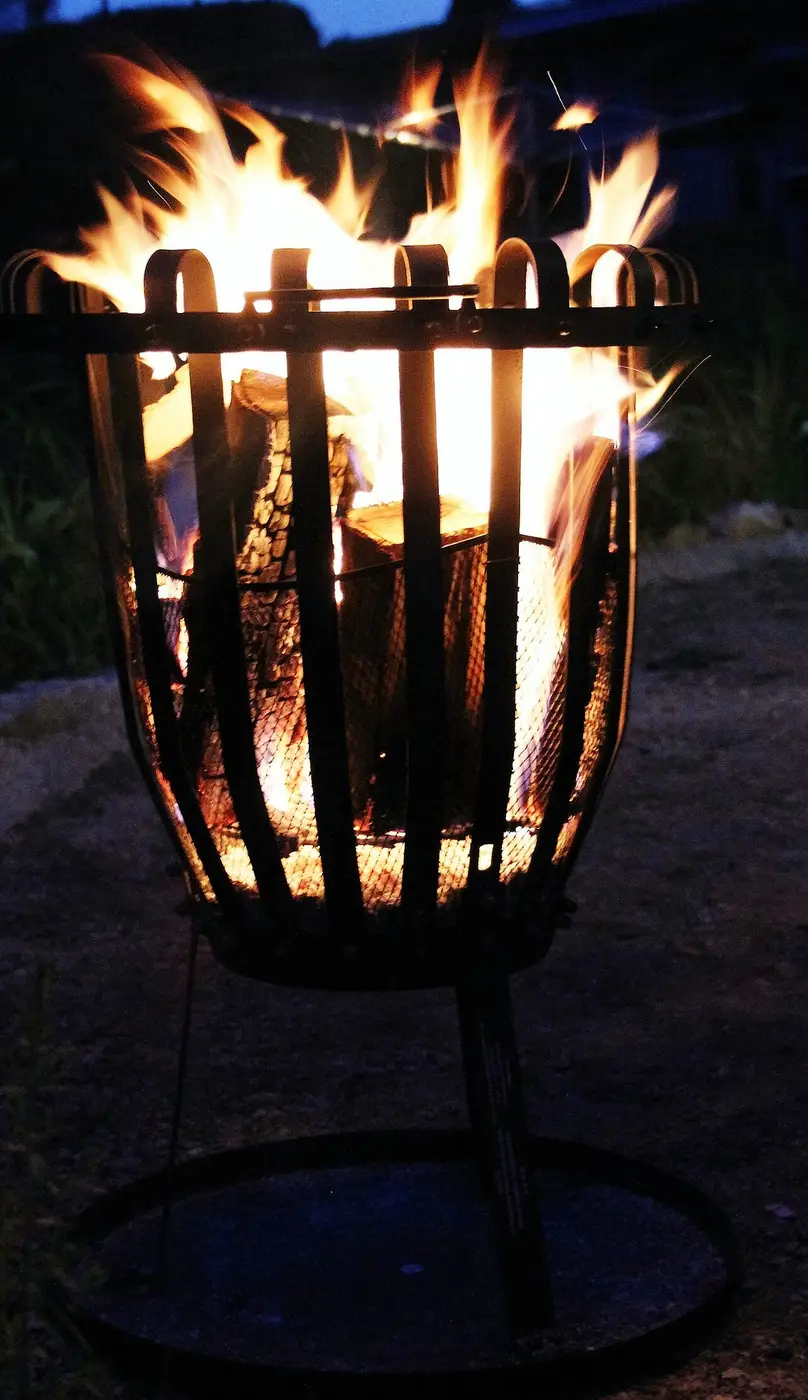
| A fire basket or fire pit | Dry canes, broken to length, where local rules allow an open fire | Dry matter contains about 17 MJ per kilogram, so a 30 m row yields 140-570 kWh a year. Because of their low bulk density the canes burn within minutes and leave few embers; wood or charcoal is still needed for cooking. |
| A stove or boiler | Not in a hand-fed stove | In Germany straw-like fuels, including miscanthus, may be burned only in automatically fed boilers built and type-tested for them, with emission limits to match. The ash content is up to ten times that of wood, and the ash softens at a low temperature. |
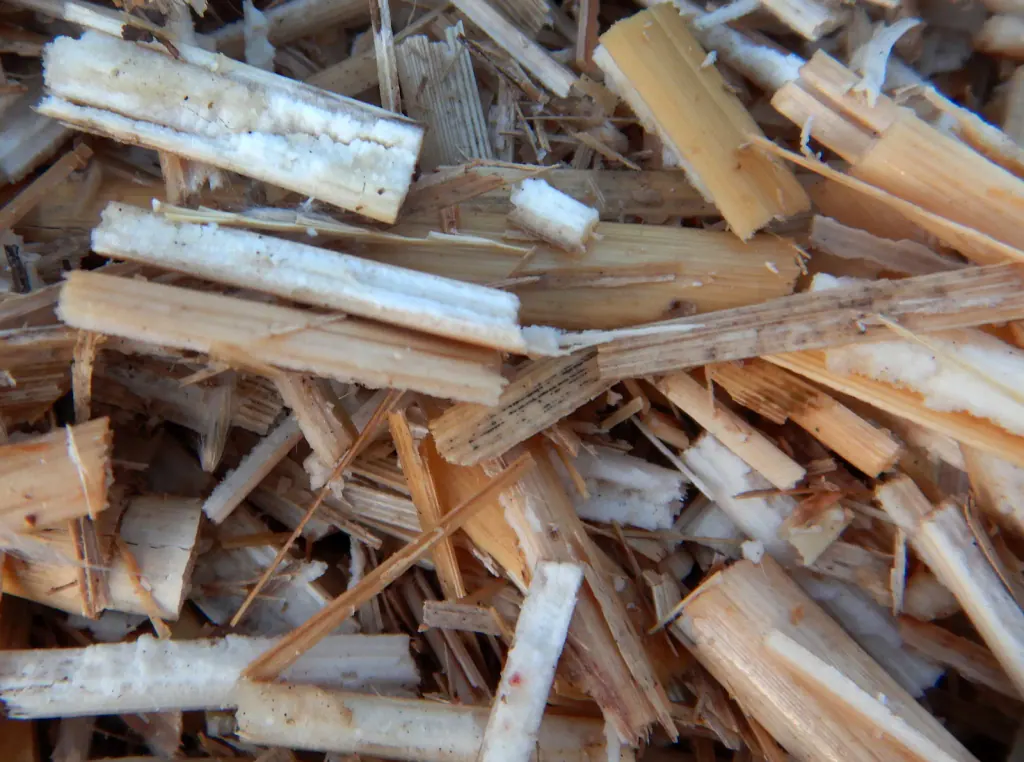

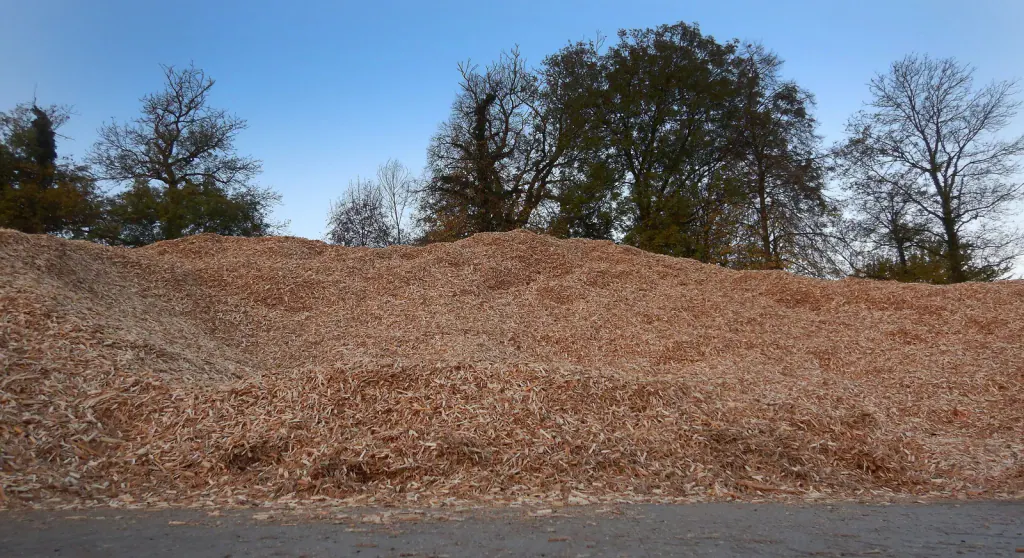

By our estimate, a 30 m single row yields 30-120 kg of dry canes a year. The estimate is based on 0.5-2 kg of dry matter per plant, the range for a field stand yielding 10-20 t per hectare, and on two plants per metre of row. A five-row hedge at 75 cm has nearly seven plants per metre and yields several times as much.
The canes of a 20-30 m hedge are enough to mulch the beds along it for two years, and the surplus can go into the compost. We are preparing chopped miscanthus mulch and a miscanthus-based growing medium as retail products from our own fields; the two articles linked below describe the trial results and how the material is used.
.jpg)

Rhizomes for a hedge, a strip or a screen
A garden hedge
We sell planting stock by the hectare, and our minimum order is three hectares. Write to us with the length and the layout you have in mind, and we will tell you whether and when we can supply a hedge quantity.
Strips on a farm
For windbreaks, erosion strips and wildlife cover the rhizomes are ordered by number; three rows at 50 cm take 600 rhizomes per 100 m. Please send us the length, the number of rows and the planting date.
A municipality or a landscaper
For roadside screens and park plantings we supply the sterile clone, with the genotype and the generation documented for the tender file.
Planting a field, and the two products made from the canes
The planting window, the handling of the rhizomes, the machines and the choice of planting density.
Read it MulchMiscanthus mulch on beds, under glass and in nursery potsTrial results on weeds and moisture, how thick to spread it, and how it compares with bark, straw and wood chips.
Read it Growing mediaMiscanthus as a growing medium: a peat-free substrate componentWhy peat is being replaced, what the trials found, and how the fibre is processed and blended.
Read itFrequently asked questions
A mature stand of the clone reaches 3-4 m by late summer; the Royal Horticultural Society gives 2.5-4 m. The height builds up over several years. At six European trial sites the canopy averaged 2.1 m in the third summer, and the plant is considered mature after two to five years. In its first summer a new hedge usually reaches about waist to chest height.
The hedge does not screen all year. It is green from early summer to autumn and stands as dry canes through the winter, and it is open from the late-winter cut until the new shoots reach head height in early summer. Where privacy is needed all year, an evergreen hedge or a fence has to be added.
In France, plants over 2 m high must stand at least 2 m from the dividing line unless local usage provides otherwise. In Germany each Land has its own rule: 2 m in Bavaria, 1 m in North Rhine-Westphalia and 0.75 m in Hesse for hedges over 2 m. Austria sets no distance, but a neighbour may object to a plant that takes an unusual amount of light. England and Wales have no statutory planting distance. Ukrainian building norms name 1 m for shrubs and 4-6 m for trees on new plots. We suggest treating the hedge as a hedge over 2 m high and adding the width it will gain, which on our fields is at most about 35 cm beyond the outer row.
The clone sets no viable seed, so it does not seed itself. On our fields a clump grows to about 70 cm across at the base and stops growing where it meets its neighbours, so the hedge extends at most about 35 cm beyond its outer rows. Sources in the United States describe a wider spread, so we recommend mowing a strip along both sides every year and digging out any shoot that appears outside the line. Pieces of rhizome moved with soil or carried by floodwater can grow into new plants, so the hedge should not be planted on a stream bank, and soil from the hedge line should stay where it is.
A hedge of the clone cannot be grown from seed, because the clone produces no viable seed. Miscanthus sold as seed is a different plant, usually a fertile Miscanthus sinensis cultivar or a new hybrid. The fertile species are on Germany's list of potentially invasive plants. For a screen we recommend the sterile clone.
A single row needs 40 rhizomes at a spacing of 50 cm, 27 at 75 cm and 20 at one metre. Two staggered rows need twice as many and three rows three times as many, so a dense three-row screen at 50 cm takes about 120 rhizomes for 20 m.
The hedge is cut once a year, close to the ground, in late winter or early spring before the new shoots appear. For a few dozen metres a hedge trimmer, a brush cutter with a blade or loppers are enough, and gloves are needed because the leaf edges are sharp. The cut canes are chopped with a garden shredder for mulch or compost. In the first winter the thin canes can be left standing or cut in spring.
In Germany they may not be burned in a hand-fed room stove: straw-like fuels, which include miscanthus, may be burned only in automatically fed boilers built and tested for them. In a fire basket or fire pit, where local rules allow open fires, the dry canes burn fast and hot but leave few embers, so wood or charcoal is still needed for cooking.
A miscanthus hedge screens a road from view, but its effect on traffic noise is probably small. Measurements of thick evergreen hedges found a reduction of 1-4 decibels for light traffic, most of it from the ground rather than the foliage, and no measurement exists for miscanthus.
About this article
We wrote this article ourselves. We grow miscanthus and sell planting stock, and we used the sources listed below and our own figures.
The information was current when the article was published. Rules change and errors are possible, so please check the figures and the law for your own site before you rely on them.
If you find an error or have more accurate figures, write to us at info@miscanthus.eu or use the form below.

Sources
- Royal Horticultural Society, plant profile Miscanthus × giganteus: height 2.5-4 m, spread 1.5-2.5 m, deciduous, hedging and screens, cut down by early spring. RHS, How to grow ornamental grasses.
- Kalinina, O. et al. (2017). Extending Miscanthus cultivation with novel germplasm at six contrasting sites. Frontiers in Plant Science 8: 563: third-year canopy heights and first-winter losses. Nedilska, U. I. (2021). Podilskyi visnyk 34: third-year height in western Ukraine.
- Matlaga, D. P., Schutte, B. J. & Davis, A. S. (2012). Age-dependent demographic rates of the bioenergy crop Miscanthus × giganteus in Illinois. Invasive Plant Science and Management 5(2): 238-248: spread of 0.15 m a year, no seedlings from spikelets, establishment of rhizome fragments. West, N. M., Matlaga, D. P. & Davis, A. S. (2014). Managing spread from rhizome fragments is key to reducing invasiveness in Miscanthus × giganteus. Invasive Plant Science and Management 7(3): 517-525: buffers of 3 m outgrown in 11-15 years.
- Sater, H., Hirsh, S. & Moyle, J. (2025). Giant Miscanthus: A Perennial Biomass Crop. FS-2024-0734, University of Maryland Extension: about a foot a year of spread in the first three years, roots to 8 feet, stand life 15-30 years, water as the main vector. Vollmer, K. & Rogers, E. (2024). Considerations for Terminating Giant Miscanthus on Maryland Farms. FS-2023-0685. University of Maryland Extension, Ask Extension answer of 18 November 2024 on a privacy hedge.
- Jodl, S., Eppel-Hotz, A. & Kuhn, W. (2008). Miscanthus als Nachwachsender Rohstoff. Veitshöchheimer Berichte 126, LWG: growth peak May to July, no flowering at Güntersleben, the zoological study of roe deer, hares, small mammals and birds. TFZ Straubing (2011). TFZ-kompakt 5: Miscanthus; TFZ (2018). Miscanthus: Ausführliche Anbaubeschreibung: harvest window, mulch-mowing of young stands, cut as regrowth begins.
- Teagasc (2010). Energy Crops Manual and fact sheet Energy 18: height up to 3.5 m, stand life, leaf fall over winter. Strašil, Z. et al. (2016). Research in Agricultural Engineering 62(2): 92-97: dry matter lost between autumn and spring.
- Słomka, A. et al. (2012). Sterility of Miscanthus × giganteus results from hybrid incompatibility. Acta Biologica Cracoviensia Series Botanica 54(1): 113-120. EPPO Reporting Service 2013/251 (the German grey list of potentially invasive plants, BfN-Skripten 352).
- Brandle, J. R., Zhou, X. & Hodges, L. (2006). How Windbreaks Work. EC1763, University of Nebraska-Lincoln Extension. Tamang, B. et al. Windbreak Designs and Planting for Florida Agricultural Fields. FR289, UF/IFAS Extension: porosity, sheltered distance, turbulence behind dense single rows.
- Van Renterghem, T. et al. (2014). Measured light vehicle noise reduction by hedges. Applied Acoustics 78: 19-27. Sage, R. B. et al. (2010). Ibis 152: 487-499 and Bellamy, P. E. et al. (2009). Biomass and Bioenergy 33(2): 191-199: birds in miscanthus in England.
- Service-Public.gouv.fr, fiche F614 Plantations: distances à respecter (Code civil art. 671-673); Conseil constitutionnel, commentaire de la décision n° 2014-394 QPC. Bayerisches AGBGB Art. 47; Nachbarrechtsgesetz NRW § 42; Hessisches Nachbarrechtsgesetz §§ 39-43; Nachbarrechtsgesetz Baden-Württemberg § 12; ABGB §§ 364 and 422 (RIS); Anti-social Behaviour Act 2003, Part 8, ss. 65-66; ДБН Б.2.2-12:2019, п. 6.1.41; Zakon o vlasništvu i drugim stvarnim pravima (NN 81/2015), čl. 104-105; Stvarnopravni zakonik (Ur. l. RS 87/2002), 81.-83. člen.
- Rogstad, A. et al. (2014). Comparing the Ignitability of Mulch Materials for a Firewise Landscape. University of Arizona Cooperative Extension AZ1440. University of Arizona Cooperative Extension (2025). Firewise Landscapes, Backyard Gardener 214.
- Quennesson, S. & Dewaegeneire, P. (2012). Utilisation de paillis pour la maîtrise des adventices sur massifs arbustifs. FREDON Nord Pas-de-Calais. Killer, A. (2023). Mulchmaterialien, trials 2021-2023. DLR Rheinpfalz. Jensen, H. E. K., Leth, M. & Iversen, J. J. L. (2001). Acta Horticulturae 549: 137-146. Debode, J. et al. (2018). Frontiers in Plant Science 9: 213.
- Reisinger, K. / TFZ Straubing (2009). Thermische Verwertung von Miscanthus im Vergleich zu Holz. Landtechnikbericht 154: calorific value and ash. 1. BImSchV § 3 Abs. 1 Nr. 8 and § 5 Abs. 3 (straw-like fuels only in automatically fed boilers). Chambre d'agriculture de Normandie, Bandes ligno-cellulosiques: le miscanthus.
- Zelena Biomasna Energija: clump diameters by age on our fields (about 20 cm in the second year, 40 cm in the third, 60 cm from the fourth, at most about 70 cm), our layouts, cutting practice and first-year observations.