




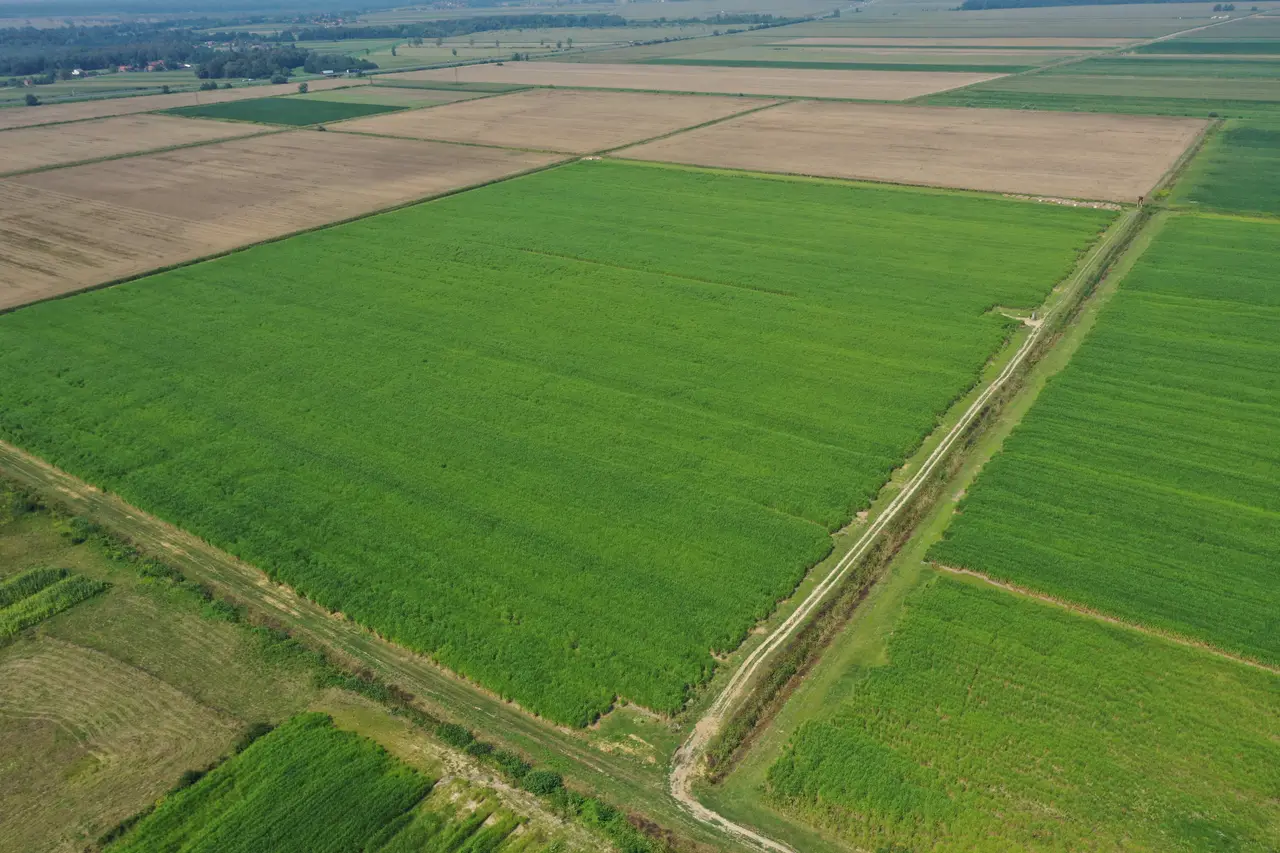
Miscanthus in a company's climate plan: avoided allowances, carbon credits and tax relief in Europe
A hectare of miscanthus holds carbon in its roots and rhizomes and yields 12-18 tonnes of dry matter a year on degraded land, which a company can burn, turn into biochar, build with or sell. This article, written for sustainability, energy and finance directors, sets out what each use is worth under European rules as of October 2026. It starts with the carbon in a hectare and a table of every route, then covers replacing gas in a boiler, biochar, building materials, carbon capture, soil carbon, transport fuels and fibre, the land that qualifies, what a company may report and claim, tax relief and grants, and how a programme is set up.
Every route in one table: chapter 03 · Boilers, ash and permits: the fuel series · Planting: the planting article
Main points for a company's emissions, energy costs and tax
The statements below answer the main questions a company asks about miscanthus and carbon, in the order of the chapters. Each one is explained, with its sources and calculations, in the chapter named at its end.
-
Nothing from miscanthus can be sold into the EU ETS, and no carbon credit counts there.
No offset or removal credit of any kind has counted towards an obligation in the EU ETS since 2021. The only link between miscanthus and the ETS is that an installation in the system needs fewer allowances when it burns certified miscanthus instead of gas or coal, because sustainable biomass is counted at zero emissions. -
In an ETS installation, a tonne of bales burned instead of gas saves allowances worth about €62.
At the 2026 average allowance price of €78, a tonne of bales that replaces gas in an industrial boiler avoids 0.79 t of CO2, worth about €62, or about half the field-edge price of the bale. A hectare yielding 15 t of dry matter avoids about 14 t of CO2 a year, worth about €1,100. Outside the ETS the same switch avoids Germany's national carbon price today and the price of the EU's second carbon market from 2028. This is the largest and most certain carbon value of the crop (chapter 04). -
Burning miscanthus earns no carbon credit.
The saving is a cost that the user of the fuel avoids, and it appears as lower emissions in its own inventory. If the same tonne were also sold as a credit, it would be counted twice. -
Biochar from miscanthus earns removal credits under some standards, at the pyrolysis plant.
Verra's biochar method and Isometric exclude feedstock grown for the purpose; Puro.earth and Carbon Standards International accept miscanthus. The EU certification framework accepts it only in a plant where the biochar holds less than half of the energy the plant exports. At the Puro.earth biochar index of €124 a tonne in September 2026, the harvest of a hectare gives €750-1,900 a year in credits. A 10 MW plant that buys its miscanthus does not cover its costs at today's prices (chapter 05). -
Carbon stored in building materials is credited only by smaller standards, as temporary storage.
Puro.earth has no method for bio-based building products, and Verra has archived its proposal. Credits from Carbon Standards International and the Dutch standards sell for about €85-110 a tonne of CO2 stored (Rainbow publishes no price), and the Dutch state pre-pays €95-110 a tonne through the processors' module of its 2026 fund, for Dutch-grown fibre used in Dutch buildings. Cement-rich miscanthus concrete emits more CO2 than its miscanthus stores, so a product that stores carbon needs little binder, such as a lime- or clay-bound block (chapter 06). -
Capture and storage of the CO2 from burning miscanthus is possible only at large plants near a CO2 store.
EU certification rules for such removals have applied since May 2026. The ETS gives them no value today; a Commission proposal of July 2026 would buy up to 250 Mt of them in 2031-2040, but it is not law. We found no miscanthus plant of this kind in Europe (chapter 07). -
The lasting gain in soil carbon is small, and few schemes pay for it.
Roots and rhizomes hold about 7-14 t of carbon per hectare within the first years and keep it for the life of the stand. The lasting net gain in soil carbon is 0.3-1.5 t of carbon per hectare a year on former arable land, and nothing or a loss on old grassland. No soil-carbon scheme had been recognised under the EU framework by 10 November 2026 (chapter 08). -
EU law lists miscanthus as a feedstock for advanced biofuels, and no European plant buys it for fuel today.
Fuel made from it earns compliance value for fuel suppliers and no carbon credits. Clariant's cellulosic-ethanol plant in Romania closed in December 2023, and the Croatian oil company INA had not decided by October 2026 to build the plant it planned around miscanthus (chapter 09). -
Clearing forest to plant miscanthus is excluded under EU rules.
A harvest from land that was forest in January 2008, or primary or highly biodiverse forest at any time since, fails the EU land criteria. It earns no support and no certified removal units, and an ETS installation that burns it must count it as fossil fuel (chapter 10). -
No EU country exempts a company from profit tax because it invests in a green project.
Three narrower reliefs exist: extra deductions for assets on closed national lists, faster depreciation, and regional tax holidays for new factories. For a large profitable company they return about 2-17% of the eligible investment, once. Planting stock earns no tax relief in any country we checked (chapter 12).
The order of value for a company in October 2026
The first use to consider is a boiler or combined heat and power plant in which miscanthus replaces a fuel that already carries a carbon price, inside the EU ETS or outside it. In that case the value lies in the allowances or taxes the company no longer pays, and it begins with the first delivery of bales.
Where the company has no heat demand of its own, the harvest can go into biochar in a plant that sells its heat to a year-round customer, or into building materials for which a buyer pays for the stored carbon. Both routes earn removal credits, but the market for them is small and depends on a few buyers. Soil carbon can be added to any of these routes, but it is worth little. Carbon capture and storage, and removals in the ETS, are options for very large plants in the 2030s. Chapter 13 sets out how a company sets up a programme and what we supply for it.
A tonne is used and claimed only once
A tonne of harvest can be burned, charred or built into a product only once, and each tonne of CO2 can be claimed by only one party (chapter 11).
Prices and rules in this article
Allowance prices are to 13 October 2026, and every rule is stated as it stood on 14 October 2026. Decisions that were pending on that date were checked again on 10 November 2026, and each carries its own date. Germany is the price example; other countries are named where they differ. Our own calculations are labelled as such.
Carbon in a hectare of miscanthus, and how long each use of the harvest stores it
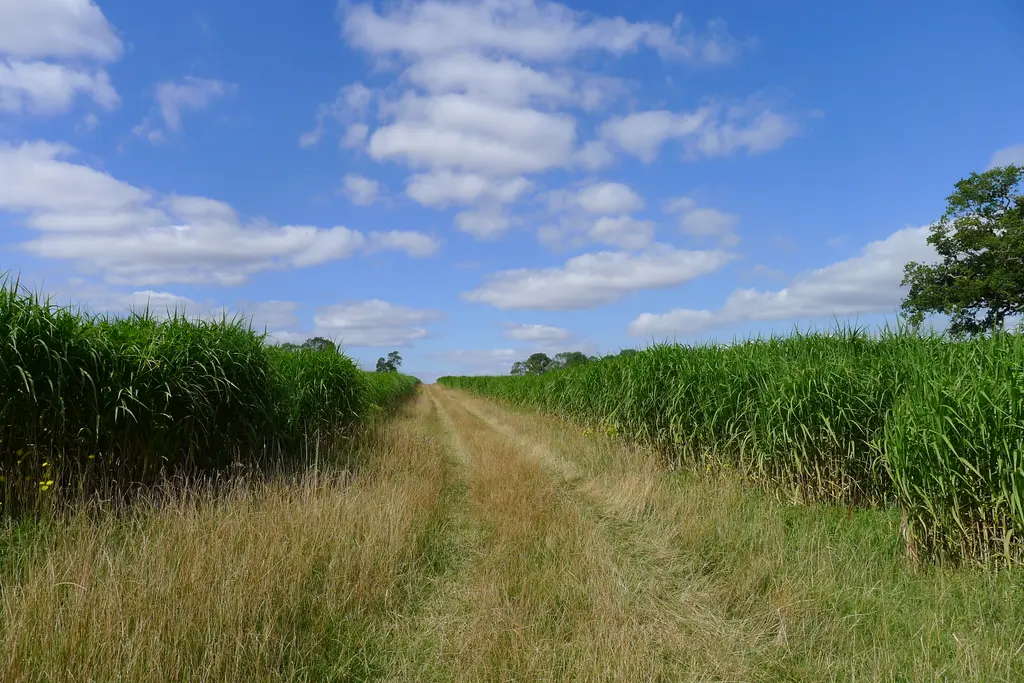
Miscanthus is a perennial grass that is planted once, at 20,000 rhizomes a hectare, and cut every late winter for about 20 years, from the second or third year after planting. Its carbon is held in two places. Below ground, the roots and rhizomes form a standing stock, and the soil slowly gains carbon from fallen leaves and dead roots. Above ground, each harvest contains carbon that the plant took from the air during the growing season, and what happens to that carbon depends on how the harvest is used.
The stock in roots and rhizomes and the net gain in soil carbon
The roots and rhizomes build up within the first few years after planting and then stay roughly constant. They are a large store but a temporary one, because most of the rhizome carbon in the plough layer decomposes when the stand is removed. The EU carbon-farming method and Verra's soil method do not count this pool, and of the schemes we found only the Dutch ONCRA scheme counts it.
The lasting net gain in soil carbon is much smaller than the carbon the plant puts into the soil each year, because old soil carbon continues to decompose while new carbon arrives. On old grassland it is usually nil. Chapter 08 sets out the evidence by previous land use and the schemes that pay for the gain.
Calculation basis: the carbon in the harvest
Dry matter is the weight of the crop without its water. Miscanthus dry matter is 47-49% carbon, and a tonne of carbon corresponds to 3.67 t of CO2, so a tonne of dry matter contains about 1.75 t of CO2; the research we used gives 1.73 and 1.79 for different samples. Bales are harvested at about 14-15% moisture and weigh 18% more than their dry matter, so a tonne of bales holds 0.85 t of dry matter and about 1.5 t of CO2. On degraded land a mature stand yields 12-18 t of dry matter a hectare, and 18-26 t on good soils.
How long the harvest's carbon stays out of the air, by use
When the harvest is burned, its carbon returns to the air within hours, and the climate benefit comes from the gas, oil or coal that the bales replace. Each of the other uses holds the carbon for the period shown in the figure. For biochar the period applies to most of its carbon, and geological storage means CO2 captured from a boiler and injected into a deep geological formation.
The EU certification framework counts carbon stored in a product only if the product lasts this long, as a building does. Paper, packaging, bedding and car parts last less and earn no storage credit; their value lies in the product price and in the fossil material they replace.
Avoided allowances and carbon taxes
When miscanthus replaces gas, oil or coal in a plant that pays a carbon price, the value is the allowances or taxes that the operator no longer pays. It goes to the user of the fuel (chapter 04).
Removal credits
When the carbon of the harvest or of the field is stored, a standard can certify it as a removal and issue credits that a buyer pays for (chapters 05-08).
Product value
Product value is the price a buyer pays for the harvest as fuel, fibre, animal bedding or feedstock. For most growers it is the main income, and the carbon values above come on top of it or are built into it (chapter 09).
Terms used in this article
| Term | What it is | How it applies to miscanthus |
|---|---|---|
| Allowance | A permit to emit one tonne of CO2 in the EU emissions trading system (EU ETS). Each year an installation surrenders one allowance for every tonne of fossil CO2 it emitted, and it buys the allowances it lacks at auction or on the market. | Certified miscanthus is counted at zero emissions, so an installation that burns it instead of gas surrenders fewer allowances (chapter 04). |
| Avoided emission | Fossil CO2 that is not emitted because a fuel or a material has been replaced. It appears as a reduction in the inventory of the company that made the change. | This is the main climate value of miscanthus fuel. In the EU it cannot be sold as a credit, because the reduction is already counted in the user's own inventory and in the ETS. |
| Removal | CO2 taken from the atmosphere and stored in soil, plant biomass, a long-lived product, biochar or a geological formation. A removal is reported separately from emissions and can be reversed if the carbon is released again. | Biochar, building materials, geological storage of captured CO2 and soil carbon under the stand count as removals (chapters 05-08); burning the harvest does not. |
| Carbon credit | A certificate for one tonne of CO2 avoided or removed, issued under a standard such as Puro.earth, Verra or Carbon Standards International and sold to a buyer. The buyer reports it separately from its emissions (chapter 11). | Credits are issued for some of the removals in the row above, under the standards named in chapters 05-08. |
| CRCF unit | A unit certified under the EU Carbon Removals and Carbon Farming Regulation, (EU) 2024/3012. Permanent removal units cover storage for several centuries; carbon-farming units and units for carbon stored in products are temporary and expire at the end of the monitoring period. | Methods exist for biochar and for capture and storage of biogenic CO2. No certification scheme had been recognised by 10 November 2026, so no unit could be bought. |
The routes for the harvest and the field compared by value, recipient and status
The table sets the routes side by side. Each tonne of harvest can go to only one use, so the values per hectare cannot be added together, with two exceptions: soil carbon comes on top of any route, and capture and storage comes on top of the heat saving of the plant that burns the harvest (chapter 07). The values are gross: the boiler, the pyrolysis plant, the capture unit or the factory has to be paid for out of them.
Every route in one table, October 2026
| Route | What it earns | Who receives it | t CO2 per ha a year | € per ha a year | Scale needed | Status |
|---|---|---|---|---|---|---|
| Heat in an ETS installation, replacing gas | Avoided allowances; not a credit | The operator of the installation | 11-17 | €870-1,300 at €78 a tonne | A combustion installation above 20 MW of total rated thermal input; about 83 ha per MW of boiler input | Mature. The fuel must be certified under the renewable energy directive (chapter 04). |
| Heat outside the ETS, replacing gas | Avoided national carbon price: Germany's CO2 price now, the EU's second trading system (ETS2) from 2028 | The company that buys the fuel | 11-17 | €610-1,090 at Germany's €55-65 a tonne | A boiler built for straw-type fuel; certified fuel from 7.5 MW | Mature in Germany, Sweden, Switzerland and France; ETS2 from 1 January 2028. |
| Biochar | Removal credits from Puro.earth or Carbon Standards International, and heat for sale | The operator of the pyrolysis plant, unless the supply contract shares the credits | 6-9; 13-15 on good soils | €750-1,900 in credits at €124 a tonne | A pyrolysis plant with a year-round heat customer; a 10 MW plant needs 1,100-1,400 ha | Early commercial. Verra and Isometric exclude miscanthus; the EU framework accepts it only in plants that mainly supply heat (chapter 05). |
| Building materials | Credits for temporary storage from smaller standards at €85-110 a tonne; Dutch state pre-payment of €95-110 a tonne in its processors' module, for Dutch fibre in Dutch buildings | The product maker or the builder, depending on the standard | 7-22, depending on how the standard counts | €600-2,500 | A block or board maker within 25-50 km; a block line takes the harvest of 100-200 ha | Blocks on sale in France from Alkern since 2022; Vicat launched its block in March 2026; the Commission planned to publish the EU method for buildings by the end of 2026 and had not done so by 10 November 2026 (chapter 06). |
| Capture and storage of the CO2 (BECCS) | Permanent removal units; state support in Sweden and Denmark; ETS purchases from 2031 under a proposal | The capture plant | 18-27; 39 on good soils | €2,800-4,300 at €158 a tonne, our calculation of the Swedish award per tonne; most of it pays for capture, transport and storage | A plant of 20 MW or more on 1,400-2,100 ha, with access to a CO2 store | EU certification rules since May 2026; no miscanthus plant in Europe (chapter 07). |
| Soil and rhizome carbon | Temporary carbon-farming credits | The farmer, or the company that funds the planting | 1-5.5 on former arable land; none or a loss on old grassland | €35-190 at €35 a tonne | Any area, with soil sampling before planting and every five years | One Dutch scheme certifies miscanthus; no scheme recognised under the EU framework (chapter 08). |
| Transport fuels | Compliance value for fuel suppliers under quota and blending obligations; no credits | The obligated fuel supplier | 5.8 as ethanol; 8.7 as biomethane (15 t of dry matter) | €870-1,970 of German quota value for the ethanol, at reported prices | An ethanol plant of 25,000 t a year needs about 8,300 ha | No European plant buys miscanthus for fuel (chapter 09). |
| Paper, bedding, mulch, packaging and car parts | The product price; no storage credit for products that last less than 35 years | The grower, through the price of the fibre | None credited | The product price only; bedding sells for €120-180 a tonne in France | A mill or converter within about 80 km | Tissue, bedding, mulch and growing media are commercial; packaging, car parts and chemicals are not yet made from miscanthus on a commercial scale (chapter 09). |
| Credits for burning the harvest | Nothing | - | - | €0 | - | Not available: the saving is already counted in the ETS and in the user's own inventory. |
Carbon value per tonne of bales, against the price of the bale
Where miscanthus replaces gas in an ETS installation, the allowances it saves are worth about half the price of the bale at 2026 prices, and where it replaces coal, about the whole price. These savings need no buyer for credits.
Credit revenue goes to the pyrolysis plant, the product maker or the capture plant, and not to the grower. Per tonne of bales it is of the same order as the allowance saving. Capture and storage has the highest gross value in the figure (chapter 07). Soil carbon adds a few euros per tonne.
For a company that already burns gas under a carbon price, the switch to miscanthus is therefore the first route to examine, and chapter 04 works it through for two boilers.
Burning certified miscanthus instead of gas saves EU allowances or the national carbon price
The EU ETS covers combustion installations with a total rated thermal input above 20 MW. CO2 from biomass is counted at zero in the system, but only if the operator shows that the fuel meets the sustainability and greenhouse-gas criteria of the renewable energy directive (RED, Art 29); biomass without that proof is counted as fossil fuel. The value of the switch is the allowances the installation no longer has to surrender for the gas it stops burning. Below 20 MW the same switch avoids the national carbon price on gas where there is one, as in Germany, and from 2028 the price of the EU's second trading system (ETS2), which covers heating fuels in every member state. Boilers, ash and permits are covered in the fuel series, and process heat in its grain-drying part.
Certification from the field to the boiler
Every link in the chain, field included, must be covered by a certification scheme recognised under the RED, such as SURE or ISCC. The operator records the zero-rated biomass in its ETS monitoring plan, and the verifier checks the certificates every year. Outside the ETS the criteria apply to heat plants of 7.5 MW or more, and member states may set a lower threshold.
The status of the land in January 2008
Each farm must show that its fields were not forest, wetland or peatland in January 2008, and not highly biodiverse grassland, primary forest or heathland at any time since. If one field fails, the bales from it cannot be zero-rated. Chapter 10 explains the rule and what such fuel costs an ETS installation.
A greenhouse-gas saving of at least 80%
A heat plant that started after 20 November 2023 must save at least 80% of greenhouse gases against the fossil comparator. The directive gives no default value for miscanthus, so the operator calculates actual values. Miscanthus grown and burned within a few hundred kilometres meets the threshold, as the life-cycle figure further down this chapter shows.
Calculation basis: what a tonne of bales replaces
A tonne of bales contains 4.08 MWh, or 4.80 MWh per tonne of dry matter. An industrial miscanthus boiler converts 88% of it into heat, 3.59 MWh, and a gas boiler would need gas containing 3.90 MWh to deliver the same heat at 92%. Gas emits 0.202 t of CO2 per MWh, so a tonne of bales avoids 0.79 t of CO2, or 0.93 t per tonne of dry matter. With a smaller boiler of 82% efficiency the figure is 0.74 t; against coal it is 1.44 t per tonne of bales. A hectare avoids 11.1, 13.9, 16.7 and 20.4 t of CO2 a year at 12, 15, 18 and 22 t of dry matter.
The ETS basis and the life-cycle basis of the saving
The ETS and national carbon prices count only the CO2 from the gas that is no longer burned, and every figure in this chapter is on that basis. Our fuel article gives about 0.9 t per tonne on a life-cycle basis, measured against the directive's fossil comparator of 288 g of CO2 per kWh of heat; on that basis miscanthus heat saves 91-92%. Both figures are correct on their own basis, but only the first one reduces an ETS or carbon-tax bill.
Carbon prices on gas heat in Europe, 2026
| Carbon price | Per t CO2 | € per MWh of gas heat | € per t of bales | Note |
|---|---|---|---|---|
| EU ETS allowance, 2024 average | €64.75 | 14.2 | 51 | EEX primary auctions |
| EU ETS allowance, 2025 average | €73.45 | 16.1 | 58 | EEX primary auctions |
| EU ETS allowance, 2026 average to 13 October | €78.17 | 17.2 | 62 | The planning price in this article, rounded to €78 |
| EU ETS allowance, 13 October 2026 | €87.04 | 19.1 | 69 | The last auction read for this article |
| Germany, national CO2 price on heating fuels | €55-65 | 12.1-14.3 | 43-51 | 2026 corridor; the first auction, on 1 July 2026, cleared at €65. On 15 October 2026 the Bundestag passed a law that keeps the same corridor for 2027; on 10 November 2026 it was still before the Bundesrat |
| EU ETS2, buildings, road transport and small industry | from 2028 | - | - | Starts on 1 January 2028; extra allowances are released if the price exceeds €45 in 2020 money |
| Sweden, CO2 tax on non-ETS industry | about €135 | 29.7 | 107 | SEK 1,520 a tonne in 2026 |
| Switzerland, CO2 levy on heating fuels | about €130 | 28.5 | 102 | CHF 120 a tonne |
| France, carbon component of the gas excise | €44.6 | 9.8 | 35 | Frozen since 2018 |
| Denmark, CO2 tax on ETS installations | about €21 | 4.6 | 16 | Paid on top of the allowance, DKK 154.9 a tonne in 2026 |
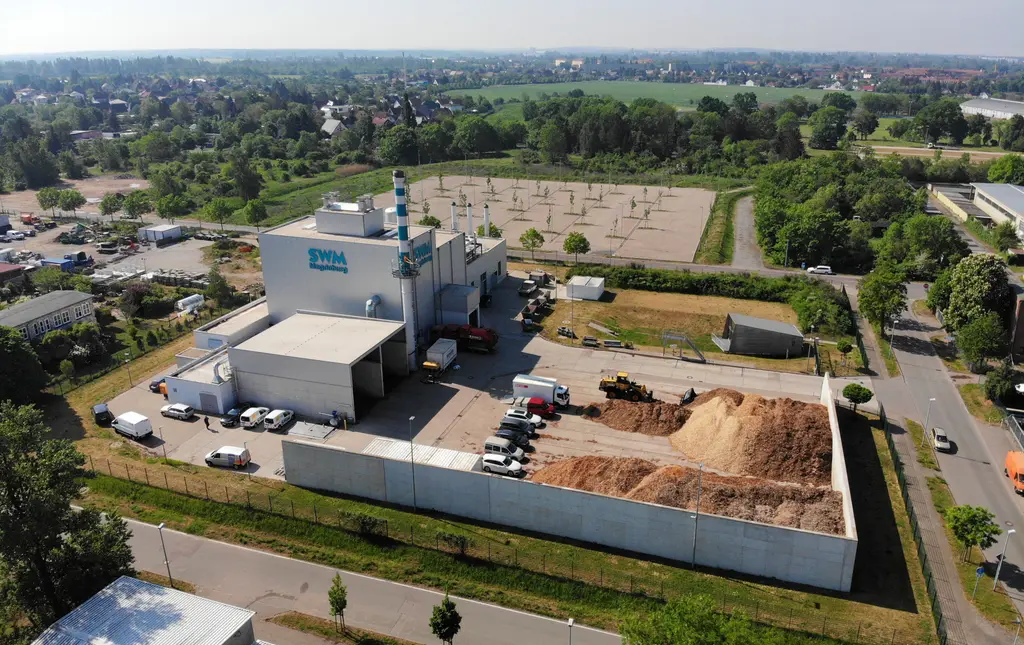
A 10 MW boiler outside the ETS and a 30 MW boiler inside it, in Germany
| Heat delivered at 6,000 full-load hours | 52,800 MWh |
|---|---|
| Bales a year | 14,700 t |
| Land at 15 t of dry matter a hectare | 830 ha |
| Planting stock at our list price, 16.6 million rhizomes | €2.5-3.0 M |
| CO2 avoided a year | 11,600 t |
| Carbon price saved a year, at €65 | about €0.75 M |
| Boiler, installed | about €8.8 M |
| Bales delivered a day | about 40 t |
| Net saving a year, after the boiler and running costs | about €0.62 M |
| Simple payback of the boiler | about 6 years |
| Heat delivered at 6,000 full-load hours | 158,400 MWh |
|---|---|
| Bales a year | 44,100 t |
| Land at 15 t of dry matter a hectare | 2,500 ha |
| Planting stock at our list price, 50 million rhizomes | €7.5-9.0 M |
| CO2 avoided a year | 34,800 t |
| Allowances saved a year, at €78 | about €2.71 M |
| Boiler, installed | about €23.8 M |
| Bales delivered a day | about 120 t |
| Net saving a year, after the boiler and running costs | about €2.8 M |
| Simple payback of the boiler | about 4.7 years |
Our calculation for a food, paper or chemicals site in Germany, with gas at the first-half-2026 industrial price before taxes (€44.1 per MWh of gross calorific value) plus energy tax after the relief for manufacturing, bales at €125 a tonne delivered, a boiler of 88% efficiency, and the boiler priced from the Danish Energy Agency's technology data and paid off over 20 years at 7%. Example A is calculated with Germany's 2026 CO2 price of €65 a tonne, which ETS2 replaces in 2028, and example B with allowances at €78, the 2026 average. The existing gas boiler stays as back-up. Six months of storage takes 37,000-49,000 m³ of bales for A and 110,000-147,000 m³ for B.
Cost of a MWh of heat, Germany, first half of 2026
The saving comes from the carbon price on gas
Including the boiler, heat from miscanthus costs €59-62 per MWh, about the same as heat from gas before any carbon price, €59. The carbon price adds about €14-17 per MWh to gas heat, and that is the saving. In example B the switch would save about €0.1 M a year without any carbon price.
The result depends most on the gas price, then on the number of full-load hours, the carbon price, the bale price and the cost of the boiler. If gas fell by 30%, the switch would need a carbon price of €70-85 a tonne to cover its costs, and at gas prices like those of 2020 it would need about €130-145. A boiler that runs only for space heating, about 2,000-4,000 hours a year, generally does not cover its costs; at 4,000 hours example A makes a small loss (table at the end of this chapter).
Two rules that can change a site's ETS status
- The 20 MW count. Since the 2023 amendment of the ETS directive, boiler units that burn only biomass count towards the 20 MW threshold; units below 3 MW are not counted. A site with 15 MW of gas boilers that adds a 10 MW miscanthus boiler and keeps the gas boilers as back-up comes into the ETS.
- The 95% exit. An installation whose emissions from certified biomass averaged more than 95% of its total emissions over the five-year reference period is not covered in the next allocation period, and it loses its free allocation. The 2031-2035 period uses the data for 2024-2028. The gas such a site still burns then falls under ETS2.
Free allocation does not change when the fuel changes
Free allocation for heat is calculated on the heat produced, not on the fuel, so an installation that switches keeps its free allowances while it stays in the ETS and can sell those it no longer needs. The value of the switch is therefore the full allowance price on the CO2 avoided.
Grants for the boiler
Few grants are open to a miscanthus boiler of this size. Germany's main process-heat grant excludes it; chapter 12 sets out the EU and national schemes that remain.
Land needed and time to full supply
The land a boiler needs follows from its fuel input and full-load hours. The first harvest comes in the second or third winter after planting and the full supply in year three or four, and a boiler takes 12-18 months to build, so the crop should be planted about two and a half to three years before the boiler needs its full supply. Straw can be burned in the same boiler in the first years. Chapter 13 sets out the timeline and how a large area is planted over several springs.
At 6,000 full-load hours and 15 t of dry matter a hectare; 69 ha at 18 t and 104 ha at 12 t.
Read the detailSensitivity of the two examples to prices, hours and costs
| Change from the base case | A: net saving a year | A: payback | B: net saving a year | B: payback |
|---|---|---|---|---|
| Base case | €0.62 M | 6.0 years | €2.81 M | 4.7 years |
| Carbon price €55 (A) / €60 (B) | €0.51 M | 6.6 years | €2.19 M | 5.4 years |
| Carbon price €100 (A) / €120 (B) | €1.03 M | 4.7 years | €4.27 M | 3.6 years |
| Gas 30% cheaper | -€0.22 M | 14.3 years | €0.29 M | 9.4 years |
| Gas 30% dearer | €1.47 M | 3.8 years | €5.34 M | 3.1 years |
| Bales €110 a tonne delivered | €0.85 M | 5.2 years | €3.48 M | 4.2 years |
| Bales €145 a tonne delivered | €0.33 M | 7.6 years | €1.93 M | 5.7 years |
| 4,000 full-load hours | -€0.02 M | 10.8 years | €0.73 M | 8.0 years |
| 8,000 full-load hours | €1.27 M | 4.2 years | €4.90 M | 3.3 years |
The base case
The base case uses the assumptions listed under the two example tables and a boiler cost of about €1.0 M per MW of heat at 10 MW and €0.9 M at 30 MW. With the EU average gas price of the second half of 2025 instead of the German one, example A saves about €0.49 M a year at a carbon price of €65 (€0.37 M at €55), and example B €2.39 M at €78.
Free allocation in example B
If the site's sector is exposed to carbon leakage and receives 100% free allocation, it gets about 17,800 allowances a year at the heat benchmark of 31.2 allowances per terajoule of heat, and it keeps them after the switch.
Biochar from miscanthus: the standards that accept it and the economics of a plant
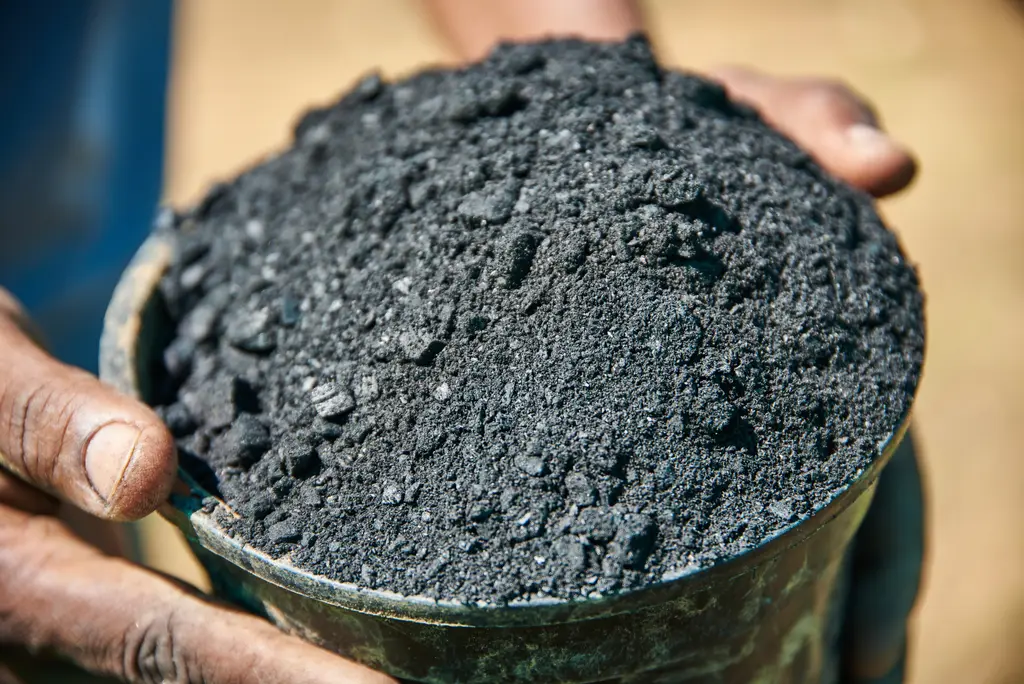
Chapters 05-08 cover the routes that store carbon and can earn removal credits. The first is biochar, charcoal made by heating biomass without air, a process called pyrolysis, and used in soil, animal feed, compost or concrete. Most of its carbon stays stable for centuries, so standards certify it as a removal. A pyrolysis plant also releases gas, which it burns to supply heat.
What a pyrolysis plant makes from one tonne of miscanthus dry matter
- 1 tof dry matter, containing 4.80 MWh and about 1.75 t of CO2
- 0.25-0.29 tof biochar at 73-78% carbon, holding 42-44% of the energy
- 0.70-0.77 tof CO2 held in the char before deductions
- 0.45-0.60 tof CO2 credited, after permanence and the chain's own emissions
- 1.5-2.3 MWhof heat exported by the plantagainstabout 4.2 MWhfrom a boiler burning the same tonne
Which standards accept miscanthus as biochar feedstock
| Standard | Purpose-grown miscanthus | Status, October 2026 |
|---|---|---|
| EU CRCF, Delegated Regulation (EU) 2026/285 | Only in a plant where the biochar holds less than half of the energy the plant exports, batch by batch | In force since 7 May 2026. No certification scheme had been recognised by 10 November 2026, so no unit had been issued. |
| Puro.earth Biochar, Edition 2025 v2 | Yes: non-food crops grown on agricultural land, subject to Puro's biomass sourcing criteria | Issues credits (CORCs) for 200-year storage, for ten years, renewable twice. Applied for CRCF recognition in June 2026. |
| Carbon Standards International, Global Biochar C-Sink, with the EBC | Yes: miscanthus is named on the EBC list of permitted feedstocks | Issues C-sink certificates; fertiliser use on the field must be declared. Its draft standard for the CRCF copies the 50% rule. Applied for CRCF recognition in August 2026. |
| Rainbow | Yes, through the EBC list, after a review of sustainability risks | Applied for CRCF recognition in July 2026. |
| Verra VM0044 v1.2 | No: waste biomass only; "purpose-grown feedstocks are not allowed" | A revision consulted on in July-August 2026 concerns other new feedstocks, not crops grown for the purpose. |
| Isometric Biochar v1.3 | No: crops cultivated for food, feed, energy or carbon removal are ineligible | Applied for CRCF recognition in June 2026. |
The EU 50% test: biochar's share of the energy a plant exports
A plant must sell more heat than its char contains
Under the EU rule, a batch of biochar in which the char holds 50% or more of the energy the plant exports may be made only from waste or residues. Miscanthus grown to be harvested is neither, so a plant using it must export more useful heat to users outside the plant than the energy held in its char, which means more than about 43-44% of the fuel energy in every batch.
That is near the upper end of what slow-pyrolysis plants achieve. A plant designed mainly for biochar fails the test, and a plant with a year-round heat customer passes it by a small margin. If the heat customer takes no heat for a summer, the batches made in that period earn no units. The rule applies only to CRCF certification; Puro.earth and Carbon Standards International have no such rule in their voluntary standards.
Credits per hectare and per plant
At about 0.51 t of CO2 credited per tonne of dry matter under the EU method, the harvest of a hectare gives 6-9 t of credits a year on degraded land (7-10 t at Puro.earth's 0.58 t) and up to 13-15 t on good soils (our calculation). At the Puro.earth biochar index for September 2026 that is €750-1,900 per hectare a year. These credits arise at the plant from the harvest, and they belong to the plant operator unless the supply contract shares them with the grower.
Credit revenue of a million euros or more a year arises only at the scale of a whole plant. The heat-led plant of 10 MW fuel input in the table below takes the harvest of 1,100-1,400 ha and earns about €1.1 M a year in credits at the index price. For each credited tonne of CO2 the plant sells about 3.9 MWh less heat than a boiler burning the same fuel, about €180 at €45 a MWh (our calculation).
Quotes for single projects run from €80 to €200 a tonne, and a few premium deals are above €300.
| Miscanthus, at 15 t of dry matter a hectare | 16,670 t DM, 1,110 ha |
|---|---|
| Biochar | 4,390 t |
| Heat exported, 47% of the fuel energy | 37,600 MWh |
| CRCF units | about 8,500 t CO2 |
| Plant, installed | about €11.7 M |
| Annual cost, including bales and capital | €5.46 M |
| Revenue: heat €1.69 M, credits €1.05 M | €2.74 M |
| Shortfall, with the char given away | -€2.72 M |
Our calculation: bales at €140 per tonne of dry matter delivered (€119 a tonne of bales, slightly below the €125 used in chapter 04), plant cost about €1.17 M per MW of fuel input from the Danish Energy Agency's catalogue as used in a 2026 study, capital over 15 years at 8%, heat sold at €45 a MWh, credits at €124. The capital cost comes from a single source and should be read as an order-of-magnitude estimate. A boiler supplying the same heat would need about 8,900 t of dry matter a year, at the 88% efficiency of chapter 04, and deliver the heat at about €47-49 a MWh.
The range depends on what the char itself sells for. With credits at €124, the char would have to sell for about €620 a tonne.
Conditions under which a miscanthus biochar plant covers its costs
- A user of heat all year round, such as process steam, a dryer, greenhouses or a heat network with a summer load, within reach of the plant.
- A buyer that pays more for removals made and stored in the EU and certified under the CRCF.
- A paid outlet for the char, as a feed additive, in compost or growing media, or in concrete.
- Public support, such as Denmark's budget of about €1.35 billion for pyrolysis to 2045.
- Cheaper feedstock than bought bales, for example from the company's own land.
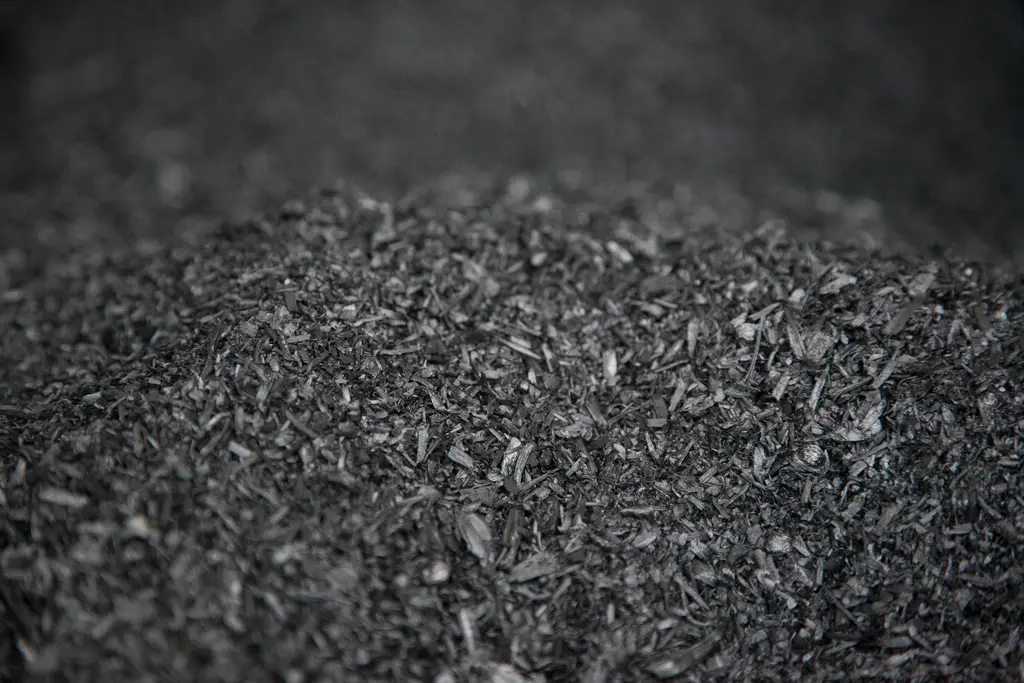
Uses of the char
The largest use in Europe is animal feed, about three quarters of purchases by volume in 2025 according to one market estimate. Sold as a soil improver across the EU, the char must meet the fertilising-products rules (hydrogen-to-carbon ratio below 0.7, at most 6 mg of PAH per kg) and be registered under REACH. The CRCF counts it in soils, feed that ends up in manure, growing media, and in cement, concrete or asphalt.
Limits on soil application and on metals
The CRCF caps biochar on agricultural and forest soil at 50 t per hectare in total, past applications included. Metals in the harvest concentrate three to four times in the char, so char made from a crop grown on contaminated land can exceed the limit for use on soil, 1.5 g of cadmium per tonne of char; such char may still go into concrete or asphalt. Our article on contaminated land covers the crop on such sites.
Biochar credits and the EU ETS
Biochar credits cannot be used for an ETS obligation. The Commission's proposal of July 2026 would let removals into the ETS from 2031 only for capture and storage of CO2 and for direct air capture; biochar is not included. The buyers are voluntary and few, and most of the biochar credits sold so far came from plants outside Europe that use residues.
Read the detailPermanence, deductions and the buyers
| Method | Share of carbon counted as permanent | Credited, t CO2 per t DM | Note |
|---|---|---|---|
| CRCF, decay method, soils at about 10 °C | 0.84 | 0.51 | 200-year model; the soil temperature is rounded up to the next 5 °C |
| CRCF, decay method, soils at about 15 °C | 0.73 | 0.44 | A soil just above 10 °C drops to this row |
| Puro.earth, soils at 10-12 °C | 0.88-0.90 | 0.57-0.60 | 200-year model; the share is the lower bound of an 80% confidence interval |
Basis of the credited figures
Char made at 600 °C with a hydrogen-to-organic-carbon ratio of 0.25 holds 0.73 t of CO2 per tonne of dry matter. The chain emits 0.13-0.18 t of CO2 per tonne: growing and harvesting, haulage, the plant's electricity, chopping, and transport and spreading of the char. A 5% uncertainty deduction is assumed. Bales stored at about 14% moisture carry no storage-methane deduction under the CRCF.
Buyers of biochar credits
Microsoft contracted 46% of all biochar removals up to mid-2025, and with Google, BCG and JPMorgan 57%; we found no European supplier among Microsoft's biochar deals. Across all durable removals Microsoft has contracted about 80-90% of the tonnes so far, 87% in 2025 according to CDR.fyi, and it cut new purchases sharply in 2026: a pause was reported in April, and BloombergNEF counts about 80% fewer tonnes in the first half than a year earlier. The EU's Buyers' Club for certified removals, presented in May 2026, aimed to make its first purchases of permanent removals by December 2026; we found no announced purchase by 10 November 2026. Frontier, a buyers' group, avoids purpose-grown biomass by default. Most European biochar producers earn nothing from credits and sell the char as a product.
Carbon stored in building materials made with miscanthus, and the credits paid for it
Fibre built into a wall keeps the CO2 that the crop took from the air out of the atmosphere for the life of the building. When the building is demolished and the fibre is burned or decays, the CO2 returns, unless the material is reused in another long-lived product. Buildings last 50-100 years in practice, above the 35-year minimum of the EU certification framework (chapter 02). The storage is therefore long but temporary, and credits for it sell for less than credits for permanent removals.
The binder determines whether the product stores carbon
A lime-bound miscanthus block stores a net 135 kg of CO2e per m³ over 100 years, according to a study by the universities of Exeter and Bath. A structural miscanthus lightweight concrete tested in Luxembourg contains 150 kg of miscanthus, 592 kg of cement and 324 kg of lime per m³. Its miscanthus stores about 0.26 t of CO2, while the cement alone emits about 0.36-0.47 t, so the concrete emits more than it stores (our calculation).
Miscanthus therefore makes cement-rich concrete lower in carbon without turning it into a store. Only products with little binder, such as lime-bound or clay-bound blocks, infill and insulation, store more carbon than their production emits. Biochar mixed into concrete is a separate route, covered in chapter 05.
Three quarters of the block's production emissions come from its mineral binder.
Who pays for carbon stored in buildings, and how much a tonne
| Standard or buyer | What it credits | Price per t CO2 | Status, October 2026 |
|---|---|---|---|
| Puro.earth | No method for bio-based building products among its eight listed methods | - | Checked 13 October 2026 |
| Verra | A proposed method for hempcrete | - | Archived on 13 February 2024 |
| Carbon Standards International, Global Construction C-Sink | Net carbon stored in buildings made with biogenic materials; miscanthus not named and not excluded | about €85 net to the builder | First certificates in December 2025, for a Swiss hempcrete building storing about 500 t of CO2e |
| Rainbow, Biobased Construction Materials (France) | Removal credits from bio-based products, based on the product's environmental declaration; miscanthus not named | not published | 20 projects, 109,491 t available |
| SNK and ONCRA (Netherlands) | CO2 stored in building materials made from Dutch-grown crops, after deducting growing and processing; SNK names miscanthus | sold to the Dutch state, below | Operating |
| Dutch state, through Nationaal Groenfonds | Buys SNK or ONCRA certificates for Dutch-grown fibre used in buildings in the Netherlands | €95-110 in the processors' module, paid in advance | Processors' module of the 2026 fund: bids of €300,000-2.3 million per processor, delivery by 31 December 2031. The growers' module may pay differently |
| EU CRCF, carbon storage in products | Products that store carbon for at least 35 years; the draft covers structural solid wood and bio-based insulation | - | The Commission planned to publish the method by the end of 2026; not published by 10 November 2026 |
Products on the market
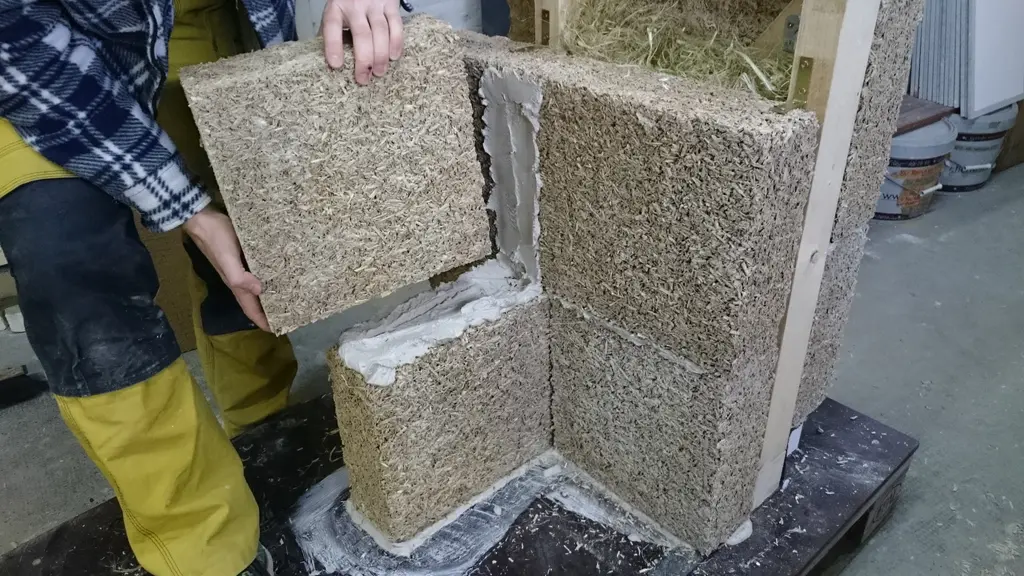
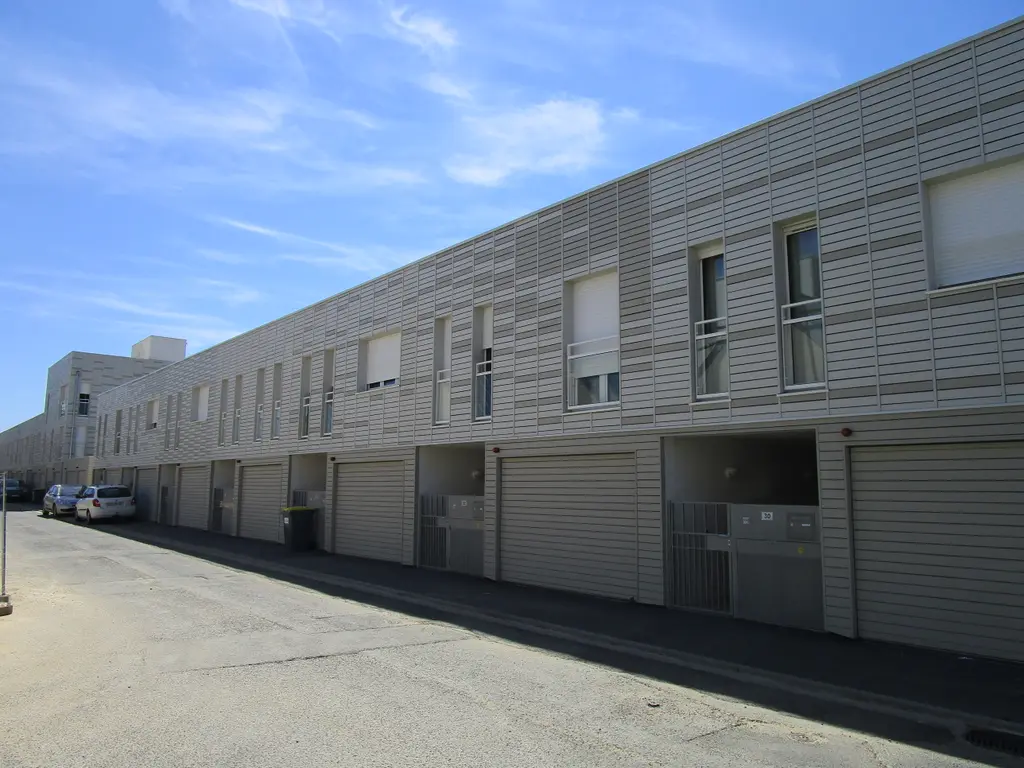
Vicat, the French cement group, launched the Miscanbloc on 3 March 2026. It is a non-load-bearing block of natural quick-setting cement and miscanthus for infill walls, partitions and insulating linings, made on a line of 220,000 blocks a year beside a 200-ha miscanthus farm in Hauts-de-France. The line was due to start in summer 2026; by 10 November 2026 we had found no announcement that it had started. Alkern converted its plant at Les Andelys in Normandy to make blocks with 30% miscanthus, supplied from about 100 ha within 25 km; according to the trade press the conversion cost about €8 M, of which €2 M was public aid. Miscanthus insulation boards are still at the research stage.
What a product needs before its stored carbon can be credited
Before credits can be issued for a product, it needs CE marking, in France a technical approval for insurers, and an environmental product declaration under EN 15804+A2 that states the stored biogenic carbon. Without that declaration the stored carbon counts for nothing under the French rules and earns no credit under any of the standards above.
How building rules count the carbon stored in materials
| Rule | What it requires | Stored biogenic carbon |
|---|---|---|
| EU, Energy Performance of Buildings Directive (EU) 2024/1275 | Life-cycle global warming potential calculated and shown on the energy performance certificate: new buildings over 1,000 m² from 1 January 2028, all new buildings from 1 January 2030; national limit values from 2030 | Member states must "address" carbon storage in buildings; the certificate may show it |
| EU, Delegated Regulation (EU) 2026/52 | Common method for the life-cycle calculation: 50-year period, EN 15978, in force since 24 May 2026 | Carbon stored at production is booked out again at end of life, so storage alone nets to zero; member states may weight emissions by date for their own limits |
| France, RE2020 | Carbon cap for new houses: 530 kg CO2e per m² from 2025, 475 from 2028 and 415 from 2031 | Dynamic life-cycle analysis weights early emissions more than late ones, so carbon stored in year one counts in the product's favour |
| Denmark, building regulations | Average limit of 7.1 kg CO2e per m² a year over 50 years for new buildings from 1 July 2025 | Stored carbon is counted at production and released at end of life, so it nets to zero |
| Netherlands, MPG | Environmental performance limit for new buildings; the tightening planned for 2025 was postponed | Stored carbon is declared as an emission at the end of life and has no effective value |
Credits per hectare a year from carbon stored in blocks
| Yield, t DM a ha | CO2 in the product, t | Fibre basis, t | at €95-110 | Net basis, t | at €85-110 |
|---|---|---|---|---|---|
| 12, degraded land | 16.6 | 14.9 | €1,420-1,640 | 7.3 | €620-800 |
| 15 | 20.7 | 18.7 | €1,770-2,050 | 9.1 | €775-1,000 |
| 18, good land | 24.9 | 22.4 | €2,130-2,460 | 10.9 | €930-1,200 |
| 26, best deep soils | 35.9 | 32.3 | €3,070-3,560 | 15.8 | €1,340-1,740 |
Credits per hectare and for a builder of 100 houses a year
On degraded land the credits come to about €600-2,500 per hectare a year, depending on whether the standard credits the fibre or the block's net balance. For comparison, the bales from a hectare yielding 15 t of dry matter sell for about €1,900-2,000 as fuel.
A housebuilder in France or the Netherlands that builds 100 timber-frame houses a year with miscanthus-block infill in the external walls, 36 m³ of block per house, uses 3,600 m³ of block containing 648 t of miscanthus dry matter a year. About 54 ha supply that fibre at a yield of 15 t a hectare, of which 80% ends up in the product. The walls hold about 1,120 t of CO2, of which 490-1,010 t can be credited, worth €40,000-110,000 a year depending on the standard. Against a construction cost of €25-30 M that is 0.13-0.44% (our calculation). For a block maker the larger value is commercial, because the material helps a project meet RE2020 or win a tender for bio-based building. For a grower the value is a fibre price, which can be higher than the fuel price.
Capturing and storing the CO2 from burning miscanthus (BECCS) requires a large plant and a CO2 store
Burning miscanthus on its own is close to neutral for the climate, because the CO2 from the chimney is the CO2 the crop took up; the climate benefit comes from the fossil fuel it replaces (chapter 04). If that CO2 is captured at the chimney, liquefied, shipped and injected into a permitted geological store, a chain known as BECCS (bioenergy with carbon capture and storage), the harvest's carbon is kept out of the atmosphere for thousands of years, longer than in any other use described in this article.
The EU certification method for BECCS
Delegated Regulation (EU) 2026/285, in force since 7 May 2026, sets the EU method for certifying such removals. The units go to the capture plant, not to the farmer, and the capture plant must be in the EU. The biomass must meet the RED land and greenhouse-gas criteria even though no renewable energy is claimed. The CO2 must be a by-product of producing heat, power or goods: biomass may not be burned only to make CO2 for storage. A plant built or switched from fossil fuel less than a year before the activity must show that it is profitable without the capture costs and the removal revenue, and an existing plant may not grow by more than the energy the capture needs.
The method deducts the energy and materials of capture, transport and storage, but not the emissions of growing and hauling the biomass that the plant would burn anyway. Nine environmental organisations asked the Commission in June 2026 to review the method; the outcome was not known in October 2026.
Captured biogenic CO2 in the ETS today
Capturing biogenic CO2 saves no allowances, because biomass is already counted at zero; the Commission states this in the method's recitals. Only the fossil share of a co-fired plant's captured CO2 saves allowances.
The Commission's proposal for removals in the ETS from 2031
Under the proposal of 17 July 2026, the Commission would buy up to 250 Mt of certified removals in 2031-2040, and an installation could set its own certified removals from capture against its fossil emissions, down to zero. On 10 November 2026 neither the Parliament's environment committee nor the Council had adopted a position; the EU institutions have set the first quarter of 2027 as the date for completing the review.
Who pays for stored biogenic CO2, and how much per tonne
| Payer | Per t CO2 | Terms and status, October 2026 |
|---|---|---|
| Sweden, reverse auction for bio-CCS | about €158, our calculation | Stockholm Exergi won SEK 20 billion for more than 11 Mt in January 2025; the award states no price per tonne. The support is paid for up to 15 years from the start of storage. In the second round, which closed on 13 August 2026 with a budget of SEK 10.17 billion, the agency granted SEK 9.3 billion on 16 October 2026 to Renova, SYSAV and Öresundskraft for 5.75 Mt in total. |
| Denmark, NECCS fund, 2024 awards | €130-349 | Three projects, 160,350 t a year in 2026-2032. The smallest, 4,650 t a year, needed 2.7 times the support per tonne of the largest. No further rounds had been announced by October 2026. |
| Voluntary buyers | €130-375 | $150-430 a tonne. Microsoft held about 32 of the 36 Mt of BECCS contracted worldwide by the first quarter of 2026. |
| EU ETS, Commission proposal of 17 July 2026 | €214 falling to €176 | The prices that the impact assessment assumes for 2030 and 2040 for the purchase of removals described above, which would be funded with the revenue of 250 million extra allowances. The proposal is not law. |
| Cost of capture, transport and storage | €167-261 | The Commission's estimate for BECCS in 2030. Capture from almost pure CO2 streams, such as fermentation, costs about €64-66 a tonne. |
Plant size, removals and land
| Plant | Dry matter a year | Net removal a year | Land at 18-12 t DM a ha | Comparable project |
|---|---|---|---|---|
| Boiler, 20 MW, 6,000 hours | 25,000 t | 37,400 t | 1,390-2,080 ha | Danish NECCS projects of 4,650-25,000 t a year |
| CHP, 50 MW, 6,500 hours | 67,700 t | 101,300 t | 3,760-5,640 ha | The straw boiler at Avedøre, about 150,000 t a year |
| CHP, 150 MW, 7,000 hours | 218,800 t | 327,300 t | 12,150-18,230 ha | Stockholm Exergi, up to 800,000 t a year from forest residues |
Storage capacity in the North Sea
The plant also needs access to a CO2 store. Northern Lights in Norway injected its first CO2 in August 2025 and has 1.5 Mt a year of capacity, rising to at least 5 Mt from the second half of 2028. Greensand in Denmark opened on 18 September 2026 with 0.4 Mt a year. Porthos in Rotterdam, 2.5 Mt a year, does not expect its system to be operational before the second half of 2027. The EU's objective is 50 Mt a year of injection capacity by 2030.
The size of the plant has the largest effect on the cost per tonne. The smallest working projects store a few thousand tonnes a year and need high support per tonne; the two largest projects that won Nordic support in 2024 and 2025, at about €130 and €158 a tonne by our conversion and calculation, store about 130,000 and 800,000 t a year. We found no miscanthus-fired capture plant in Europe.
Co-firing in a straw or wood CHP that adds capture
The nearest analogue is the straw-fired boiler at Avedøre, which is planned to capture about 150,000 t a year as part of Ørsted's Kalundborg hub (about 430,000 t a year in all) and ship it to Northern Lights; Ørsted states that the capture plants will begin operation in 2027. Straw and miscanthus need the same type of grate. A 150 MW CHP that takes 20% of its fuel energy as miscanthus would burn 51,500 t of bales a year from about 2,900 ha and remove about 65,500 t of CO2 a year attributable to the miscanthus (our calculation).
Biogas and ethanol plants
Fermentation and biogas upgrading release almost pure CO2, the cheapest to capture. The Danish NECCS awards went mainly to biogas plants. An ethanol plant on miscanthus would release such CO2 too; chapter 09 gives the amount per hectare.
A supply basin around a new plant
A new CHP can be built near a port, with a supply basin planted to match its start date. The 15-year EU activity period and the 15 years of Swedish support both fit inside a stand life of about 20 years.
The objection to burning forest biomass, and how it applies to miscanthus
The organisations that challenged the EU method argue that it counts stored biogenic carbon as a removal while ignoring the carbon that forests lose when their wood is burned. A perennial grass on arable or degraded land does not take carbon from a forest, and on former arable land it usually adds carbon to the soil (chapter 08). This answer holds only where the crop does not displace food production elsewhere, so whether a miscanthus capture project meets the criticism depends on the land it is grown on (chapter 10).
Where soil carbon under miscanthus increases, which schemes pay for it and what it is worth
Chapter 02 gives the size of the carbon store in roots and rhizomes and the lasting net gain in soil carbon on former arable land.
Net change in soil carbon under miscanthus by previous land use, t C per hectare a year
| Previous use and evidence | Range | Middle | Note |
|---|---|---|---|
| Former arable land, 14 European comparisons | -0.26 to +3.8 | median 1.1 | Six of the 14 significant; most sampled to a fixed depth of 30-150 cm, which can overstate the gain |
| Former arable land, six commercial stands aged 11-19 years | -0.17 to +1.57 | mean 0.87 | Germany, Denmark, the Netherlands and Switzerland, sampled to 80 cm |
| Former annual crops, global review of perennials | +6 t C over 20 years | 0.3 a year | Top 30 cm |
| Former arable land, French model used for credits | 0.37 in the north to 0.91 in the south | 0.55 weighted | Over a 20-year stand, removal year included |
| Former grassland, four comparisons | -1.2 to +0.29 | around zero or below | Ireland, Britain and Germany |
| Marginal grassland in Wales, 12 years | -8 t C over 12 years | -0.67 a year | Top 30 cm; still 4 t C behind the grassland after 15 years in the model |
Where the soil gains carbon under miscanthus
The best land for soil carbon is arable land with a low carbon stock. A 2018 review concluded that the starting stock predicts the gain better than the previous land use, and that the largest savings come on soils low in carbon. On old grassland the soil usually gains nothing in the first 10-15 years, and in Wales it lost carbon. Abandoned grassland, scrub and woodland are therefore poor choices for soil credits, and clearing trees makes a field ineligible under the EU method.
The gain is concentrated near the surface. In 5- and 20-year-old fields in eastern France and Switzerland, carbon from miscanthus made up 69% of the soil carbon in the top 10 cm but only 7% at 70-100 cm. The schemes measure the top 30 cm, and they require soil sampling methods that correct for the looser soil under the crop.
The same tonne burned in place of gas avoids 0.93 t (chapter 04), so soil carbon adds a tenth to a third to the climate value of the harvest.
Which schemes pay for soil carbon under miscanthus
| Scheme | Miscanthus | What it counts | Status, October 2026 |
|---|---|---|---|
| EU CRCF, carbon-farming method C(2026) 4666 | Not named. Possible under "improved crop management that increases carbon input to the soil", a list that is not exhaustive, if a scheme accepts it | Soil carbon in the top 30 cm; not rhizomes | Adopted on 9 July 2026 and corrected on 3 September; the European Parliament rejected an objection to it on 20 October 2026; not published in the Official Journal by 10 November 2026, so not in force; no scheme recognised; EU registry by 27 December 2028 |
| France, Label Bas-Carbone, field-crops method v2.0 | Yes, a "planting miscanthus" lever on arable fields in rotation, at most 20% of a farm's arable land | Soil carbon, modelled: 0.37-0.91 t C per ha a year | Draft submitted in February 2025; the official page still showed the 2021 version in October 2026. Average price of the label's credits €35 a tonne, range €20-70 |
| ONCRA (Netherlands) | Yes: a project with 18 farmers, according to the project listing | Soil carbon and roots and rhizomes; planning figure 4.8 t CO2e per ha a year according to the project listing, 20% held in a buffer | Operating; re-sampling in years 5 and 10. Applied for CRCF recognition in July 2026, which can cover only methods already in force, so it gives no route to CRCF soil units for miscanthus until the carbon-farming act applies and a scheme is recognised for it |
| Verra VM0042 v2.2 | Not listed among the practices | Below-ground non-woody biomass excluded | Active |
| German humus certificates (private schemes) | Not specific | One-off payments after a few years, without long-term monitoring | Judged unsuitable as a climate instrument by a 2023 study led by ZALF and Thünen |
The EU carbon-farming method
The activity period is five years and can be renewed up to three times, to 20 years in all. The soil is sampled within a year before or after the start and at least every five years, and at least 8% is deducted for uncertainty and 2-15% for the risk of reversal. The units expire at the end of the monitoring period, five years after the last activity period, unless monitoring continues.
The EU financial viability test
The EU method requires that the activity, without the carbon revenue, is not the most profitable option for the land, tested by net present value at 3.5% with all revenues and subsidies included. A plantation whose harvest has a good buyer may already be the most profitable use of the land, and it then fails the test.
The end of the stand after about 20 years
If the field is replanted, the stock below ground is kept and new activity periods can follow. If it returns to arable crops, the EU framework treats the stored carbon as released at the end of monitoring, and removal before that is a reversal for which the operator is liable. The supply contract should record this choice at the start.
A 500-ha programme on suppliers' arable fields in France, over 20 years
| Region | Gross, t CO2e a ha | Net, t CO2e a ha | 500 ha | Value at €35 | Share of planting cost |
|---|---|---|---|---|---|
| Northern France | 27.4 | 23.9 | 11,960 t | €0.42 M | 20-23% |
| French weighted mean | 40.6 | 35.4 | 17,720 t | €0.62 M | 30-34% |
| Southern France | 66.8 | 58.3 | 29,160 t | €1.02 M | 49-57% |
Value of the soil credits in the 500-ha programme
A food or drinks company that funds 500 ha of miscanthus on its suppliers' arable fields would earn credits worth €0.42-1.02 M in total over 20 years at the French average price, which covers a fifth to a little over a half of the cost of establishing the stand. Each farm may convert at most 20% of its arable land, so 500 ha means many farms, for example 50 farms with 10 ha each.
In the French mean case the soil credits are worth about 3% of the yearly value of the same hectare's bales at our field-edge price. In the Netherlands, ONCRA's planning figure from the project listing, after the buffer, gives 1,920 t a year on 500 ha (our calculation), worth €29,000-115,000 a year at soil-credit prices of €15-60.
Other buyers of the harvest: transport fuels, tissue, bedding and other fibre products
Besides boilers and pyrolysis plants, the harvest can be sold to fuel suppliers, which turn it into ethanol or biomethane to meet their legal obligations, and to mills and processors, which use it as fibre for tissue, animal bedding, mulch and composites. None of these routes earns a carbon credit. Fuel made from miscanthus gives compliance value to the supplier who has to blend it, and fibre products last too short a time to count as storage (chapter 02).
EU law names miscanthus as a feedstock for advanced biofuels
The renewable energy directive names miscanthus among "non-food cellulosic material" (Art 2(42)), which places it in Part A of Annex IX, the list of feedstocks for advanced biofuels. Fuel made from it counts towards the sub-target for advanced biofuels and renewable fuels of non-biological origin, at least 1% of transport energy in 2025 and 5.5% in 2030; it falls outside the 7% cap on food and feed crops and outside the 3% cap in the EU aviation-fuel regulation, ReFuelEU. Our article on aviation fuel covers the jet-fuel route.
Under the reform passed by the Bundestag in April 2026, Germany's greenhouse-gas quota rises from 12% in 2026 to 26.5% in 2030 and 65% in 2040, with an advanced sub-quota of 2% in 2026 rising to 9% in 2040; quota certificates were reported to trade at €150-340 a tonne of CO2 in 2025-2026, and a shortfall in the advanced sub-quota costs €45 per gigajoule, about €0.95 a litre of ethanol. According to the environment ministry, Germany ended the double counting of advanced fuels from 2026; some of the new rules apply only from 2027. The Netherlands replaced its renewable-energy units with emission-reduction units in 2026, France moves to a new mechanism in 2027, and shipping is covered by FuelEU Maritime.
Fossil CO2 avoided per hectare a year at 15 t of dry matter, t
Clariant, Podari, Romania
The cellulosic-ethanol plant was built to turn 250,000 t of agricultural residues a year into 50,000 t of ethanol, all sold to Shell. Production started in 2022, and Clariant announced its closure on 6 December 2023 after the plant did not reach its target parameters. In an EU research project, Clariant's pilot plant had converted about 30 t of miscanthus from a Croatian demonstration field into sugars and ethanol in 2019.
INA, Sisak, Croatia
The Croatian oil company planned a second-generation ethanol refinery of about €250 M, with about €50 M for the feedstock chain, mainly miscanthus plantations on neglected farmland. On 16 April 2024 it said there was no investment decision, as the cost had risen and demand for bioethanol was uncertain. It has since contracted a biomethane plant at Sisak.
The cost of ethanol and the methane yield of biogas
At our field-edge price the bales alone cost about €0.51 per litre of ethanol, before the plant's capital and running costs, against a market price of €0.75-0.80 a litre for conventional ethanol in September 2026. A plant would cover its costs only if the advanced sub-quota remained scarce for years. Biogas needs an October green harvest, which cuts the following year's yield, and in a German trial Miscanthus × giganteus gave the lowest methane yield of the genotypes tested.
Tissue, animal bedding, mulch and growing media are the commercial fibre outlets in Europe
| Route | Commercial in Europe | Price | Carbon credit | What a company gains |
|---|---|---|---|---|
| Tissue and paper | Yes, one buyer at small scale | A guaranteed price under a ten-year contract; the level is not public | None | A lower product footprint where the fibre replaces virgin wood pulp |
| Animal bedding | Yes; the largest outlet in France, 46% of the crop in 2019 | €120-180 a tonne to the livestock farmer | None | Half a tonne replaces about a tonne of straw |
| Mulch and growing media | Yes, in trade and retail | See the mulch and growing-media articles | None | Replaces peat and bark |
| Moulded-fibre packaging | No European plant on miscanthus found | No published price | None | - |
| Car parts and other composites | Demonstration, in the EU GRACE project of 2017-2022 | No published price | None: parts last 12-15 years | Fossil plastic removed from the product |
| Chemicals: HMF, furfural, lignin | Pilot scale | HMF from miscanthus costs three to four times its fossil equivalent | None | - |
Tissue, packaging and plastic taxes
WEPA, a German tissue maker, has made a professional tissue with miscanthus fibre since 2022. It has given a ten-year purchase guarantee, at a guaranteed price whose level is not public, to an organiser in Zeeland that contracts several farms. A price of €150 a tonne was reported in the Dutch farm press in 2024, without its basis. A non-wood pulp line on the scale of Essity's wheat-straw line in Mannheim, 35,000 t of pulp a year, would need the harvest of about 3,900-6,500 ha of miscanthus (our calculation, assuming a pulp yield of 45-50% of dry matter).
The EU packaging regulation, (EU) 2025/40, has applied since 12 August 2026. It limits PFAS in food-contact packaging, bans several single-use plastic formats from 1 January 2030, and requires the Commission to review bio-based plastic packaging by 12 February 2028; it sets no bio-based content requirement today. Plastic taxes already favour fibre. The EU charges member states €0.80 per kg of non-recycled plastic packaging waste, Spain taxes non-reusable plastic packaging at €0.45 per kg, and the UK at £228.82 a tonne.
Using the fibre as a material first and as fuel at the end of its life
Life-cycle studies, among them a comparison of six harvest uses at six European sites (Wagner et al., 2017), favour using the fibre as a material first and burning it when the product is discarded. In that comparison, insulation made from the bales had the largest climate benefit at every site.
The EU land rule of January 2008, and why former arable land is the best choice
Every value in this article depends on the land the crop grows on. The EU renewable energy directive draws a line at January 2008: biomass from land that had certain kinds of nature or carbon value at that date, or in some cases at any time since, does not count. The rule binds every ETS installation, every heat or power plant of 7.5 MW or more, all transport fuels and every support scheme, and since May 2026 every CRCF unit from biochar or captured CO2, whatever the size of the plant. CRCF units for soil carbon have their own exclusions, listed in the second table below, and clearing forest is excluded under both sets of rules.
The January 2008 line: land whose harvest does not count
| Land | RED Article | Date test |
|---|---|---|
| Primary forest and other wooded land, old-growth forest, and highly biodiverse forest identified by the authorities | 29(3)(a)-(b) | That status at any time in or after January 2008 |
| Areas designated for nature protection, or for rare or threatened ecosystems or species | 29(3)(c) | In or after January 2008, unless evidence shows that the crop did not interfere with the protection purposes |
| Highly biodiverse grassland of more than one hectare, and heathland | 29(3)(d)-(e) | At any time in or after January 2008 |
| Wetland: land covered with or saturated by water permanently or for a significant part of the year | 29(4)(a) | Wetland in January 2008 that is no longer wetland |
| Continuously forested land: more than one hectare with trees over 5 m and a canopy of more than 30%, or trees able to reach these thresholds on the site | 29(4)(b) | Forested in January 2008 and no longer forested |
| Land of more than one hectare with trees over 5 m and a canopy of 10-30% | 29(4)(c) | In January 2008, unless the fuel still meets the greenhouse-gas threshold after the carbon lost in conversion |
| Peatland | 29(5) | Peat in January 2008, unless growing the crop involves no drainage of soil that was undrained |
The rules that exclude clearing forest for miscanthus
| Rule | Effect on a cleared forest |
|---|---|
| National forest law | Germany: clearing needs a permit, and any area stocked with forest plants is legally forest (Bundeswaldgesetz §§2, 9). France: clearing needs an authorisation, with compensation planting of 1 to 5 times the area or a payment into a forest fund |
| Environmental impact assessment | Directive 2011/92/EU lists deforestation for conversion to another land use, and the use of uncultivated or semi-natural land for intensive agriculture, among projects that may need an assessment |
| Renewable energy directive and ETS | The harvest fails the land criteria: it counts for no target or obligation, receives no support, and an ETS installation counts it as fossil fuel |
| EU certified removals (CRCF) | The RED land criteria apply to the biomass of every biochar or capture activity, whatever the size of the plant; the carbon-farming method for soil excludes the removal of existing trees or woody elements, new drainage after 1 January 2023 and the conversion of habitats of high conservation value |
| EU Deforestation Regulation | Timber from forest converted to farmland after 31 December 2020 is not deforestation-free; the rules apply to large and medium operators from 30 December 2026 |
| Company greenhouse-gas inventory | From 2027 the GHG Protocol counts land-use-change emissions in the inventory for 20 years after the conversion |
An ETS installation counts such fuel as fossil, at about 1.45-1.5 t of CO2 per tonne of bales (our estimate from the default factor for solid biomass), so the allowances cost about as much as the bale itself.
Much "abandoned" land is legally forest
Half of the EU farmland that has shown signs of abandonment since 2000 is turning into forest. Under the German definition in the table such regrowth is already forest, and in France about 3 million hectares of former farmland are under young woods. A French young wood may be cleared without authorisation, yet if it already met the forest thresholds over more than one hectare in January 2008, its harvest fails the directive for every ETS, support, biochar and capture use.
Old grassland
Ploughing old grassland for miscanthus loses soil carbon, as the Welsh trial in chapter 08 shows, and the directive counts the conversion as a land-use change whose carbon loss is spread over 20 years. Under the CAP, land under grass for five years or more is permanent grassland, regions may lose at most 5% of it against 2018, and sensitive grassland in Natura 2000 sites may not be ploughed.
Wetland and peat
Wetland and peat are excluded by the directive unless no new drainage is involved, and the Nature Restoration Regulation sets targets for restoring drained peatland in agricultural use: 30% by 2030, 40% by 2040 and 50% by 2050. The crop is not suited to such land in any case.
Former arable land
Land that was arable in January 2008, is still open and lies outside protected areas meets the land criteria, and miscanthus planted on it counts as cropland, so the directive's calculation shows no land-use change. On such land the soil gains carbon and loses less nitrate than under the previous crops. Land that was farmed or fallow until recently and has no tree cover is therefore the best choice for a programme.
Farmland in the EU that could carry an energy crop, million hectares
Why poor farmland stays idle, and the rules for contaminated land
The main reason poor farmland is not brought back into use is economic. In interviews for the Commission's 2020 study of land availability, 163 of 199 answers named economic or social causes, and the lack of a market for the harvest was the most frequent. A 15-20-year contract to buy the harvest addresses the reason given most often.
For contaminated land, the Soil Monitoring Directive, (EU) 2025/2360, in force since December 2025, lists phytostabilisation among the recognised risk-reduction measures. Member states must set up public registers of potentially contaminated sites by 17 December 2029 and identify all such sites by 17 December 2035. Miscanthus keeps such land in use but removes little of the contamination, as our article on marginal and contaminated land explains.
What 20 years of miscanthus do to a former arable field
| Effect | Finding | Source |
|---|---|---|
| Soil carbon | 13 t C per hectare more than the neighbouring arable field after 20 years (France) | Dufossé et al. 2014 |
| Soil structure and water holding | Perennial roots improve structure and raise water-holding capacity by 100-150 mm, according to a review of British studies | McCalmont et al. 2017 |
| Earthworms | 5.1 species in a 15-year-old stand against 3.0-4.0 under maize, cereals and rape (Germany) | Felten and Emmerling 2011 |
| Erosion | On a loess slope in Poland a young strip cut soil loss by about a fifth and rill erosion by almost half | Mazur and Kowalczyk-Juśko 2021 |
| Nitrate | 154 kg N per hectare lost in the first winter, then 8 and 3 kg in years two and three, close to extensive grassland (Rothamsted) | Christian and Riche 1998 |
| Phosphorus and potassium | About 100 kg P and 1,170 kg K per hectare less in the soil after 20 years; to be replaced when the field returns to crops | Dufossé et al. 2014 |
| Removal of the stand | About 1.5 t of CO2 per hectare and a rise in nitrous oxide in the following year; the next wheat crop was hardly affected | Dufossé et al. 2014; McCalmont et al. 2018 |
Wildlife and water
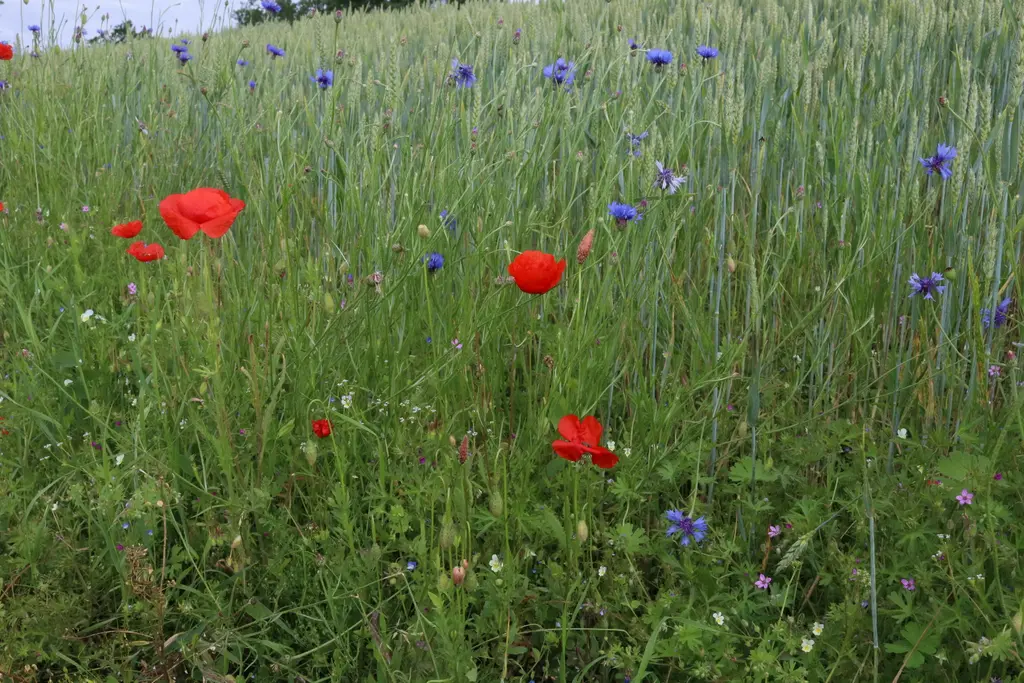
A meta-analysis of 25 studies found that biodiversity in perennial grasses such as miscanthus tends to be higher than in annual crops, but significantly so only for plants and small mammals; for arthropods and birds the difference was positive but not significant. In Cambridgeshire, stands up to five years old held 24 bird species in winter against 11 in wheat, and about twice the species in the breeding season, except for skylarks, which did worse than in wheat. Pollinators were more abundant in the field margins than in the crop. The crop is no substitute for grassland, and much of the wildlife lives in the field margins.
Miscanthus uses about 100-120 mm of water a year more than wheat, 1,000-1,200 m³ per hectare, so it suits sites with at least about 500 mm of rain. Because of the low nitrate loss after the first year, shown in the table above, French and Belgian water utilities are testing it in drinking-water catchments.
Screening a parcel before planting
- Land status in January 2008, from orthophotos of 2006-2009 and the parcel's CAP declarations.
- No tree cover today above 10%, and no regrowth that is legally forest.
- No protected area, sensitive grassland, species-rich grassland or heathland since 2008.
- Whether the parcel is permanent grassland under the CAP.
- Contaminated-site registers, and the land-remediation steps if the site is listed.
- At least about 500 mm of rain a year, or irrigation planned; no stream banks that flood.
- A soil baseline before planting: carbon, clay, pH, phosphorus, potassium and bulk density.
A company reports emissions gross and shows removals and credits on separate lines
No reporting standard lets a company subtract credits or removals from its emissions. The European sustainability reporting standards (ESRS), the GHG Protocol and the Science Based Targets initiative (SBTi) all require emissions to be reported gross, with removals in the value chain and credits bought outside it on separate lines. The reduction a company can report from miscanthus comes from the fossil fuel or material that the crop replaces.
The gross inventory
Scope 1-3 emissions are reported with no removals, credits or allowances netted. A fuel switch appears here as lower scope 1 emissions.
Biogenic CO2
The CO2 from burning miscanthus goes on its own line, outside scopes 1-3; the methane and nitrous oxide from burning stay in scope 1.
Removals in the value chain
Soil carbon on supplier fields, and biochar or stored CO2 from the company's own plants, are reported separately, with their monitoring and any reversals.
Credits bought
For credits from outside the value chain, the company discloses the tonnes retired in the year, the standard and whether they are removals.
Insetting, offsetting and the right to report
Funding a removal inside the company's own supply chain, for example soil carbon on the fields of the growers who supply its boiler, is called insetting. From 2027 the GHG Protocol's Land Sector and Removals Standard allows a company to report such removals only with physical traceability to the fields or to a defined sourcing region, measured data, a quantified uncertainty, a plan to monitor the storage for its whole life, and a written right to report from each landowner. Certificates traded separately from the bales cannot show physical traceability. Buying credits from projects outside the value chain is offsetting, and those credits are disclosed separately.
Each tonne can be claimed by one party only. If a grower sells soil-carbon credits from a field to another company, the buyer of the field's biomass loses the right to report those removals. The EU framework states the same rule for its units, and the supply contract is the place to settle who reports what.
The GHG Protocol rule for biogenic CO2 from 2027
From 1 January 2027 the GHG Protocol keeps the CO2 from burning biomass outside the inventory only if the company accounts for the whole life cycle of that biomass, including the carbon change on the fields it came from. Otherwise the CO2 is reported inside the inventory as land emissions. Fuel bought under contract from known fields meets the condition; anonymous fuel does not. The ESRS keep biogenic CO2 outside the scopes in any case, and the SBTi follows the GHG Protocol.
Product claims banned in the EU from 27 September 2026
Directive (EU) 2024/825 bans in consumer advertising any claim, based on the offsetting of emissions, that a product has a neutral, reduced or positive climate impact. It also bans generic claims such as "green" or "eco" without proof of recognised excellent performance. By the transposition deadline seven member states, among them Germany, Italy and Ireland, had transposed it (ClimatePartner, June 2026), and on 28 May 2026 the Commission opened infringement proceedings against 20 others. By 5 October 2026, 19 of the 27 member states had measures in force (Freshfields tracker).
- "This product is climate-neutral" or "CO2 compensated", based on credits.
- "Carbon-negative block" or "climate-positive building".
- "CO2-free heat" or "zero-emission fuel".
Statements a company may make, if they are accurate
- "Since 2030 the boiler at our plant has burned miscanthus grown on about 830 ha within 50 km, which has cut the plant's fossil CO2 emissions by about 11,600 t a year."
- "In 2029 we financed the removal of 5,000 t of CO2 by biochar made from miscanthus, certified under [standard] and retired in [registry]."
- "Each m³ of this block contains N kg of carbon taken up by miscanthus, as stated in environmental product declaration no. ..."
The proposed Green Claims Directive is not law, and negotiations on it stopped in June 2025.
CSRD scope after Directive (EU) 2026/470
Since Directive (EU) 2026/470, the reporting obligation covers EU companies with more than 1,000 employees and more than €450 M of turnover; those newly in scope report in 2028 on 2027. The simplified ESRS, adopted by the Commission on 3 July 2026 and published in the Official Journal on 21 September 2026 as Delegated Regulation (EU) 2026/1563, have been in force since 10 November 2026 and keep a disclosure on removal projects and carbon credits. Suppliers with fewer than 1,000 employees may decline data requests beyond the voluntary standard, so the field data a buyer needs must be written into the supply contract.
SBTi Net-Zero Standard V2.0
Published in June 2026, the standard does not count credits towards targets in any case. A company may seek recognition for taking responsibility for its ongoing emissions, with verified outcomes or a budget covering at least 1%, 10% or 100% of them. For larger companies in higher-income countries (Category A) the standard also illustrates a requirement to support removals from 2035, rising to all residual emissions by the net-zero year; it is to be reviewed in the next version and is not yet binding. Soil carbon is a short-lived removal; biochar and stored CO2 are the candidates for long-lived ones.
The EU Taxonomy covers miscanthus boilers and CHP plants
A miscanthus boiler, CHP or power plant is a taxonomy activity (4.24, 4.20 and 4.8) if the biomass meets the RED land criteria and saves at least 80% of greenhouse gases. The plantation itself is not, because the taxonomy has no criteria for growing crops. A European Green Bond may put up to 15% of its proceeds into activities without criteria.
What a company may report and claim, route by route
| Route | In the inventory | Reported separately | SBTi | Credit | EU Taxonomy | A claim it may make | Claims to avoid |
|---|---|---|---|---|---|---|---|
| Fuel switch, boiler or CHP outside the ETS | Scope 1 falls; scope 3 rises slightly for the fuel's supply chain | Biogenic CO2 on its own line; from 2027 the GHG Protocol needs life-cycle data from the fields | Counts towards targets | No | Aligned (4.24, 4.20) with at least 80% saving and the RED land criteria | "Our fossil CO2 at site X fell by N t a year" | "Carbon-neutral heat", "CO2-free" |
| Fuel switch in an ETS installation | Scope 1 and verified ETS emissions fall | Biogenic CO2 on its own line | Counts towards targets | No: the CRCF excludes emissions inside the ETS | Aligned, as above | "Verified ETS emissions of the site fell by N t" | Any credit or neutrality claim |
| Soil and rhizome carbon on supplier fields, kept by the company | Not netted against emissions | Removals in the value chain, with traceability, measurement and a monitoring plan | Short-lived; may count for land-sector targets if not used elsewhere | Only if the company does not claim it | Not eligible: no activity for growing crops | "Measured soil carbon gain of N t on our growers' fields, reported separately" | "Carbon-negative supply chain", "climate-positive product" |
| Soil-carbon credits sold to another company | The buyer of the biomass must adjust its own figures | The credit buyer discloses the credits | Short-lived, for the credit buyer | Yes, temporary units | No | Credit buyer: "we financed N t of soil-carbon removals, certified under ..." | Any product neutrality claim |
| Biochar credits bought | Not netted | Credits retired, as removals and technological | Likely long-lived; for recognition beyond targets and later for neutralisation | Yes: Puro.earth, CSI; CRCF once schemes are recognised | No activity for biochar | "We financed the removal of N t of CO2 by biochar, certified under ..., retired in ..." | "Climate-neutral product" |
| Biochar made in the company's own value chain | Not netted | Technological removals in the value chain | As above | Only for tonnes the company does not claim itself | No | "Our biochar plant stored N t of CO2 in 2029" | Selling and claiming the same tonnes |
| Building products with miscanthus | Not a removal | Product carbon storage, and the biogenic carbon in the product declaration | Not counted | From smaller standards; CRCF units once the method exists | Indirectly, through the building criteria | "N kg of biogenic carbon per m³, product declaration no. ..." | "Carbon-negative block" |
| Capture and storage of the CO2 | Stored biogenic CO2 is a removal | Geological removals in the value chain | Long-lived; for neutralisation | Yes: CRCF method since May 2026; ETS purchases proposed from 2031 | 4.8 with capture, 5.11 and 5.12 for transport and storage | "We stored N t of biogenic CO2 under [site]" | Counting the fuel switch and the storage twice |
| Transport fuels from miscanthus | The fuel user's life-cycle emissions fall | Biogenic CO2 on its own line | Counts towards targets | No: compliance value for the fuel supplier | 4.13, at least 65% saving | "Our fleet's fuel emits N% less over its life cycle" | "Zero-emission fuel" |
| Paper, packaging and other short-lived products | Scope 3 falls if the fibre replaces a fossil or virgin material | Product carbon storage only if the stock grows | Scope 3 reduction | No | No | "Packaging made with N% miscanthus fibre" | "Carbon-neutral packaging" |
Tax relief, grants and farm payments: what each is worth for a miscanthus programme
No EU country exempts a company from profit tax because it invests in a green project. A green label, such as alignment with the EU Taxonomy or a green-bond label, is a disclosure and financing label, and no tax law we found attaches a profit-tax exemption to it. Three narrower kinds of relief exist: an extra deduction for assets on a closed national list, faster depreciation, and regional tax holidays for new factories. For a large, profitable company they return about 2-17% of the eligible investment, once. The tax that a company saves every year with a miscanthus boiler is the energy and carbon tax on the gas it no longer burns (chapter 04).
Extra deductions on listed assets
The Netherlands, Belgium, Austria, Italy, Slovenia, Lithuania and Denmark let a company deduct more than the cost of an asset on a published list. The tax saved is the extra deduction times the tax rate: in Belgium, for investments made in 2026, 40% times 25%, or 10% of the investment.
Faster depreciation
Germany, Spain and Ireland let a company depreciate faster. The total tax paid over the asset's life does not change, so the benefit is the interest on tax paid later, worth 2-5% of the cost.
Regional tax holidays
Poland, Croatia and Hungary exempt part of the profit of a new production investment for 10-15 years, up to the regional aid ceiling. They suit a factory, such as a board or block plant, and generally not a stand-alone heat plant or a plantation.
Tax relief on investment by country, October 2026
| Country | Measure | What it gives | A biomass boiler | Tax saved per €1 M, present value |
|---|---|---|---|---|
| Netherlands | Energy investment deduction (EIA) and environmental deduction with free depreciation (MIA and Vamil) | EIA: 40% extra deduction. MIA: 27-45% extra deduction, with 75% of the cost depreciable at any time | No biomass boiler on either list. The environmental list names equipment for growing or processing miscanthus into bio-based raw materials (code F 2318) | €156,000 on code F 2318 |
| Belgium | Thematic investment deduction | 40% for investments made in 2026; for 2025 investments the rate for large companies was 30% when we checked in October 2026 | Probably, as renewable-energy production equipment on the energy list, if the cascading principle, a payback of at least three years and, for large companies, a return of at most 13% are met; the wording for biomass is not verified | €94,000 |
| Austria | Investment allowance, eco rate | 15%, or 22% on costs from 1 November 2025 to 31 December 2026, on at most €1 M a year | Only through an environmental grant from KPC, or as biomass CHP | €48,000 at 22% |
| Germany | Declining-balance depreciation | Up to 30% a year on movable assets bought from 1 July 2025 to 31 December 2027; the timing of tax changes, not the amount | Yes, as for any movable asset | €30,000-41,000 |
| Italy | Hyper-depreciation 2026 | Tax cost raised by 180% up to €2.5 M, 100% from €2.5 M to €10 M and 50% from €10 M to €20 M, for investments to 30 September 2028 | Not confirmed; the predecessor scheme excluded biomass | €318,000 on the first band, if eligible |
| Spain | Free depreciation | Immediate depreciation of thermal installations using renewable energy that replace fossil ones | Yes, on at most €500,000 of investment, entering service in 2025 or 2026 | €26,000 in total |
| France | Green-industry investment tax credit (C3IV) | A tax credit for factories that make batteries, wind turbines, solar panels and heat pumps | No: the users of such equipment receive nothing | 0 |
| Poland | Polish Investment Zone | Profit-tax exemption for 12-15 years on the new investment, up to the regional aid ceiling | For new production investment; a stand-alone heat plant generally not | Case by case |
| Ireland | Accelerated capital allowance | 100% of the cost deducted in year one instead of over eight years | If the boiler model is on the SEAI register | €21,000 |
| Denmark | Green investment window | Depreciation base of 108% for new assets not driven by fossil fuels, bought in 2025-2026 | Yes | €14,000 |
Tax relief on the boiler of example A
Applied to the €8.8 M boiler of example A, the Belgian deduction would return about €0.83 M in present value (€0.88 M nominal) once, for an investment made in 2026, if the boiler is accepted as renewable-energy equipment and passes the scheme's tests, and Germany's declining-balance depreciation about €0.26-0.36 M in present value (our calculation). The switch itself saves about €0.62 M a year after paying for the boiler and its running costs (chapter 04).
Planting stock earns no tax relief in any country we checked. The plantation is a farm asset, and the only list that names miscanthus is the Dutch environmental list, for equipment that grows or processes it, and for farms only if they are small or medium-sized.
The share depends on the country and the asset.
Tax relief by part of a miscanthus project and by country
| Asset | Netherlands | Belgium | Austria | Germany | Italy | France |
|---|---|---|---|---|---|---|
| Planting stock and the plantation | No | Not on the list | Not on the eco list | No | No | No |
| Planting, harvesting and processing equipment | MIA 45% and Vamil (F 2318); farms qualify only if small or medium-sized | Only if listed (not checked) | Basic allowance, not eco | Declining-balance depreciation | If an interconnected "4.0" good | No |
| Biomass boiler for process heat | No; operating support through SDE++ instead | Probably, 40% (2026), as renewable-energy equipment | Eco rate through a KPC grant | Depreciation; the EEW grant only below 700 kW | Not confirmed | No tax relief; heat grants instead |
| Pyrolysis or biochar plant | No code found | Possibly, as other renewable energy | No | Not as a firing plant | Possibly, as a "4.0" good | No |
| Building-product factory | Only for wastes and by-products, not primary biomass | Environmental list (not checked) | Basic allowance | Depreciation; research allowance for development | If a "4.0" good | No |
Grants and EU funds
Germany's process-heat grant (EEW, module 2) pays 40-60% of the cost of a renewable process-heat plant, less for biomass firing. Biomass is funded only where the total biomass firing capacity on the site is below 7.5 MW, and plants of 700 kW or more may burn only listed wastes and residues. Miscanthus is allowed only in boilers under 700 kW and for at most 25% of the fuel, so neither boiler of chapter 04 qualifies; pyrolysis plants are not funded as firing plants.
The EU Innovation Fund's heat auction of the 2025 round offered up to €1 billion and invited 65 projects with 766 MW; the final terms of the 2026 auction, also €1 billion, were published on 24 September 2026, and the Commission expected to open it in early December 2026. The Commission's notice on the 2026 auction names electrified heat, direct solar thermal and geothermal heat and nuclear technologies and does not mention biomass boilers. EU state-aid rules allow investment aid for renewable energy of up to 45% of the eligible extra cost, more for smaller firms and poorer regions, and up to 100% where aid is awarded by tender. The Modernisation Fund finances national schemes in 13 member states, Croatia and Poland among them. In the Netherlands the application window of the 2026 SDE++ round is 27 October to 26 November 2026, with €8 billion; which biomass categories are open has to be checked.
CAP payments go to the farmer
A miscanthus stand is a permanent crop and keeps the land eligible for CAP basic income support, €147 a hectare in Germany in 2026, paid to the active farmer who manages the land and not to a company that funds the planting. On 500 ha that is €73,500 a year to the growers. We found no planting grant for miscanthus in any of the countries we checked.
Bought credits are a deductible business expense
Voluntary carbon credits bought by a company give no tax credit. Where the purchase serves the business it is generally a deductible expense, so €100 of credits costs about €75 after tax at 25%. Credits cannot replace ETS allowances or a national carbon price.
Deadlines for applying for grants and tax relief
- Grants and state aid. German grants and most state-aid schemes must be applied for before the order is placed or work starts.
- The Netherlands. The EIA and MIA must be notified within three months of the commitment; a signed or oral order counts, the invoice does not.
- Belgium. The regional certificate must be requested within three months after the end of the tax period.
- Tax holidays. In Poland, Croatia and Hungary the decision must come before the investment starts.
- Combining. All aid together must stay within the state-aid ceilings; the Netherlands deducts grants from the base, and aid above the ceiling is reclaimed with interest.
How a company sets up a miscanthus programme, and what we supply for it
The largest and most certain value described in this article comes from a company's own boiler (chapter 04), so a programme is built around the fuel supply: the land, the grower contracts, the certification chain from the field, the planting and the boiler. The timeline below follows example A of chapter 04, a 10 MW boiler outside the ETS that burns the harvest of about 830 ha. A programme of that size needs its planting stock reserved a season ahead. Example B, 2,500 ha, would be planted in blocks over several springs, each with the lead time shown in the timeline.
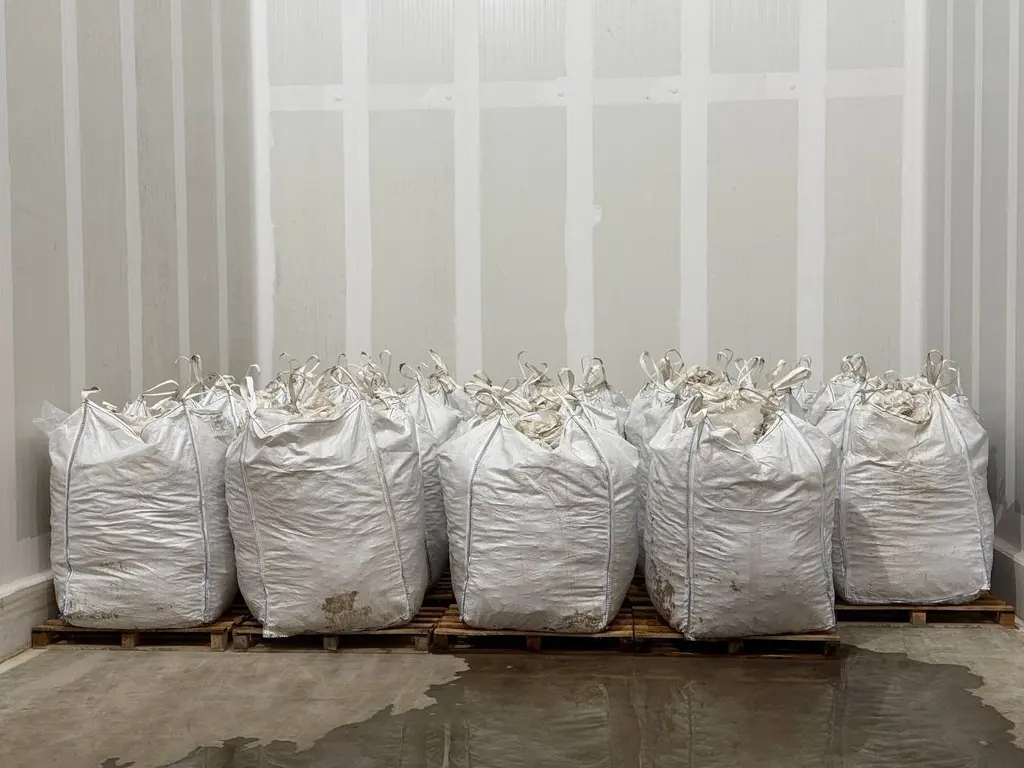
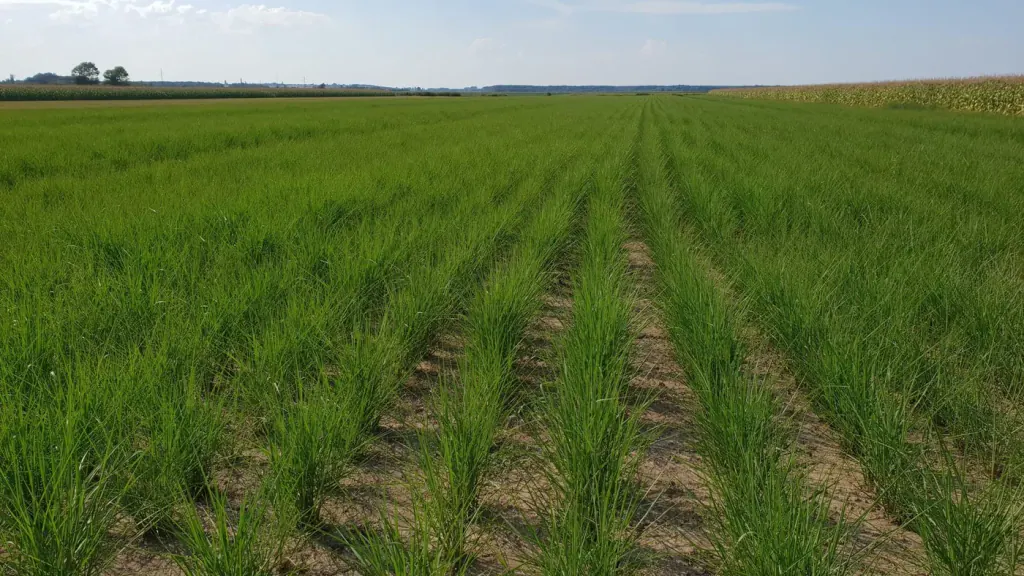
Land and grower contracts
A company can plant its own land, lease land for longer than the stand, about 20 years plus the year of removal, or contract growers who keep their land and their CAP payments. A grower contract of 15-20 years matches the life of the stand; it fixes a delivered price, indexed in part to gas or allowance prices or fixed with an annual increase. The company may pre-finance the planting stock and the first year, about €5,100 a hectare in our planning model including planting stock at list price, and recover it through the fuel price.
The contract should also say who may report the carbon of the fields and who owns any credits from them, what records each grower keeps for the certification chain, and what happens at the end of the stand: replanting, or removal with the potassium and phosphorus replaced. Chapter 11 explains why the right to report must be written down, and chapter 10 lists the checks on each parcel before it is signed.
What we supply
We supply traceable planting stock of the sterile Illinois clone of Miscanthus × giganteus, generation G1-G2. Each delivery comes with the EU plant passport and the delivery documents, which state the clone, the quantity and the date; growers keep them with their field records for the certification audit. A hectare takes 20,000 rhizomes, at our list price of €3,000-3,600 a hectare (€0.15-0.18 a rhizome, FCA Croatia); the cost for examples A and B is given in their tables in chapter 04.
We produce planting stock for about 1,000 hectares a year. For a given area we can say how much stock it needs and in which springs it can be lifted. Planting takes place in spring, and the planting article covers timing, depth and machinery.
Who does what in a programme
| Party | Role |
|---|---|
| The company | Heat demand, the boiler or plant, fuel storage, supply contracts and finance; the ETS monitoring plan; reporting and claims |
| Growers or a supply cooperative | Land, planting, harvest, baling, storage and delivery; field records; CAP payments |
| Plant builder | A boiler built for straw-type fuel, or a pyrolysis or capture plant; permits |
| Certification body | Audits of the chain from field to boiler under SURE or ISCC, including the status of the land since January 2008 |
| Carbon standard and verifier | Only for removals: the method, the verification and the registry for biochar, building products, soil carbon or stored CO2 |
| Us | Traceable planting stock of the Illinois clone with the EU plant passport and the delivery documents; the amount of stock an area needs and the springs in which it can be lifted |
Certification before planting
The evidence of a field's status in January 2008 is easiest to assemble before planting, so the certification body should be engaged in the first year. If soil carbon is to be claimed, the baseline samples must be taken within the window the scheme sets around planting.
Monitoring over the stand's life
The ETS verifier checks the fuel certificates every year. Soil carbon is re-sampled at least every five years where it is claimed, and the company's reports carry the fuel reduction, the biogenic CO2 line and any removals, each on its own line.
Time to the first saving
The fuel saving begins with the first delivery of bales, two to three years after planting. Biochar credits follow the commissioning and certification of the plant, soil credits follow the first verification after at least five years, and ETS purchases of stored CO2 would not begin before 2031.
Planting stock for a company's miscanthus programme
A site with a boiler
Tell us the area to be planted and the region, or the boiler's fuel input and full-load hours, from which the area follows (chapter 04). We will tell you how much planting stock the area needs and in which springs the stock can be lifted.
A company funding growers
For a programme on suppliers' fields we supply the planting stock to each grower, and the growers can keep the delivery documents with their field records for the certification audit.
Carbon projects
We do not develop carbon projects, verify removals or sell credits. Removals are certified by the standards and verifiers named in chapters 05-08.
The fuel series, marginal land and aviation fuel
The fuel specification, the price of heat by fuel and country, the boilers, the permits and the 20-year budget for a hectare.
Read it Marginal and contaminated landMiscanthus on marginal and contaminated landWhat the crop does on damaged soil, what the trials found, and the three uses for the harvest.
Read it Aviation fuelEU law requires sustainable aviation fuel, and supply lags behind demandThe EU mandate for aviation fuel, the production routes from miscanthus and the time a feedstock base needs.
Read itFrequently asked questions
No. Since 2021 no offset or removal credit of any kind has counted towards an obligation in the EU ETS. An installation that burns certified miscanthus instead of gas surrenders fewer allowances, because sustainable biomass is counted at zero emissions. At the 2026 average allowance price of €78, that saving is worth about €62 per tonne of bales.
No. Replacing gas with miscanthus avoids fossil CO2 in the user's own inventory and, in the ETS, saves allowances; selling the same saving as a credit would count it twice. Credits exist only where carbon is stored: in biochar, in long-lived building products, in geological storage of captured CO2 and in the soil.
Yes, if the operator shows that the fuel meets the sustainability and greenhouse-gas criteria of the renewable energy directive, through a certification scheme such as SURE or ISCC that covers the chain from the field. Without that proof the fuel counts as fossil, at about 1.45-1.5 t of CO2 per tonne of bales (our estimate), or about €113-117 of allowances at €78, comparable to the price of the bale itself.
In Germany gas for heat carries a national CO2 price of €55-65 a tonne in 2026, and Sweden, Switzerland and France have their own carbon taxes on heating fuel. From 1 January 2028 the EU's second trading system, ETS2, puts a carbon price on heating fuels in every member state. Biomass that meets the criteria is outside both.
About 830 ha at 15 t of dry matter a hectare and 6,000 full-load hours, or about 83 ha per MW of fuel input. At 18 t a hectare it needs about 690 ha, and at 12 t about 1,040 ha. The crop should be planted about two and a half to three years before the boiler needs its full supply.
No. Verra's biochar method, VM0044, accepts only waste biomass, and Isometric also excludes crops grown for the purpose. Puro.earth and Carbon Standards International accept miscanthus, and the EU certification framework accepts it only in a plant where the biochar holds less than half of the energy the plant exports.
The harvest of a hectare gives 6-9 t of credited CO2 a year on degraded land and up to 13-15 t on good soils, or €750-1,900 a year at the Puro.earth biochar index of €124 a tonne in September 2026. The credits arise at the pyrolysis plant, not on the field, and a 10 MW plant that buys its bales does not cover its costs at that price unless the char itself sells well.
It can, but only in products with little binder, such as lime-bound blocks and insulation, and only from smaller standards that credit temporary storage at about €85-110 a tonne. Puro.earth has no method for bio-based building products, and Verra archived its hempcrete proposal. A concrete rich in cement emits more CO2 than its miscanthus stores.
It can be sold in a few schemes. The Dutch ONCRA scheme certifies a miscanthus project, according to a credit marketplace listing, the French Label Bas-Carbone has a draft method with a miscanthus lever whose approval had not been confirmed by October 2026, and the EU carbon-farming method adopted in July 2026 was not in force on 10 November 2026 and does not name the crop. The credits are temporary, and on old grassland the soil usually gains nothing.
It counts only in some schemes. The EU carbon-farming method and Verra's soil method count soil carbon in the top 30 cm and leave out the rhizomes; ONCRA counts roots and rhizomes as well. The rhizome carbon lasts as long as the stand: when the field returns to arable crops, most of it in the plough layer decomposes.
Under the Commission's proposal of 17 July 2026, the Commission would buy up to 250 Mt of certified removals from the capture and storage of biogenic CO2 and from direct air capture in 2031-2040, and an installation could set its own certified removals against its fossil emissions, down to zero. Biochar is not included, and the proposal is not law.
Not if the claim rests on offsetting: since 27 September 2026 EU law has required member states to ban such claims in consumer advertising. A company may state precisely what it reduced and what it funded, in tonnes, with the standard and the registry named. It may not subtract credits or removals from its reported emissions under any reporting standard.
No. A boiler, CHP or power plant that burns miscanthus can be aligned with the Taxonomy if the biomass meets the land criteria and saves at least 80% of greenhouse gases. The plantation itself is not covered, because the Taxonomy has no criteria for growing crops.
No EU country exempts a green investment from profit tax. Extra deductions on listed assets, faster depreciation and regional tax holidays return about 2-17% of the eligible investment once for a large, profitable company, and planting stock earns no tax relief in any country we checked.
The active farmer who manages the land receives them. A miscanthus stand is a permanent crop and keeps the land eligible for basic income support, €147 a hectare in Germany in 2026. A company that only funds the planting receives none of it.
No. Clearing needs a forest-conversion permit in Germany and, except for young or small woods, in France. If the land was forest in January 2008, the harvest fails the EU land criteria: it earns no support and no certified removal units, and an ETS installation must count it as fossil fuel. Removing trees also rules the field out of EU soil-carbon units. Many plots that look abandoned are already legally forest, so each parcel needs to be screened before it is planted.
We hope this article was useful
We collected the information in this article from published sources and from our own experience, and we tried to present it as it is.
Prices and rules change, and we may have made mistakes. Please check the figures that matter to you again before you rely on them.
If you find a mistake, please write to us at info@miscanthus.eu or use the form below, and we will correct it.

Sources
- EU ETS: Directive 2003/87/EC, consolidated text of 1 March 2024 (Annex I points 1 and 3, Arts 10a, 10b, 11, 14, 27, 27a, Annexes III and IV); Implementing Regulation (EU) 2018/2066 as amended by (EU) 2020/2085 and (EU) 2024/2493 (Art 38(5), zero-rated biomass); Implementing Regulation (EU) 2026/1412 (benchmarks 2026-2030); ICAP, EU ETS factsheet.
- Commission proposals of 17 July 2026: COM(2026) 616, procedure 2026/0212(COD) (review of the ETS, including the purchase of removals in 2031-2040), with the impact assessment SWD(2026) 616; and COM(2026) 619, a separate top-up of the 2026-2030 benchmarks for free allocation; as summarised by ICAP (updated 23 July 2026) and the EPRS briefing of September 2026. Not law; status read on 10 November 2026 (European Parliament procedure files, 2026/0211(COD) for the benchmark proposal; Council document 13435/26 of 25 September 2026).
- Prices: EEX primary auction reports 2024, 2025 and 2026 (to 13 October 2026); EEX, press release of 2 July 2026 on the first nEHS auction (1 July 2026); Bundestag Drucksache 21/7869 of 7 September 2026 and Bundesrat Drucksache 624/26 of 30 October 2026 (BEHG corridor for 2027, passed by the Bundestag on 15 October 2026); Eurostat nrg_pc_203, industrial gas prices, updated 13 October 2026; EnergieStG §§2 and 54; IEA, Sweden carbon tax (June 2026); tax.dk, Den Juridiske Vejledning 2026-2; Rijksoverheid, CO2-heffing industrie; EDF entreprises, gas excise (August 2026); BAFU and BAZG, Swiss CO2 levy; Regulation (EU) 2026/667 (2040 target, ETS2 from 2028).
- Danish Energy Agency, technology data for industrial process heat (January 2026) and for electricity and district heat (August 2026): boiler costs, efficiencies and running costs.
- Renewable energy directive: Directive (EU) 2018/2001 as amended by Directive (EU) 2023/2413 (Arts 2(42), 25-27, 29, 30; Annexes V, VI and IX); Implementing Regulation (EU) 2022/996 (verification of land status since January 2008).
- CRCF: Regulation (EU) 2024/3012 (Arts 2, 6, 7, 12); Delegated Regulation (EU) 2026/285 (permanent removals: biochar and BioCCS, in force 7 May 2026); Commission Delegated Regulation C(2026) 4666 of 9 July 2026 (carbon farming) and its corrigendum C(2026) 6304, read through Council document 11809/26, not published in the Official Journal by 10 November 2026 (European Parliament procedure 2026/2819(DEA): objection rejected on 20 October 2026); Commission pages on certification methodologies (June 2026) and certification schemes (applications to October 2026).
- Biochar standards: Puro.earth Biochar Methodology, Edition 2025 v2; Puro.earth and Nasdaq CORC indexes, September 2026; Verra VM0044 v1.2 and its FAQ; Isometric Biochar v1.3 and Biomass Feedstock Accounting v1.3; EBC Standard 10.5 and positive list v02_2025; CSI Global Biochar C-Sink and draft CS-BCR v0.7 (consultation August-September 2026); Delegated Regulation (EU) 2021/2088 (fertilising products, CMC 14).
- Biochar science and market: Rasse, D. P. et al. (2017), PLoS ONE 12(9): e0184383; Kwapinski, W. et al. (2010); the Woolf et al. yield model as given in the Commission's review of biochar carbon removal (DG CLIMA, 2026); CO2RE, biochar standards report (June 2026) and CO2RE and ERM, GGR cost update (December 2025); Fernandes, R. et al. (2026), arXiv 2603.25663; CDR.fyi, biochar market snapshot 2025; Bioenergy International on Biochar Europe's fifth market report (26 June 2026); Frontier, sustainable biomass sourcing principles.
- Buyers: CDR.fyi report of April 2026 as quoted by ESG Dive (15 April 2026; Microsoft's share of durable removals, 87% in 2025); Sylvera, State of Carbon Credits 2025; ESG Today on Bloomberg's report of a pause in Microsoft's new purchases (April 2026); BloombergNEF on purchases in the first half of 2026; the EU CRCF Buyers' Club (presented May 2026). Status read on 13-14 October 2026; the Buyers' Club was read again on 10 November 2026.
- Building materials: Vicat, Miscanbloc press release (3 March 2026; no announcement of the start of the block line found by 10 November 2026); Alkern (Neozone, 10 June 2024, for the plant cost and public aid; Batiweb, 2017); Nationaal Groenfonds and TenderNed, module 2 tender form and market consultation 2026; myclimate project 7854 and HempBuild Magazine (November 2025) on the CSI construction C-sink; Rainbow, Biobased Construction Materials; ONCRA registry; Puro.earth methods list (13 October 2026); Pereira Dias and Waldmann, University of Luxembourg; Ntimugura et al. (2021), Sustainable Materials and Technologies 28: e00253; Lask, J. et al. (2025), GCB Bioenergy 18: e70099.
- Building rules: Directive (EU) 2024/1275, Art 7; Delegated Regulation (EU) 2026/52; RE2020 and décret 2024-1258; Danish building regulations BR18/BR25; Boverket, limit-value proposal (June 2026); Climate Cleanup, Bepalingsmethode materiaalgebonden CO2-opslag v1.0 (January 2026).
- Capture and storage: Energimyndigheten, bio-CCS award (January 2025) and second call; Danish Energy Agency, NECCS awards (17 April 2024) and CCS tenders; IETA Business Brief on BECCS (July 2026); Stockholm Exergi and Ørsted releases; OGJ on Northern Lights (August 2025); AFP on Greensand (18 September 2026); OneStopESG on the NGO review request (17 June 2026).
- Soil carbon: McCalmont, J. P. et al. (2017), GCB Bioenergy 9: 489; Poeplau and Don (2014); Holder, A. J. et al. (2019), GCB Bioenergy 11: 1173; Hu et al. (2018), PLoS ONE; Whitaker, J. et al. (2018), GCB Bioenergy 10: 150; Agostini et al. (2015), BioEnergy Research 8: 1057; Ledo, A. et al. (2020), Global Change Biology 26: 4158.
- Soil-carbon schemes: Label Bas-Carbone, Grandes Cultures method v2.0 (draft of 6 February 2025) and the draft approval decision, with the official method page read on 13 October 2026, which still showed the 2021 version; DREAL Pays de la Loire (7 October 2025), average credit price; Verra VM0042 v2.2; ONCRA miscanthus project (Regreener) and Interreg Europe (27 May 2026); Paul et al. (2023), Journal of Environmental Management (humus certificates); Öko-Institut for Carbon Market Watch (7 May 2026).
- Transport fuels: BMUKN press release 042/26 (23 April 2026) and the Bundestag archive on the GHG quota; §37c BImSchG; German quota-certificate prices as reported by emobility.energy and energate for 2025-2026, which are reported trades, not an official index; Regulation (EU) 2023/2405 (ReFuelEU Aviation); Regulation (EU) 2023/1805 (FuelEU Maritime); Directive (EU) 2023/958; Clariant on Podari (6 December 2023); INA statement (16 April 2024); Kiesel and Lewandowski (2017), GCB Bioenergy 9: 153; Kiesel et al. (2017), Frontiers in Plant Science 8: 347; Platts T2 ethanol assessments (September 2026, from subscriber notes).
- Fibre and packaging: WEPA in Stal & Akker (28 October 2022), EUWID (16 November 2022) and Nieuwe Oogst (9 December 2024), which reports a price of €150 a tonne without its basis; the guaranteed contract price is not public; Regulation (EU) 2025/40; Council Decision (EU, Euratom) 2020/2053; Ley 7/2022; HMRC, Plastic Packaging Tax; FranceAgriMer and Agrex (2020); Chambre d'agriculture Nouvelle-Aquitaine (September 2023); Wagner, M. et al. (2017), Frontiers in Plant Science 8: 990; Götz, M. et al. (2022), GCB Bioenergy 14: 447; CORDIS, GRACE project; Bioenergy International on Essity Mannheim (30 September 2021).
- Land: Bundeswaldgesetz §§2 and 9; French written question no. 16954 and the ministry's answer (JO 12 March 2019); Directive 2011/92/EU, Annex II; Regulation (EU) 2023/1115 and (EU) 2025/2650; Regulation (EU) 2024/1991; Directive (EU) 2025/2360; Regulation (EU) 2021/2115; MAGIC D2.6 (Elbersen et al. 2018); the land-availability study for DG ENER (Elbersen et al. 2020); JRC LUISA (Perpiña Castillo et al. 2018); S2BIOM via Concawe (2021).
- Land and wildlife: Lask, J. et al. (2020), GCB Bioenergy 12: 968; Bellamy et al. (2009); Stanley, D. A. and Stout, J. C. (2013), Journal of Applied Ecology; Felten, D. and Emmerling, C. (2011), Applied Soil Ecology; Christian, D. G. and Riche, A. B. (1998), Soil Use and Management 14: 131; Dufossé, K. et al. (2014), Biomass and Bioenergy 69: 198, from the abstract; Mazur, A. and Kowalczyk-Juśko, A. (2021), Resources 10: 66; McCalmont, J. P. et al. (2018); ANR, MisEauVert project.
- Reporting and claims: GHG Protocol, Land Sector and Removals Standard v1.1 (effective 1 January 2027); SBTi, Corporate Net-Zero Standard V2.0 (June 2026); Directive (EU) 2024/825; ClimatePartner, transposition tracker (22 June 2026); Freshfields, transposition tracker for Directive (EU) 2024/825 (status at 5 October 2026); EFRAG, simplified ESRS E1 and news of 3 July 2026; Delegated Regulation (EU) 2026/1563 (OJ 21 September 2026); Directive (EU) 2026/470 (Linklaters, William Fry); Delegated Regulation (EU) 2021/2139, consolidated 1 January 2026; Regulation (EU) 2023/2631; ICVCM assessment status (4 August 2026); Taylor Wessing and EUWID on the Green Claims proposal (2025).
- Tax and grants: RVO, Energielijst 2026 and Milieulijst 2026; Flemish handbook on the thematic deduction (19 June 2026); BGBl. II 155/2023; §7 EStG and §23 KStG; Italian Law 199/2025 as commented by Pirola Pennuto Zei (July 2026); entreprises.gouv.fr on the C3IV (August 2026); AEAT on RDL 2/2026; Council of the EU, report 9626/26 ADD 1 (Denmark); PwC Worldwide Tax Summaries, country pages reviewed in 2026; BAFA, EEW module 2 page and Merkblatt 2025; Commission, Innovation Fund pages (IF25 and IF26 heat auctions); Regulation (EU) 651/2014 as amended by (EU) 2023/1315; Modernisation Fund; RVO, SDE++ 2026 round.
- CAP payments: national basic income support rates for 2026 as compiled in our earlier research on CAP and carbon policy.
- Zelena Biomasna Energija: our planting-stock prices, our field-edge bale price, our planning model for a hectare, and the calculations marked as ours in the text.
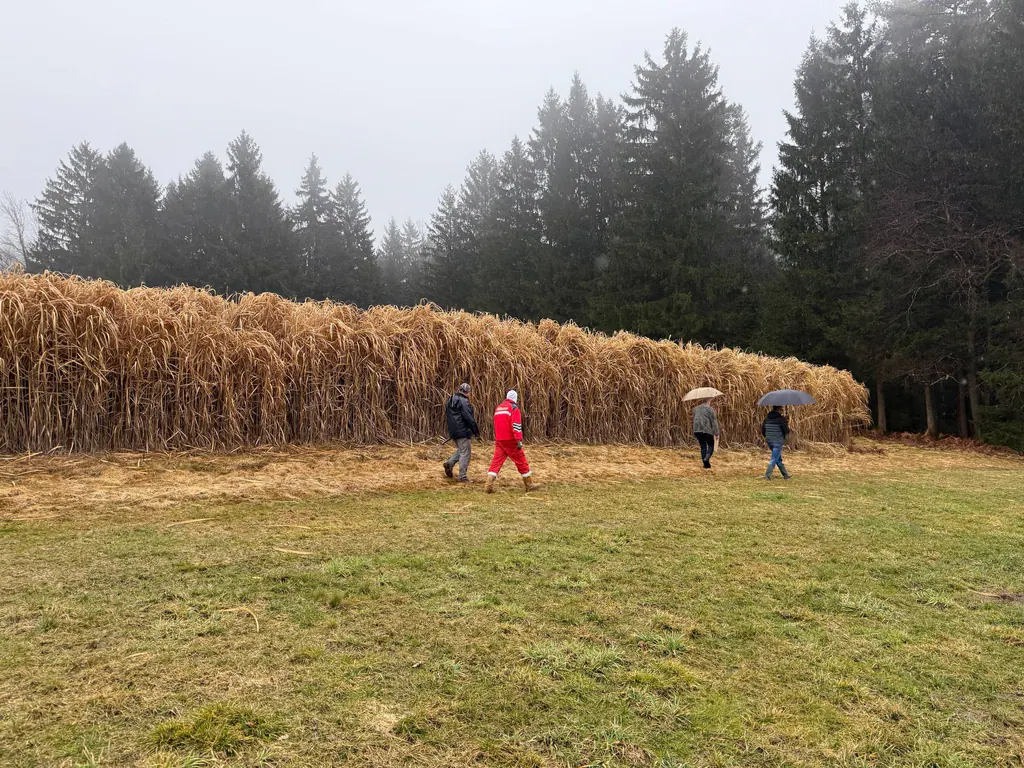

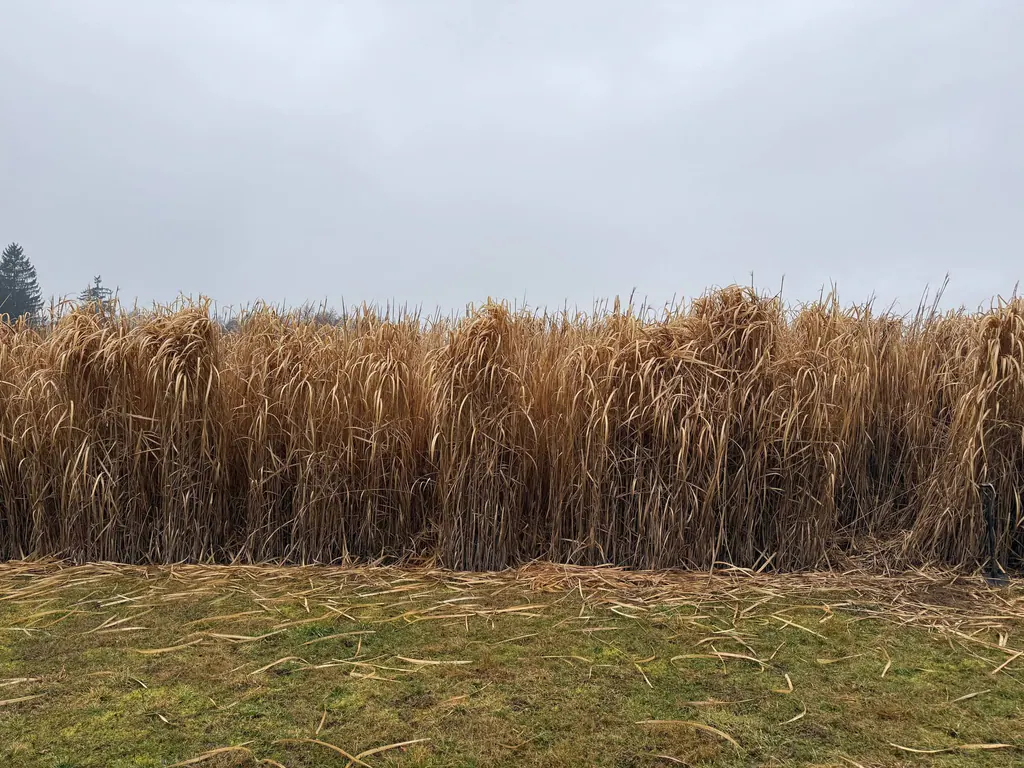

Contacts
Published Updated